Showing posts with label Wedding. Show all posts

Saturday, 2 July 2022

Back to basics (Fuji Instax Mini Evo Review)


Taken with a Fuji XT-2

(All images were taken with the Fuji Instax Mini Evo, unless otherwise stated) 

(For a more complete review see the following video)


Film photographers are a bit like steam train enthusiasts. They preach how great the technology is, but gloss over the reason we don't use them any more was because they were difficult to use, expensive  and to be honest a pain in the butt.

Being old enough to span both film and digital cameras, I have boxes of photos, all taken and printed at great cost, and with a few exceptions, all pretty awful.  It was only when I went to digital, that I started really getting to grips with photography and ability to learn from my mistakes were an important part of that (sure about that? - Ed). Film I found unforgiving, and it is so hard to correct your deficiencies when you can only take 36 photos, the results of which you only saw a week later.

Saying all that, however, there is still something about a physical image which will always trump a digital one. Posting an image on Facebook will never have the cachet of handing someone a real object. It is just a pity that film does not have the immediacy of digital. Actually, that is not quite true. Since the late 40's, when Edwin Land brought out Polaroids, there has been a subset of photography that is both analog and immediate. 


This year I went to the wedding of the century (no, nothing to do with the Beckhams's), when my niece gets married. Of course outside the immediate family, this is a non-event, and my niece having her own way of doing things, and did not want presents, but still I thought I should do something. Obviously taking photos is one thing, but it felt out of kilter with the wedding, so I thought why not get one of those Instax cameras, take a picture of the guests,  stick it in a book  and present it at the end...job done.

One issue however was that my success rate with Instax cameras are hit and miss. I wanteda way of getting good photo prints without wasting film. One way would be to use my phone and get a Bluetooth printer, but that required carring two devices and I was looking for the analog look. 

Then Fuji announced the Instax Mini Evo. This combined a digital camera with a Fuji film printer, meaning I could review the photos before printing them out. 

This is the review of that camera

The review


The camera comes in a small box, together with a camera strap, an instruction manual and just in case you don't alreday have 1000's of the things already, a micro USB charging cable.

Things that the camera does not come with is Micro SD card, and film. The former is excusable, since most of us have loads lying around, and also there is a 40 image in-built memory in the camera. However, the lack of film is a strange omission. The whole point of the camera is to get you to print images, so you would expect they would put at least a 10 shot pack in for the price. This is a bit of a bummer if you receive one on Christmas day, then you have to wait until the shops open to get your physical film. 

Also in the box a user manual, consisting of the usual text in 30 languages, with only 4 pages on any use. I do wonder why they bother, really. Stick the manuals online, add more content and save a tree!

The manual uses a small part of the contents to sell the virtues of the product. Apparently it has the highest image quality of and Instax camera (4.9 MP!!!!!). You can use over a 100 effects!! (more on that later). It also has a Luxury classic design!!!

It was the last one that got me. I am not sure what goes for luxury classic design where the manual writer lives, but be assured, this camera is not a Leica. Actually, the feel is more plastic toy than quality camera. This is not helped by trying to do the two things most essential to the camera. 

Firstly charging. The camera has a fixed battery, and has to be charged via USB. The port to get to it, is behind a flimsy panel, which will almost certainly break off at some point. Why they could not just stick it on the outside is beyond me. To make it worse, the camera will not operate while charging, so no plugging it in to print off. To me, this is a big mistake. If you are at a party and the battery starts running down, the ability to run it from an external battery pack seems to me essential.

Secondly, is inserting the film. Fuji have gone to great lengths to make the camera look like a analog camera. You would have thought therefore the film mechanism would be like film cameras of yore with the film winder pulling out. No, it is a tiny lever on the back, which is virtually impossible to operate. It takes about 2 minutes to get in. Again, since printing is the primary function of the device, you would have thought they would have come up with a mechanism a bit more slick.   

Then we come to the design of the camera itself, Fuji camera designers are the Jacob Rees-Mogg of the camera world. For them, camera design reached its nadir in 1970 and nothing will change their minds. So the camera has the look and feel of a Kodak Instamatic. Emphasizing this is the lens which is 28mm f2.0, fixed aperture, fixed focus affair.  The camera comes with no lens cap to speak of, so obviously the designers are not greatly concerned about damage or knocks. Let's face it, this camera will be used almost exclusively for selfies and party pictures, so the lens optics are not going to be stretched too much.

The front of the camera has a large on-off switch, a small flash unit, a selfie mirror(!!!) and two shutter buttons that it can be used in landscape and portrait mode, which is a nice touch. The buttons fall into hands nicely. Less pleasant is the slab face of the camera, meaning there is danger of fingers obscuring either the flash or the lens. Some sort of finger rest would have been useful.

Rounding off the front controls is the dial around the  lens. This you would have thought could have been an aperture dial, but actually lets you choose the photo effects.

On the top of the camera is a large rotary dial. This allows you to choose colour effects that can be applied to your image. Also on top is a lever, like a film advance lever of old, which initiates the printing. This is nicely implemented, but you do feel that the majority of the design budget was spent on this, not leaving much for the rest of the camera design.

Completing the top is a fake flash shoe. Why this is here, other than to assuage the Fuji design teams love of Nikon F3's, I have no idea. To be honest, I am surprised they did not add some of those flashcubes to complete the Kodak 126 Instamatic homage

On the back is a reasonable LCD and menu buttons. There is no EVF of course, however a simple glass viewfinder would have been useful and would have added to the whole retro vibe. 

The controls at the back provide access to the stored images and a menu button to access things like date/time, print settings etc. Some surprises include face detection, and firmware upgrade functions suggesting that some form of autofocus takes place and that Fuji at some point expect to upgrade the software (Maybe to add video capability :) - Ed ) 

The back includes a d-pad that allows access to the camera settings, such as self-timer, flash settings (off, on, auto, high speed sync :) ), a macro option  and white balance. Probably the most useful is the EVF button, since with a fixed aperture it is pretty well the only way to control over exposure (Strangely +ve EVF is on the left, while -ve is on the right, which seems wrong). It also allows access to a digital zoom, which is as about as useful as any digital zoom. None of these buttons are customizable,  which is a pity because it would have been nice to control the exposure compensation directly via the D-Pad or the front dial

Finally, on the right-hand side of the camera is a plastic tripod mount. Strangely there is not one on the bottom, so if you want  to take self timed landscape images you will need to find a table or cushion to rest the camera on.

And that is pretty well it. The photos can be stored on a both micro-SD and internal memory can take up to 40 photos. It is not clear what the point of the internal memory is, since the SD card would of been perfectly usable on its own. To get the images of the camera  you either have to extract the SD card (not easy accessible ) or Bluetooth since there is no USB download method (The USB is to charge the camera only)

The camera itself has an ISO range of 100 to 1600 and a shutter speed range of 1/4s to 1/8000s, although these are automatically selected. It would have been nice to have control over the speed.

Remote Access


Fuji have taken a lot of grief, quite rightly, on their apps. However, the phone app actually works quite well, allowing the transfer of images and using the camera as a printer. Unfortunately this tends to highlight the camera quality with camera photos looking superior to the native ones.

Camera Effects


The manual states that there are 100 effects. While that is strictly true, they get to that figure by combining both the image effects and the colour effects, both of which are independently settable. However, it is unlikely you will use some of the effects with certain colour modes such as Sepia or Monochrome, so the actual usable combinations are far less.

The image effects are probable the less usable and include such classics as 

  • Vignette - create a darkened border
  • Soft Focus - Nylons effect
  • Blur - Blur the edges
  • Fisheye - create a false fisheye effect
  • Colour Shift - purple fringing
  • Light Leak - poor lens effect
  • Mirror - Create a mirror effect down the middle
  • Double Exposure - self-explanatory
  • Half Frame - two images, one in each half of the frame

 To be honest apart from the last two I cannot see any good reason to use any of these.

The colour effects change the colour profile of the camera. Again, apart from Vivid and monochrome, the rest seem rather superfluous and is the kind of things that happen when software developers have too much time on their hands.

The effect dials beig so prominent are easy to knock. There is a quick reset button, but it does raise the argument whether these controls should be so prominent compared to the standard exposure camera controls. 

In truth while fun to play around with and giving some creative opportunities, pretty well all thse effects could be applied in post, and I think people will get pretty bored of them fast.

Usage


The camera itself is pretty well point and shoot. The LED screen provides a reasonable view, but I would of liked a simple optical one as well for when the light was bright. 

Generally I found the images slightly over exposed requiring  the exposure comp to be turned down a notch, however with no histogram features it si hard to work out whe the image is over or under exposed. It would of been great however if that could of been controlled from the top function. 
 
Of course you have little or no control over the image exposure time, ISO or aperture

The printing function is very slick. You select your image from the back, press the film lever and 5 seconds later it prints. To get a developed image takes about 2 minutes. Of course the big benefit of this camera is that you can choose which image to print and therefore not waste film.

The camera has a film indicator on the LED in the form of 10 dots. A number or dedicated LCD counter would of been better

Picture Quality


The 1st thing to mention here is that this camera is designed primarily to take prints. Therefore any image issues are slightly hidden by the fact the output is supposed to be a small 1,8 x 2.4 inch print.

However since on of the benefits of this camera is that it is also a digital one, that also needs to be taken into account.

In good light, the images are quite pleasing with good colours. However there is limited dynamic range meaning highlights quickly get blown out. As the light gets worse, however it is a different story, with photos quickly falling apart in only average light. Since this is a camera which will get used primarily at indoor parties, that is unfortunate.
 
Of course you have a flash to compensate for this, but this will further use your battery life up. It would also have been better to have a dedicated Flash button on the side of the camera.

As the evening went on, image noise became unacceptable


Conclusion 


 One thing that surprised me about this camera is how pleased people were to have the images and it is easy to forget that the Gen-Z  have virtually never dealt or held film. To them images are on their phone, snapchat etc. Having a physical representation is a great novelty. 

In that way the camera  fulfiulled its brief, and was a great success at the wedding. 

However there are caveats....

The 1st one is the price. This camera has a £100 price premium over the other Instax cameras. For that you get a slighter higher resolution camera, the ability to store your images and a LED screen.  In truth, it is hard to justify the price premium for those features alone and therefore the camera feels overpriced.

Secondly the question is whether there are better ways  of doing the same thing. Pretty well everyone has a mobile phone camera which is far better than the Instax one. Not only that you can store, edit, transfer via the phone. Therefore apart from having it all in one unit, it is hard to see the advantage of just buying a Instax printer and using your phone rather than using this camera and basically saving £100

Finally, the effects are gimmicks which could of been ditched and instead Fuji could of provided better controls such as a exposure compensation dial and a flash control button. However it did make me think perhaps  that Fuji missed a trick.

One thing Fuji cameras are famed for is there film simulations. Rather than niche effects it would be better to be able to print out a image as Kodak Gold, or Ilford B&W.

In truth I enjoyed this camera more than I thought I would. However Fuji just could not seem to decide whether this is a fun camera or something more serious so priced it at the serious end, but did not back it up with the controls required for you to take control of the image. I think there is something there, but not at this price and design.


For a more complete review see the following video


Friday, 3 June 2022

4 lessons for being a wedding photographer


If I was going to make a list of the world's most stressful jobs, it would go something  like this

1. Surgeon
2. Secondary School Teacher
3. Wedding photographer

Number 2 and 3 may surprise some people, but they both had the same elements in that they require a high level of responsibility over events that they have little control. For example, most parents expect teachers to get little Tarquin to Oxford independently of their ability or desire to work. Wedding photographers have a similar combination of factors in that they are made responsible in creating an image perfect record of a couple's most important day, at an event that may have little control. If they make a mistake, there are no do-overs, no repeats, they are just left with the online trashing and hate of all the parties involved. No landscape photographer ever had a tree publicly scorn them because they did not capture them on their day of full bloom.

I am always been in awe of wedding photographers and the level of responsibility that they take on, especially since relatively you don't really make much money out of it. It used to be a wedding photographer could eke out a reasonable living, but with digital, covid and the fact everyone has a smartphone it must make it a tough gig. I mean, at least a surgeon makes a bit of cash for their skills, while a wedding photographer is looked down on generally as an unwanted expense.

Even saying that, I have always wanted to have a go at wedding photography. I guess it is because it is in my mind the pinnacle of the event genre, and I wanted to see if I could rise to the challenge. So when my niece announced she was getting married, I hoped that I might be asked to take the photos.

However, no call came in, and I must admit this hurt a bit (it was almost as painful as when the church bought a photo from someone else for the Christmas card image). I mean wasn't I the person renowned for hanging around family do's recording them for posterity? Wasn't  I that person who hounded her through her teenage phase trying to get an image of her despite her best attempts not to be caught? 

There was however no malice in the snub. The wedding had been organized on what could be called the anarchic principle, or the so-called field of dreams concept as in if you set a date something would happen. Basically, it was assumed that people would bring cameras and something good would come out of it.

The second issue was I was not actually invited to the wedding ceremony. Again I hasten to add this was not because I had fallen out with the family or had committed some unforgivable family faux pax. It was more that they had decided on a civil partnership in Oxford registry office and decided that there was only room, for parents and direct siblings, so we would be only attending the later reception (It should be noted at this point that my niece, due to an accident of her schooling, could have chosen to of got married at Peterborough Cathedral. This, with no insult intended to Oxford registry office, would have been a far better location photographically speaking). However, due to a paperwork mistake the partnership was upgraded to a full wedding, and suddenly we were on the list again (although we were not informed of this until a week before the event), so my again my realisation of being wedding photographer for the day was on again.

Generally at weddings I am that annoying bloke which professional photographers at best barely tolerate, but some secretly loathe. The guy with the gear who is always sneaking in to get that shot setup by the pro, and has to be put up with because they are on the guest list. This time however I would have more flexibility on taking shots and this raised a big issue. I am terrible taking photos of people. 

In these events, you need to be the sort of person who can connect and link with your subjects. I struggle to do this. Generally, I hate asking people to do things that I would hate doing myself, and being prodded by a photographer is one thing I would hate. What is more annoying is that my brother-in-law would be there (he has to, he is the father of the bride). Despite owning a 10-year-old Sony A-series camera and the inability to tell the Exposure triangle from his elbow, he almost always gets better shots than me at these types of events. Basically he is the kind of person that dropped into an event with 100 strangers, at the end he would be on first name terms with all of them and best friends with at least half, while I would struggle to remember the Christian name of the host. I always thought we would make the dream team. He could set up the shot, and I would take it. As it was, I would have and do my best.
This left the big question to be answered.... Which lenses to take. 

Since we were also taking enough party food to feed the Ukrainian front and a top layer of wedding cake that had to be protected at all costs, space in the car was limited. A zoom however seemed essential, but I also wanted to take some primes for portrait shots. 

I have 3 primes that I use, 23mm and 35mm f2.0 and a 85mm f1.8. However the 23mm and 35mm are not that fast and as the light dimmed in the evening  I felt I would need something a bit faster. So justifying to myself that new lenses were needed, I went looking at what was out there. Unfortunately the Fuji fast primes, as good as they are, are a bit pricey. Fortunately, Sigma had decided to enter the Fuji lens space and brought out 3 fast primes, a 16mm, a 30mm and a 56mm f1.8. These were tempting because, while not perhaps quite as sharp as their Fuji equivalents, they were half the price. However, I felt all 3 would be a bit much, so I decided to get two. But which ones? 

In the end I went with the 30mm and 56mm, hoping my 14mm Fuji prime would be good enough for wide shots and taking my 23mm 2.0 to fill in the gap. This left the zoom. In truth, apart from the 400mm, I have never liked Fuji zooms. For example, there is no good constant aperture 28-70mm in the Fuji line up which is pretty well the standard kit in an event shooter bag, but I put in my 18-135 as my zoom of choice. Adding to my bag was a flash. I don't generally like flashes, but with the event barn dance scheduled in the evening I thought it may come in useful.

However, this was not my only new kit. I had decided many months before that as a present to the bride and groom I would create a book of images taken on the night of guests who could write their own messages. To do this I had purchased an Instax Mini Evo camera (Review here )which allowed photos and printing. My plan was to go to each couple at reception, get an image, give them a card to write a missive and present it at the end. The plan seemed so good in my head, however things did not turn out as hoped. Firstly the couple had their own Instax camera which was passed around, and secondly the marquee which held the food was so cramped it was impossible to move. So instead I just took images when I could, got my daughter to stick them in the album and presented that. The couple seemed appreciative, but it was not the kind of thing I had planned.

The wedding

The bus we missed...


So how did it go. The plan was to arrive at the in-law's house at 8:45 where once we had dropped off our dog at some friends of the couple, we and the wedding party would be taken on a vintage bus, the 30 minutes to Oxford. We arrived at 8:40, only  to see the bus being waved off, with us not on it. Fortunately, some friends of the grooms parents took pity on us, and one took the dog off us while the other rang the bus and asked it to stop while they gave us a lift to catch up.

Once on the bus, I positioned myself on the top deck to try and take photos. Not sure if anyone else has ever tried taking photos on top of 1960's double-decker going along country roads, but let us say the ICM effect was more CM than I. Still, we got there and after a few shots outside next to the bus, we went into the registry office itself. This is where I learnt lesson 1.

1. Always have your camera on

Weddings are a set of orchestrated moments, with random events in between. You need to capture both. While the organised bits were fine, sometimes I would turn off my camera to save battery. This was why I missed the 1st married kiss. Of course, there was no reason to turn the camera off. I had enough spare batteries to power a tesla, it is just something I always do. It was often at those moments were essential events happened. The 1st kiss, a look, a hug. This is why the pros have the big battery packs. That 5 second period as your camera comes out of standby is an eternity in these situations.

Just missed that kiss....


After we congregated outside the registry office which is in a busy part of Oxford, where we tried to take the obligatory group shot. I thought I had done pretty well in that I made sure that all the camera settings were correct, and took a number of shots to ensure that at least one was correct. It was only when I got back I found that every single image has someone looking away or blinking. Fortunately there was enough material to construct one good image from all of them, but here is lesson 2


2. Exist outside the moment


The before and after after some tweaking

What makes a great astronaut, pilot, etc is that when all things are going wrong they can raise themselves above the chaos and do what is needed. Wedding photographers must have the same ability. They must be able to rise above the chaos of the location, and people, and concentrate on the fundamentals in getting the image. I thought I had done well to make sure the camera was set up, but in doing so, I had forgotten to organise my subjects, given clear instructions, making sure everyone was looking in the same way, etc. In these situations, a partner to do these sort of things is useful to take some of the pressure off.


3. Plan your photos

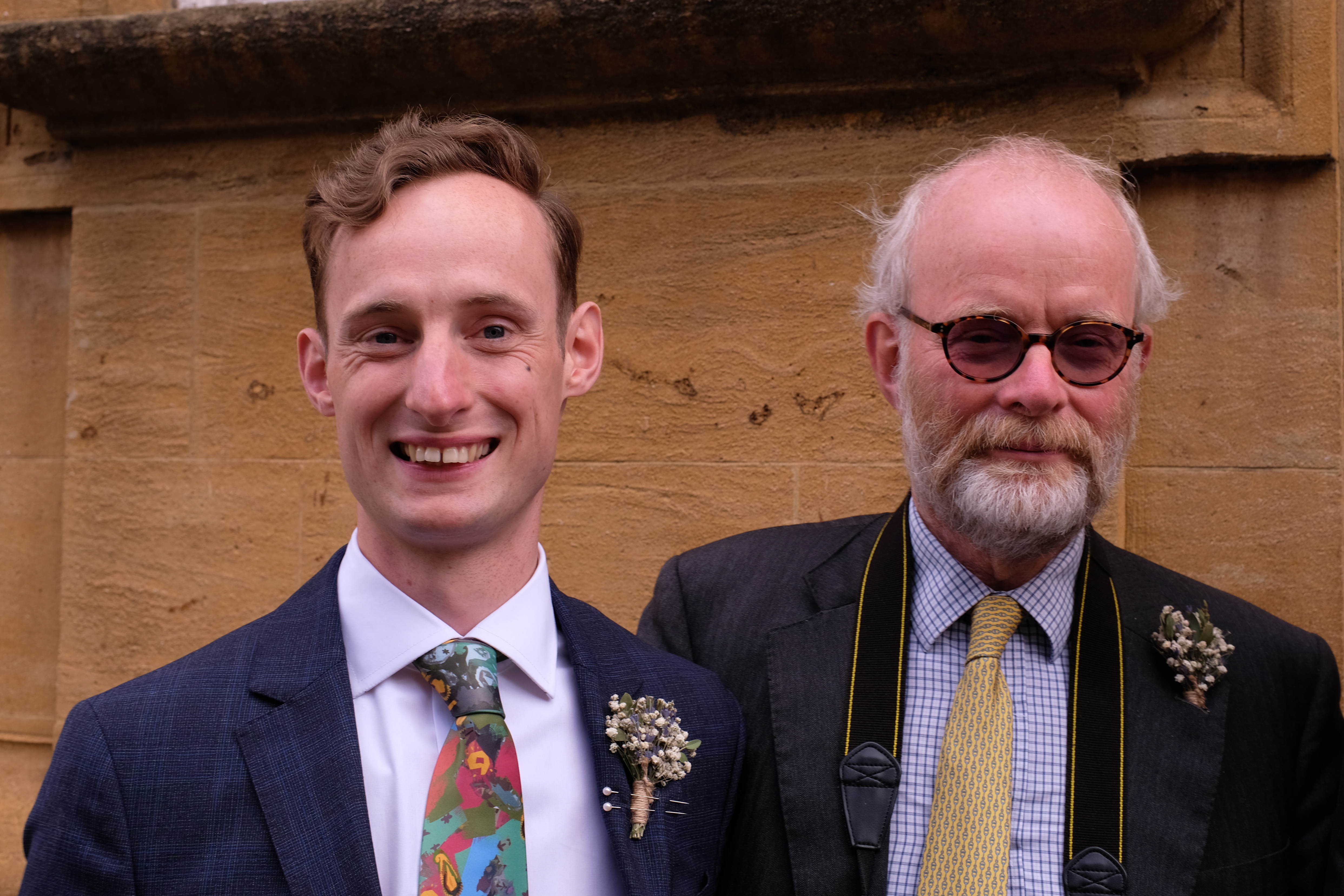
The groom and father. One I did get...


I thought however I had done a pretty good job in getting some images, but it was only when I got back that I realised I had made a fatal mistake. While I had plenty of photos of the bride and groom, there were many people I did not get images of with the happy couple. Such as

  • The Grooms Parents
  • The Brides Parents
  • The Brides grandparents
  • My Family
  • Me
In hindsight, the problem was is that I was used to weddings where I was on the periphery and someone else  was orchestrating it. I did not realise that someone needed to fill that hole, and that person should of been me. Now I realised I should of taken control and organised everyone, but of course that was not my job, but it just highlights the essential role a proffesional wedding photographer fills. It is not just the photos, it is the organisation of the day to get all the required images. This is why coordination and communication with the photographer and wedding party is essential in these situations
 
Finally we made it back to the reception and again unfortunately I reverted to my shell. One of irritating things for me was that there was a photographer at the event who took some great images of the reception and he was a 10 years old lad who borrowed his dad's camera and just went around asking people for images. This was the task I had set out to do, but I failed at thsi point. To be fair he did have a few advantages. Firstly when a 10 year asks to take a picture its cute, when a 50+ year old bloke does it, it can be a bit creepy. Secondly it was interesting that the lower portrait angle acheived was a attractive, but I am not sure my knees are up to it, and finally he did not suffer (I hope) the effect of too much alchol. 

So Lesson 4, Grasshopper - Embrace your 10 years old child

To be honest I am still pretty mad about myself for not getting all the images and then not doing more at the reception and have been beating myself up all week. However on the plus points, there are some images I really like and I have been having fun with some of the photoediting, one talent I can rely on.

As for the lenses, the zoom got the most use, followed by the 14mm. To be honest the 56mm and 85mm did not really get a look and in, and I need to work out what the 56mm can be used for, falling into unfamiliar territory for me.


The conclusion


In conclusion, I am still in awe of wedding photographers (even more so) and i'm glad my living does not depend on it, because I would not hire me. 
 
Saying that I learned a lot, not least that a professional wedding photographer still has an essential role to play in this world of smart phones, if you want to capture those irreplacable moments.

Would I do it if called again? Hopefully I could put some of my lessons into play, but I'm not sure I could take the responsibility...


Saturday, 21 February 2015

Wedding Photography Blues


My family and I recently went to a wedding reception for my wife's cousin wife. I have found recently that I have reached the stage in life where I am more likely to go to a funeral than a wedding,  so it was a nice change, and of course it goes without saying that weddings are a lot more fun to take photos of.

As someone who enjoys most types of photography, weddings raise a bit of a dilemma. Obviously you want to take your camera, but you also don't want to get in the way of the official photographer and be a pain to the bride and groom.

Most importantly I don't want to make the official photographers job any harder than it already is. I always have a lot of respect and sympathy for professionals doing difficult jobs like this and I am sure they find amateurs like me, even ones that are invited guests a right pain. The last thing I want is for me to make their job any harder than it already is. Anyway it is always instructive to watch the photographers at work.

So I try and compromise and take photo's of areas the official photographer tend to miss. I remember from my own wedding (even though it was many years ago), how much you miss of what is going on. I try and take photos in situations the professional is not going to see such as activities of the guests and give them to the happy couple as a thank you. At the same time of course it gives you a chance to practice your hobby.

In terms of good photo opportunities this wedding was a cracker. The bride was Tunisian/French, the groom English and to cap it off one of the relatives was a top notch bagpipe player. So we had a unique mix of Arabic/French/English disco, the hokey cokey, and the gay Gordons on the bag pipes. To cap it off, we also had belly dancing. If you can't get at least one good photo out of that, give up now!

However taking photos at night in a disco was always going to be challenging photographically speaking. In fact it is difficult to think of more difficult lighting conditions. plus we had a situation  with lots of movement (i.e dancing), a hand held camera with limited angles. You soon start to see why wedding photographers get paid so much, or why they carry the kit they do.

So how do we get some decent photos in conditions like this? Well we have a number of options

1. Use a Flash
2. Use the fastest lens possible and keep the aperture wide open
3. Crank the ISO up
4. Embrace the moment

1. Flash

Let me say first off that I don't like to use flashes. One of the reason I bought a DSLR's was because of its ability to take better images in the poor light and to reduce the number of times I had to resort to flash. I dislike the way flashes flatten the scene(darkening the background). I also find they can be very obtrusive when used at public events.

I do have a quite a powerful all singing/dancing flash which allows me to do things like bounce the light off the ceiling, but due Sony's unique hot-shoe design, I can only use it in manual mode which makes life even more challenging. After a while you realize that using such a flash is as much an art form as using the camera .While this may be possible in a studio, where you control, lighting,etc; at a live event with people moving around all the time it is a hit and miss affair

 Of course there is always the camera's own flash, but this is less powerful cannot be tilted to do things like bounce it off the ceiling.

I must admit using flash is probably something I should learn more about.

One of the things I recently find out was that when you use a flash in a dark room, the shutter speed makes little difference, since the period of the flash defines the exposure time. Then there is the flash sync time, which is basically the shortest shutter speed that you can use your flash with. Any faster and the sensor is not fully exposed and part of your image will be obscured by the shutter. Then there is front and rear curtain sync, which are too complex to go into here, but can make a difference if you want to capture objects moving across the plane of the lens with the flash.

2. Use the fastest lens possible and keep the aperture wide open

I took the my fastest lens I have with me which is my  F2.0 50mm prime. But even with this cranked to its maximum aperture, I my shutter speed was still between 1/10 and 1/30 a second, which was really too slow for hand held (Even with the camera at maximum ISO). Not only that, but it meant the I got a very narrow depth of field meaning you had a only a few people in focus,.

3. Crank the ISO up

As I said in point 2, even with the ISO pushed to my camera's maximum(ISO 3200), I found that I was only getting a shutter speed of 1/10 sec.

Increasing the ISO seems like a get out of free card, but it has its issues. The main one being that the higher the ISO goes, the more noise you will get. Generally at 3200 ISO with my camera, the photos are very noisy and I try not to use it above ISO 400 if I can help it. However sometimes it cannot be helped (top tip, never let your camera choose the ISO for you). While other cameras have a bigger usable ISO range, at some point all will hit this problem.

Saying that, this is one of those situations when I wished I had a Sony A7S and I am surprised more wedding photographers don't have one for these sort of events. It also emphasizes the point that camera manufacturers should really concentrate more on overall noise reduction and light sensitivity rather than stuffing in more pixels onto a sensor

One way around the noise issue is to process them via photo manipulation packages such as Lightroom. These have noise reduction features in their RAW conversions. I tend to use ZonePhoto and generally have ignored these settings, since I try to use the low ISO settings when possible where noise is not a great issue. (Noise processing can also greatly extend your RAW processing times)

However in this case I used the feature quite  aggressively and I was quite impressed with the improvements.  OK, it did not produce exhibition quality photos since they did introduce some softening in the image, but they made a very noisy mess into something far more acceptable

4. Embrace the moment.

OK. So the rooms dark, with flashing lights, your lens is too slow and cranking the ISO produces an image that looks like it has been sprinkled with 100's and 1000's and you don't want to use the flash

 So what do you do about it?

Well once answer is become more creative about the shots you take.

With the movement of a disco, by using the slow shutter speed we can blur the subjects and capture some of the energy and motion at the event. I also tried my wide angle zoom at its widest setting  (10 mm) to take the entire room in, which worked quite well.

It is in these sort of situations where your skills and experience can come to the fore in making the best of a difficult situation. OK, they will not always work, but sometimes you get some interesting shots


In these situations you take the light where you can get it


In moderation the in built flash works well. No way could I got this shot otherwise

I try and look for angles that the professionals won't try. Like adding context by including other guests


The belly dancer (I think it wsa the brides sister) was excellent, but without using flash there was no way to get a good picture of her. But the slower shutter speed shows the dynamism of the dance 

Again slow shutter speed adds a surreal quality


I wasn't sure how a wide angle would work, but actually I quite liked the effect


Saturday, 24 May 2014

Photographer for hire

My recent request to take some photo's at the local Brownie group made me think about the whole issue of event photography.

Normally I am pretty happy to take photos at events, as long as it is on a casual basis. It allows me to experiment with new techniques, improve my photography and help out friends at the same time.

I have only done one event which I was a critical component. My father-in-laws church was doing a wedding dress show which various members of the congregation donated and modelled wedding dresses through the ages. He asked me if I would put some photo's together and put a CD together of the event which later they would sell to raise money. As a fool I agreed.

It was only when I got there that the pressure hit me.  What if the camera failed, or the photo's were poor. What if I ran out of battery, memory mid way through? Where should I stand, how do i get a good shot? What happened if I formatted the memory card before copying the photo's or the computer hard disk failed?

As it turned out none of this happened. The shoot went OK, I got some photos and put the CD together and we sold about 30(actually the worst bit was creating 30 CD's). But if the worst had happened, I could just shrug my shoulders, say sorry, and explain you get what you paid for.

 However it did bring to mind that most dangerous of professions, the wedding photographer.

Riding on the back of that person is the job of recording two peoples most precious memory. I'm not sure any monetary recompense is worth that sort of  pressure.

So remember next time you hire a photographer for that event, that you are paying for their professionalism and skill, but also the ulcers and drinking habit that are likely to form through the responsibilities you put in their shoulders