Showing posts with label legacy. Show all posts

Saturday, 28 May 2016

The futility of art


Every once in a while I like to explore some of the lesser known nooks and crannies of my local area. This is where a bike comes in useful, providing the mobility to get places not normally accessible by foot or car. The general purpose of these explorations is to try and locate unusual viewpoints and positions not normally seen on photographs. Generally I fail, but at least it gets me out of the house.

On one such trip recently I stumbled on the following which sort of blew me away
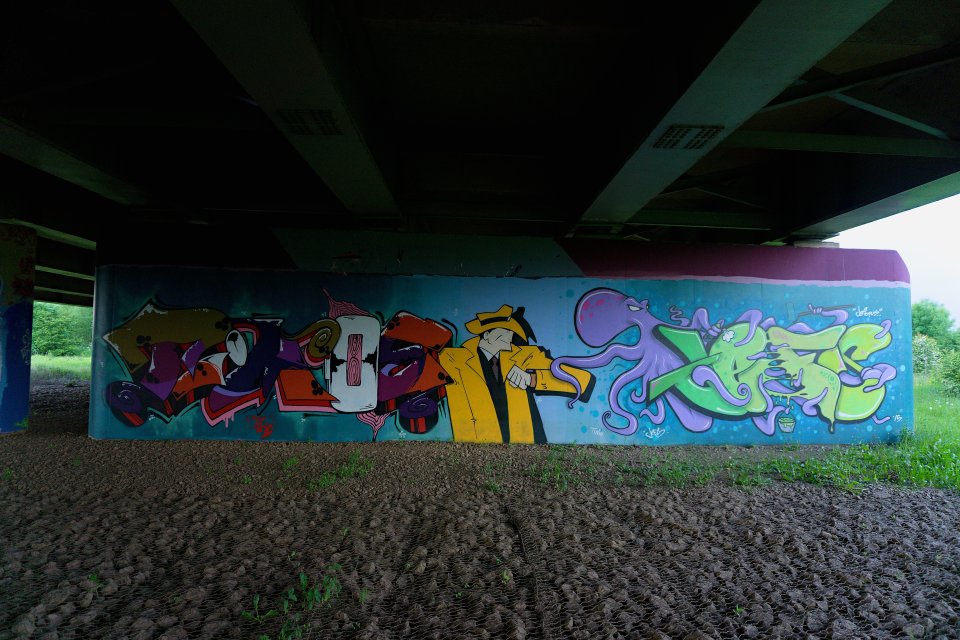


Now I not generally someone who approves or encourages graffiti, however these are not your "Baz was 'ere" type works. They are all done with considerable skill and effort (Also it could hardly be said that they are despoiling the local environment since it is hard to make concrete more ugly than it always is).

It was obvious a large amount of effort and logistics was exerted in doing these. However there location means that  virtually no one will ever see them or even be aware of them even though thousands of people drive over them every day.

So the question is then why did they do it?

It could not be for monetary award since you could hardly hang these on your wall. Nor could it be for fame since the artists are generally anonymous.  In some ways they seem the purest expression of art, since they seem to have no purpose other than to exist, seen or unseen.

Maybe they just felt the need to make the world a slightly more colorful place? Another suggestion is that this is just there way of declaring to the world of their existence . You could almost imagine the people who did the cave paintings in France having much the same idea. Or maybe it is a simple as as they did it because they could.

Since we will almost never know who did them, the motivations will be always be a mystery(I can imagine archaeologist in a 1000 years having a field day if they found these, suggesting all sort of religious significance to them).

However it did start me thinking about why I take photographs.

After all, in many ways my photographs are similar to these paintings. 99.9999% of them will never be seen apart from me and even then many will only be given a fleeting glance. Even those selected few that make it out into the wider world will only have a short lifetime before consigned to obscurity.

One suggestion would be my photos will become my legacy. But I know from bitter experience that my decedents will not put the same value on my work as I do.

When I had to clear my fathers house out, I was faced with issue of what to do with my mothers art work. My mother was quite a prolific artist with some skill.  When we cleared the house out I came across thousands of drawings, paintings and other art works. My initial reaction was to keep them, but the very quantity and size meant that this was never realistic option. In the end the vast majority ended up at the local tip, which considering that I was basically destroying my mother memory was really hard to do.

When I move onto the lightroom in the sky, my children will have the same issue. OK, they will be on hard disks rather than paper, but I doubt that will make it any better.

So in some ways my photos are like those wall arts. We may pretend that we have higher reasons for taking the photos,  but actually we do it because we enjoy it, and there should be no embarrassment in admitting that. All the rest such as exhibitions and competitions really don't matter.

We may wonder about the futility and waste of time of artists painting under motorway bridges , but as photographers can we say we are any better?


Tuesday, 28 October 2014

A voyage round my parents

A monkey in a dress? No, me in one of my 1st photo shoots.


Recently I have set myself the project of scanning my late fathers old photographic slides.

Doing so feels a bit like doing a archaeological dig. You are looking at images probably not seen by anyone else for many years(The problem with slides is that they require considerable outlay in order to display them properly). You are never sure what treasures might be on the next slide.

Of course the hope is that you will find something historical significant such as a picture taken on a grassy knoll in Dallas in 1966, but alas the majority of the photo's consist of the family snap variety,

The only one that stands out is of Talbot house, the home of the Toc-H organisation in Poperinge, Belgium, taken in 1965(One of the mystery's is that my dad only seemed to of taken one photo in Belgium. Obviously he was having too good a time ).


Talbot House, Poperinge, Belgium, 1965


That doesn't mean that all the others are worthless, Every photo is significant to someone. Most of the photo's were taken before I was born (or even conceived), and document and record a period in my parent's life that I could not and did not share (My kids also believe that we as parents had no life before their existence). For that reason alone, it has been a fascinating voyage of discovery

But in undertaking this task has raised some interesting thoughts on photography in general.

The first is how photography has changed. It would be easy to complain that many of my fathers photo's are poorly exposed or not in focus, but unlike now, my dad did not have the luxury of auto-exposure or auto-focus. In fact for that reason alone, it is amazing how many of the photo's are in-focus and well exposed since he did not have the luxury of reviewing the photos.

It is also a pity that more of the photos did not show things like the town he was born or lived. But in those days each photo was a precious thing, since you were limited to 24 or 36 per film, and each photo had to be developed at a not inconsiderable cost. There was not the luxury of taking speculative shots just to see how they looked. So photo's were reserved for the things that really mattered such as family. While the digital revolution has meant reduced the cost of photography to almost nothing, it has in some ways also reduced the value. Instead of crafting the photo's we now employ a scatter gun approach, happy in the knowledge that we can delete the ones we don't like later.  In some ways, the old restrictions mean that those old photos will always be more valuable, if for no other reason, their rarity.

The final lesson is legacy. Since these are now one of the few permanent records of my parents existence, they are very precious to me. However as a child, they meant very little, and for many years sat in old boxes, unseen and un-cared for (I guess the modern equivalent is the digital photo frame, that never gets turned on ). Unfortunately the slides condition pays homage to that fact, with many that are scratched or dirty despite my best efforts to clean them and processing in Photoshop.

But at least they are a permanent reminder, only requiring me to awaken my interest in them as I became more involved in studying my family history. I do wonder sometimes whether I will  leave my children a similar legacy.

Already I have a far greater number of photos to share with them than my father could ever of dreamed of, but the majority are stored on disk drives in digital format. Will these  still be accessible when my children reach the age when they start asking the same questions? I know I should really print them off, but the low cost of digital photos now works against us. It would be impossible to print them all, but then how do I choose which ones are significant and should be recorded in a more permanent way?

Like my fathers photo's, those that I consider important today, may not be the ones my kids wish to see in later years. It is a dilemma that many of us face, but unfortunately one we will probably leave to our children to resolve. As I found with my father, by the time I was ready to discuss these issues, it was already be too late.