
I have a similar relationship with Birmingham as does a foster child has with their adopted parents.
It's complicated.
I always say that I did not become a native Brummie by choice, but was instead assimilated by the city.
My parents moved to Sutton Coldfield when I was 4. Sutton at that time was prosperous independent town on the outskirts of Birmingham, famous for its large parkland and rich residents. A mere 7 years later the town was swallowed into Birmingham to become just another suburb of that metropolis (it was claimed, the idea was to create a block of solid tory councilors on Birmingham city council. If so it failed ).
The decision still rankles long term Sutton residents to this day.
The upshot though, was that although technically growing up in Birmingham, I never really felt much connection with that entity known as Brum.
When I was young, going to Birmingham always felt akin to travelling to another country. Exciting, different, but also slightly scary.
We would take the train to Birmingham New street station and watch through the grimey British rail diesel windows as the fields gave way to the suburbs and then eventually morphed into a skyline punctuated with tall buildings.
As enticing gateways to major cities go, New Street station in the 1970's left a lot to be desired.
Most cities stations are built around large sweeping arches allowing air and light into the otherwise dark, fume filled concourses. Birmingham New street designers on the other hand would have no truck with that and was instead based the design on WW2 U-Boat pens, burying them deep into rock so that they were always dark, fume filled and claustrophobic
From the stygian depths of the station you would ride the escalator into the Bull ring shopping center based above the station. The Bull Ring in my youth represented fun with the promise of a visit to Beatties models, or the Hudson book shops just outside. Meanwhile my parents would drag us around the Habitat shop (Think IKEA, but smaller and far more expensive). It was also a labyrinth of passages and dim florescent lighting . Woe betide any child who lost contact with their parents in the age before mobile phones. There were rumours that when it was eventually knocked down, a whole civilization was discovered based around groups of feral adults who had survived on Wimpy burger left overs.
On really good days we would get to go to the Natural History museum. The price would be listening to my mothers monologue on the pre-Raphaelite movement before we could get to the fun stuff such as a full size model of the T-Rex (with added sound effects).
To get to the museum meant braving Birmingham's streets. 1970's Birmingham was based around the city planners two overriding loves.
Firstly the automobile. Birmingham wealth and success was largely based on the motor industry, and the town planners made sure that every accommodation was made to these metal monsters in a way that would make Rishi Sunak weep with joy. Pedestrians were relegated to subterranean passages and overcrowded pavements, mingling with the lead and carbon-monoxide put out by the steel stallions, while the car enjoyed flyovers and wide thoroughfares. Nowhere was this worse than New Street itself, where after exiting the station concourse you were met with a logjam of vehicles.
There was one thing the planners loved move than cars and that was concrete. 60's and 70's Birmingham architects could not get enough of the stuff. Not for them, hiding it behind glass or burying underground. Concrete was to be cherished, displayed, loved and worshipped in brutalist buildings and dystopian public squares.
The peak of both these obsessions came in the building a vast concrete motorway junction called Spaghetti Junction in the 1970's
The upshot of this was in no way, Birmingham could be considered a attractive city. Not that the residents cared. Beauty was for cities wedded to the past. Birmingham was about the future. It was unashamedly industrial, brash and modernist.
However even within this sea of cement, there were some oasis's. As you exited New Street station you were confronted by a building looking like a giant had perched a coke can on its end, atop of New Street station. That was the rotunda building.
Among this concrete conurbation, the Rotunda building stood out. Firstly in a city designed around square boxes, it was curved. Secondly it was clad in glass rather then concrete. On the few occasions the sun penetrated the car made smog, it gleamed as the sun hit it. To a impressionable child, I always imagined that the building actually rotated, like a giant merry-go-round. If the New York skyline was defined by the Empire State building, the Rotunda defined Birmingham's and it would have been unimaginable without it
OK, it was no Sydney opera house, but it was all we had to cling onto, in an otherwise dreary landscape and as a small child it was a beacon that represented the excitement of being in a large city.
Over the years, I moved away from Birmingham and was embarrassed to admit I came from there. The view of most of the country in the 80's and 90's equated Brum with industrial decline. But as I grew older however a combination of nostalgia and experience mellowed me and my stance softened. As I moved back closer to Birmingham, I started to take my children into Birmingham, as my parents did before me, and a new appreciation grew of the city.
I found, that like me, Birmingham had grown up. Wide pedestrian boulevards had now replaced car infested rat runs. The original Bull Ring had been pulled down, replaced with a new shopping centre based on light and space. The skyline had also changed. The brutalist city had been slowly transformed with new buildings, based not on concrete, but glass and tiles.
In all this change however the constant was still the Rotunda. There had been attempts to demolish it 1980's, that was met with horror by Birmingham residents. It therefore remained as a anchor and constant link between Birmingham of my past and future.
So when there was an opportunity to climb the building and take photos, I did not delay in buying a ticket
The veritable Verity
The session was led by Verity Milligan. I had known Verity, pre-covid, from a memorable previous workshops in the peak district, where she managed to arrange both a foggy morning and a cloud inversion on the same day.
Since that time Verity had gained a rightful reputation has a renaissance Birmingham photographer by producing images that cast the city in a new positive light and in doing encouraged other photographers to to re-evaluate Birmingham as a photographic subject.
City residents are often the worst judges of a place positives. Ask virtually any long term incumbent of any British city to point out the photographic beauty spots, and they will generally stare at you like you asked where best to buy real unicorns.
It was the same with me and Birmingham. Apart from a few places like Sutton park, my formative years has trained me to dismiss any idea of Birmingham as a photographic destination. Verity, coming to the city later in life, did not have that baggage. Add an astute photographic eye, powerful technique and for the last 10 years she has been producing images that presented Birmingham in a new light to people around the world.
My Inner Don
As is my wont, I arrived at New Street station far too early. As in my youth,. Although the New Street station platforms are as dreary as ever, the old Bull Ring has changed out of all recognition. Gone is the dark concourses, replaced by a huge polythene bubble letting light into the concourse.
There is also Ozzy the bull. A refugee from the commonwealth games, it now stands proudly in the middle of grand central, as the Bull ring has been renamed. Even this is represented change. I still remember when Birmingham refused to release a relative small amount of money to buy a giant King Kong statue, so it is clear that Birmingham now understands the power of art.
 |
| A load of bull |
I had some time to kill, so I I headed down to New Street proper to practice a little street photography.
As I got closer, it was apparent that was in a middle of a huge pro-Gaza demonstration


 |
| Cycle for Gaza |
 |
| Suella's hate marchers |
 |
| Waiting for the Interfada |
 |
| Religous fundamentalist - Christian style |
I had just finished the Don McCullin biography, and I felt enthused to take some social/conflict photography. Fortunately the crowd, though noisy, was well behaved and( despite our present home secretary expressed prejudice) consisted of just ordinary people expressing their feelings about extraordinary events.
However I always feels a sense of unease in these situations. I always have the feeling the crowd would at any point, in unison, turn and point at me and my camera like some zombie movie. Realizing I was not cut out to become a conflict photographer, I instead retreated to just outside the Bull Street shopping center, where I practiced taking images of the outside of the Rotunda and passers by.
After about 20 minutes I was accosted by a security guard.
"You cannot take photos here" said the security guard.
Now that confused me since I was only 10 yards from the bronze bull which represented the bull ring which at that very moment was being surrounded by families taking selfies and photos.
Again calling on the spirit of Saint Don, I was not to be put off so easily
"I'm sorry, but where does it say that?" I replied
The Security guard motioned me over to a lamppost, which at the bottom had a small plaque saying "no public right of way"
"You can take photos there " he said pointing to the place where the German market was being installed, "but not here", motioning towards the bronze bull.
However I was still none the wiser. I knew shopping centers could get very officious about the use of tripods blocking thoroughfares , but this was just me with a camera. I decided to cross-examine
"So does that mean I cannot take photos on my phone?"
He paused for a while, since obviously he was not used to being asked questions
"No that's OK" he replied, "but not with a camera like that , in case you sell the images. For copyright reasons you see"
Apart from underestimating the quality of a modern mobile phone camera and overestimating my abilities, this confused me even more since I had never up to that point considered my images as worth selling. Also I was pretty sure that intent to sell was not covered in copyright law
"But I don't intend to sell them" I replied
"Never the less, we cannot take that chance" he said
I was tempted to continue the conversation. There were myriad arguments that I could use, but in truth I felt sorry for him. No one chooses security guard as a career path, and I doubt he felt it was his job to question the rules handed down to him. After all he was polite, just doing his job, and I'm probably he saw the stupidity of the rule, but had little say in its enforcement.
So I took pity on him and I packed my camera away and headed to the Rotunda entrance

 |
| Big eye view |

The Rotunda
The entrance to the Rotunda is remarkable hard to find, consisting in a small sliding door set among various shops. It leads into a long passage to a small unfurnished area where the lifts are.
Our destination was on the very top, the 20th floor which consisted of serviced apartments. Most importantly the rooms at the top floor are the only ones with access to a balcony that circles the entire building
The room itself opened out looking down on New Street station, the grand central plaza. Ahead, Queensway could be seen snaking into the distance. To the right, the new library could just be seen huddled between Birmingham's latest development on Chamberlain Square, while to the right Digbeth church could be seen.
Although the weather was not perfect, with a bank of cloud suggesting a dull sunset ,but at least it was dry. As we stood on the balcony, a biting wind whipped past the building as I and 20 other wannabe photographers stood around with various cameras and tripods, making us submerge into our coats and hats
The session was organized by Staying Cool At Rotunda and all the proceeds would go to charity. The organisers could not be nicer continually supplying much welcome sustenance in the form hot drinks
 |
| The city laid out for our examination |
 |
| Rotunda beer as well |
 |
| The top floor. Like some 1970's sci-fi wannabe |
Before coming I had thought long and hard about taking a tripod. I don't like tripods because they are heavy and often I end up dragging one around and never using them. Modern OIS system on cameras have reduced the need for them in my mind, but there are still scenarios where a good quality tripod is essential. Also tripods also take up a lot of room, and I was not keen in fighting for space if we were cheek by jowl with other photographers.
So I compromised. My monopod is light, and has a three splayed feet for increased stability. I hoped it would give me enough with the OIS feature of the camera without the weight penalty of a full tripod. In hindsight, it was probably a mistake, and while I got some sharp images, the extra stability as light got low, especially when bracketing the shots would of made sense
The second thought was what lenses to take. Obviously a wide angle made sense. Apart from my trusty 10-24mm, I had a Samsung 8mm Manual focus. Also it was a good opportunity to try out a Laowa 8mm I had just bought. I was attracted to this, because unlike the Samsung, with its heavy barrel distortion, it advertised as having zero distortion while providing a wider field of view than the 10-24mm. In the end I was not sure which I preferred, the natural no distorted look or the barrel distortion of the 8mm
To go to the full extreme I also brought my my big eye lens. This was a weird converter I picked up in a charity shop and after the initial test has laid unused for a couple of years. It had a very wide field of view, but also created massive distortion and a circular aspect. However I thought it would create some interesting effects.
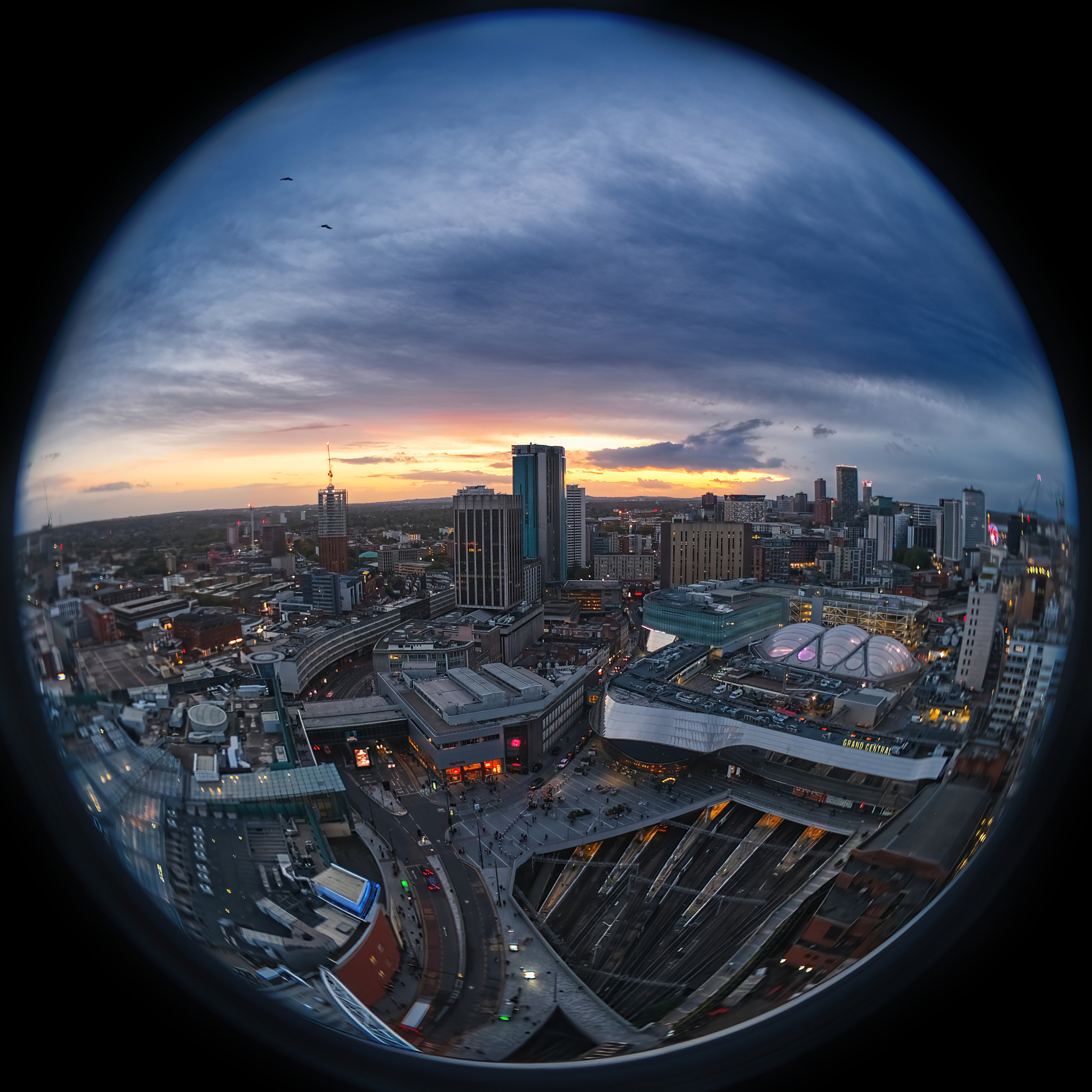 |
| A port hole onto the city. The city is confined into the fish-eye |
 |
| As are the photographers |
After a bit of soul searching, I also decided to add my 150-400mm. My main reasoning was it would be almost full moon, and maybe I could get shots as it came up behind buildings. As it turned out we were on the wrong side. and it was too cloudy. However it did prove useful for picking out features from the general city mayhem
Initially the conditions did not seem hopeful, since a layer of cloud lay across the city, but as the sun went down, enough poked through to illuminate the buildings. As it did the lights came on and the buildings lit up. Verity says she prefers the blue hour, just before it goes dark and the streetlights cast a greenish glare. I am not sure I agree and prefer the dark since it hides things like the AC units that adorn the rooftops, hidden to the people below. However it was fascinating to watch the city change as the lights dimmed.


 |
| The Birmingham toy box with a little tilt-shift effect |
 |
| Hidden in the city are some architectural gems that you miss from the ground level |
However my biggest problem, was probably too much time and too little patience. After the 1st 30 minutes I get bored and start playing with ICM, multiple exposure etc. I think this is probably the difference between me and the really good photographers. They have a clarity of objective and are willing to wait until conditions are right, while I will wander off and try something else miss the best shots.
I liked some of the results, and it was a fun evening, made even better by the hosts, Staying Cool, who could not be more accommodating or helpful.
It was probably the best evening in photography since the pandemic and while I am sure better photos were taken, I was happy with my results
 |
| Yes, I admit boredom made me start playing with a few ICM effects like zoom |
 |
| Grand Central takes off... |
 |
| I tried to capture the city reaching from the sky.... |
 |
| Enough of the sunset to catch and illuminate the buildings on the skyline |
 |
| Again the buildings capture the golden sky |
 |
| Birmingham blues |
 |
| A little multiple exposure |
 |
| As the light drops, the street colours come to the fore |

 |
| And the lighst come on, although plenty of sky colour too |

 |
| Birmingham at night |
 |
| and looking out towards Digbeth |

.JPG)


