Showing posts with label Brum. Show all posts

Sunday, 9 December 2018

3 Art Galleries and a library (Part 4) - Birmingham Museum and the library


So the 4th and final part of my journey round Birmingham (The first 3 parts can be found here)

Birmingham Art Gallery


In the last blog post, I was tired and soaked through after walking around Birmingham for the best part of 5 hours. I needed to go somewhere to dry out and get a warm drink.

I decided therefore to head to Birmingham Art Gallery and Museum (BAG).
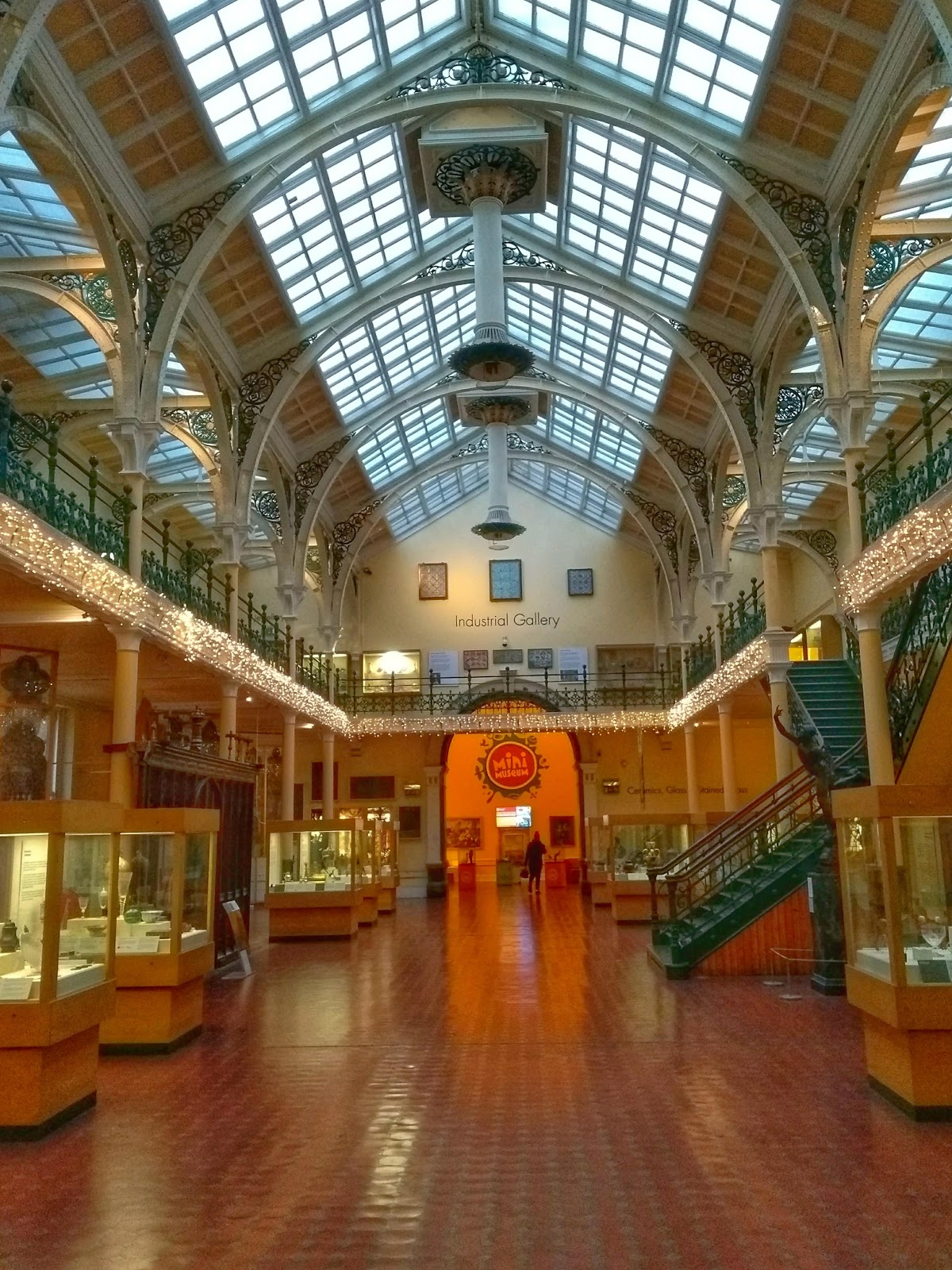
Industrial Hall, Birmingham Art Gallery and Museum


The Birmingham art gallery is situated just outside Birmingham town hall, a faux Roman/Greek edifice that looks like someone has decided to create low budget Greek myth screen-set in the middle of Birmingham.

Birmingham has gone through a great deal of change over the last 10 years, however the BAG has remained a constant. While other museums, such as the science museum have been relocated and large parts of central Birmingham have been redeveloped, BAG is pretty well as I remember it when my mother used to drag me around it.

My mother started her art degree as a mature student, and this sometimes required that me and my brother would accompany her to the art gallery (under duress) for research. Taking two young boys around an gallery is not a task that I would wish on anyone. However something must of clicked, because I still like art galleries today, and I do seem to have inherited a lot of information on the pre-raphaelite brotherhood(PRB) paintings, of which BAG has one of the worlds finest collections. This just goes to show, just because your kids don't appear to be listening,  there is still a chance that something is still going in.

Saying that, I never inherited my mothers love of pre-Raphaelite paintings. I found their simplistic morality more and more jarring as my moral compass got more refined over the years. To me they are the photographic equivalent of chocolate box pictures. Pretty, but in the end an artistic dead end and it is not surprising that the movement was relatively short lived and failed to inspire much outside the PRB clique.

The other main memory of BAG was that it was my first ever TV appearance. The event was on a local TV news affair program called West Midlands today and was due to us being around when they wanted to do a piece on BAG's new exhibit where visitors were encouraged to (shock, horror) actually handle some exhibits. They wanted some expert opinion from some 11 year old's and in those days I was obviously photogenic enough to be selected. Not only that, but I got to speak on camera, and this is where I first found my ability to spout pseudo intellectual garbage, a skill I still find  useful today when asked to comment on one of my photos. The result was 15 minute of fame at school (We lived in simpler times). I also got my photo in the local paper, the Evening Mail looking at a Barn Owl. It was a good day.

Main Ahll, Birmingham Art Gallery


The inside of the BAG has not changed much since then.The entrance halls and galleries are much the same. I always try to pick up ideas about light and composition from paintings, and Birmingham has a good range, although their modern stuff could perhaps do with a revamp. One of the things that irritates me though with art galleries is that they rarely treat photography as art and few if any have any photographic exhibitions, Birmingham is not being an exception here. Even the V&A in London, which is supposed to be the main historical photographic archive, has only a very small photographic gallery. More room is given to stain glass windows.

The one exhibition I had wanted to see was the Staffordshire hoard  . This was one of the largest Anglo-Saxon gold collections ever found and discovered not far from when I used to live. In fact unbeknownst to me, I probably cycled past its resting place  many times. In many ways the hoard is more a Anglo-saxon gold working demonstrator that actual items, consisting of small gold pieces, many from bits of larger items such as sword pommels. However the design and manufacturing skill is superb and showed what we know think as the dark ages, was more sophisticated than we give it credit for


After a walk along the rather good Birmingham history exhibition, and now fully dried out, I retired to find some tea. One thing you can say about the BAG is that it has the finest tea room in Birmingham, and I made full use of its facilities

Still you can only drag a cup of tea out for so long. Dry and refreshed, I still had 2 hours to kill, so I had to decide what to do next. The original plan was to go to Gas Street basin and photo the canals during sunset. One look at the weather outside however showed the chances of seeing any sun was slim to none, therefore I needed a plan B.

So it was off to the library.

The library


When I wore a younger mans clothes, the library was situated just outside the BAG. That library has now been demolished and the site now an area of intensive redevelopment which unfortunately dwarfs the neo-classical buildings. The new library has only moved a few hundred yards between BAG and Gas Street Basin, which itself has become a hub of new development.

The library of my era  was a build in what they termed a brutalist style. That is architecture speak for a big ugly fecker, beloved only by architect academics and historians.  It looked like someone had piled 4 giant concrete slabs on top of each other and then left them to decay. Whatever some may say, naked concrete is a harsh and ugly material and should be hidden from view if possible. Apart from a few purists I don't think many in Birmingham were sorry to see it go. Saying that, the inside was  excellent area for study being open, full of light.

The new library is a totally different building consisting of modern glass panels with a relief of interlocking rings. Although only 5 years old, it has, along with the Selfridge store, become a greatly photographed building

I had walked past it many times, and even take a photos, but never really got anything out of it. However I realised I had never actually been inside it, so this seemed a perfect opportunity to put that rights.


According to Wikipedia, Birmingham library is the largest public library in the United Kingdom, the largest public cultural space in Europe, and the largest regional library in Europe. This may be so, but in some ways it was a brave move to spend so much money on a building whose entire primary function has in recent years suffered due to a sea change in technology. Increasingly libraries are under threat. Across the UK, libraries are being closed or transferred from local authority control to one where they are volunteer run. In many ways it is a sign that we are moving back to a almost Victorian ideal, where services can only be run through local philanthropy (coming to a health service near you soon). There is a strong possibility that this will be the last purpose built library constructed ,certainly at this scale, which is a great pity since I still firmly believe libraries have an important function.

Some of the issues that have affected libraries in recent years can be blamed on austerity, local council cuts and sheer government sheer bloody mindedness. However technology is also partly to blame. When I used the old library, it was basically the only place to find reference information. Nowadays pretty well all the information can be obtained on a mobile phone, tablet etc. It is the same with books. With a kindle I can now carry the contents of a small library on a small hand held device. Some books are never even produced in a physical form and can only be obtained in electronic format. Why do you need a building if all your content can be stored on the cloud.

So in the 21st century what are libraries good for? Well, if a library are to remain relevant they have to be more than places where physical books were stored. Instead they have to be community hubs and areas where they offer services such as internet access to those who would otherwise be denied this increasingly critical resource.

In this respect Birmingham library still has an important function. If to highlight the point, while I was there, I think I only saw about 5 people actually reading a physical book. Most were there to take advantage of a warm space with free wi-fi and a somewhere to plug their laptop in or charge their phone.

OK enough of that, what about the library photographically.

The library consists of 4 levels, of mainly open space. There did not seem to any restrictions on using cameras, but as in all these situations discretion is advised. The interior consists of open plan floors with a wide central opening in which are pierced by shallowly angled escalators. As such they make good targets for practicing architectural photography, with a number of interesting shapes and angles being formed.


Birmingham Library Internals


However the real gem of the library for photographers is the so called 'secret garden'. This area (which is well sign posted and therefore not actually secret)  is a veranda on the 3rd floor that provides a great view of the Birmingham skyline. At the time, some of that skyline was being rebuilt, however it is a great place of nigh shots of the city.

Birmingham from the secret garden


.....and at night


After taking a few shots, I decided to settle down and searched out something to read. Fortunately the library had a goodf photographic section  and I spent a happy hour perusing a number of books on Ansel Adams until it was time to go.


International Conference Center


Bash Street Basin

Bash Street Basin

Bash Street Basin


Finally...

Finally I ended up in Gas Street Basin. If any area defines Birmingham renewel it is this area. Once a pollution infested relic of a industrial bygone age, it is now an area teeming with wine bars and restaurants and surrounded with iconic buildings such as the international convention centre. However despite the changes, it is still a canal boat marina and crossroads and you will often see boats transiting through the low tunnels.

On a good day, it is a fantastic place to get photographs and well worth the mile or so walk from the centre  However today was not going to be one of those days, so I decided to finish up and head to the station and go home.

So after a day spent in my so called home town, how do I feel about Birmingham after day re-evaluating it.

I must admit I like the feel of the new Birmingham. No longer the Cinderella of cities, more known for industrial grit and grime than art and culture, Brum has managed to transform itself since I was a child. The investment in the center has produced a vibrant city, the counter culture in Digbeth is promising development and hopefully Hockley will continue to re-define itself.

That is not to say that Birmingham is a perfect metropolis. Under the new chrome and glass veneer, it is easy to find examples of the 1970's architectural failings, but in some ways this only adds to the range of photographic opportunities.

Yes, it has almost got to the point when rather than hiding my identity, I can say it load and proud.

 I am Tony and I am a Brummie. 

The iconic Rotunda ala Warhol


Wednesday, 28 November 2018

3 Art Galleries and a library (Part 3) - Hockley and the Jewellery quarter


This is part 3 of this blog series and my photographic exploration of Birmingham.

Part 1 and 2 can be found here

Out of the woods

One of my reasons for spending the day in Birmingham was to visit a small photographic exhibition call "Out of the woods of thought" in the Argentea gallery, based in an area called called Hockley which is about 15 minutes out from the city centre.

While Birmingham has a fine new metro system, I decided to walk it and quickly found that Birmingham's renewal has extended only so far. In the past, one of Birmingham's issues was its unconditional love affair with the motor car. Until recently, Birmingham was the hub of motor manufacture in the UK, and it reciprocated this affection by making Birmingham one of the most car accommodating cities in the UK

This resulted in an endless array of over passes and underpasses, ending up with UK's finest  monument to motor transport, spaghetti junction. It also meant that in the past public transport was barely tolerated, rail in particular. Its not that Birmingham eschewed the need for public transport, it just it was slightly embarrassed that not everyone could or wanted to own their own car. As a result. while in other cities, train stations were massive cathedrals of steel and glass, Birmingham's main station, New Street, utilised the same architectly pattern as used in WW2 German U-boat pens.  Even today, despite the new shopping center and investment, Birmingham's main station and consequently the 1st site many visitors will get of the city consists of dark troglodyte tunnels smelling of oil and diesel.

I was reminded of this as my short walk consisted of finding my way past bustling dual carriage ways the building of which had disjointed the natural flow and pathways of the city.

Finally we arrived at St Paul's square where the Argentea gallery was situated. St Pauls's square is an elegant Georgian built cluster of shops and giant church. This provides a snapshot of the Birmingham  that existed before the industrial revolution shaped what the city is now. The church itself is often seen in photographs of the city, especially in autumn, where the natural framing by trees and the autumn leaves, combine to create a natural postcard. However I did not have much time to stay outside since now the weather was starting to close in, so after taking a few shots I went into the gallery.

Old Birmingham against the new


The Argentea gallery

I had seen this exhibition advertised on social media, and two things about it intrigued me.

Firstly the theme "out of the woods of thought". For me taking images in woodlands is a love-hate relationship, There is nothing so stimulating than wandering woodland, however I find my brain struggles to separate image from the chaos of branches and leaves. Therefore I hoped that the exhibition would give me some ideas how to improve. 

The 2nd reason was the Solargraphy images by  Al Brydon. If you don't know Solargraphs, they are ultra long exposure images that track the sun against a background. Generally they are as low tech as you can make a camera, consisting of a tin can and a piece of  photographic developing paper. I have tried a few myself, and although you need 6 months or more to give them a go, I find them intriguing and rewarding. However I have never even considered they may have some commercial value, so i was intrigued to see how they were represented in a gallery setting.

The exhibition consisted of 9 artists, and the theme was well represented with each one having a different but consistent view off the theme. What I love about exhibitions like these is the chance to form a narrative; A form of expression that single images rarely allow you to do.

Below for me, are some of the highlights


Brian Stevens "Beachy Head" was a great example of photo story telling. The images themselves do not stand out and at first glance seem to have little to do with woodland, instead they are shots taken on Beachy Head, a set of chalk cliffs in Sussex, renowned for their beauty and apparently the suicide capital of the UK. In the exhibition book, the photos are accompanied with facebook entries from rescue teams documenting each event in human tragedy. In some way the gallery missed a trick by not presenting these with the images on the wall. The facebook entries but a whole new complexion on the misty cliff tops and red telephone boxes .
Dans Le Noir

"Dans Le Noir" (Translation "In the dark"), is a set of IR images taken of the WW2 fortifications in Normandy printed on silk by Lynda Laird. I enjoy taking IR images myself, but these had an interesting treatment, with the foliage a bright red against the stark concrete. You could not help contrasting the red with the blood of men thrown against these monuments to violence.

Mametz Wood


Mametz Wood is a set of B&W images of woodland by Rob Hudson, but with the exposure turned down to the point where the objects become shapes etched out of the landscape. It's an interesting and effective treatment, and eschews the colour we might expect from such a subject. Printing must be challenging however due to the restricted tonality

The Floods


Joseph Wrights "The floods" were a more traditional view of woodland, albeit his view was of flooded land, which gave an air of mysticism and malevolence to the land. I must admit I was quite taken by these images, partly because they reminded me a lot about an image I once put into competition.

The image below, did not do well and the judge in question described it as "disturbing". At the time I was felt aggrieved , but thinking about it, if arts whole point is to generate strong emotion, then the photo was quite successful. One of the inspirations I took away was to visit the area again   to take images of a similar theme

My "disturbing" image

I was also much taken with J.M.Golding "Transitional Landscapes", which  are landscapes generated from squares of photographic film to create a landscape captured in both sections of area and time.

Finally Al Brydon's Solargraphs. One of the things about Solargraph's is that you have very little control on the outcome. All you can do is place it somewhere you hope will create interesting results and will lie undisturbed for 6 months. In some ways it is the very antithesis of digital photography. Can an image generated by random effect have value and be called art?  If there is a creative process it is in the way the images were printed. Solargraphs are produced on 5x7 inch B&W photographic print paper, however these were much bigger with wonderful rich blue hues. In doing so Al has made something beautiful from the random and chaotic


While I was there the gallery owner gave a little talk to the assembled students. Apparently she set up the gallery when she stopped being a lawyer after her child was born. She did and arts degree and a masters then setup the gallery. She said the advantage of Birmingham and her location is that she can afford far more space here. In terms of exhibits, she exhibits photos that are in that middle ground of abstract but commercial. She does not have enough time to look at portfolios so her exhibitors are found via social media.


Its certainly great to see a gallery specializing in exhibiting some of the fantastic creative photography out there and if anyone is in the area I would heartily recommend going there and I'll keeping an eye on future exhibits.

For me, I came away with a lots of inspiration and ideas plus a touch of frustration. I do often find club and competition photography limiting and would much prefer a wider canvas consisting of multiple pictures against a theme, but unfortunately their is little outlet for that.

Apart from the images themselves, the other noticeable thing was the quality of the printing. Total control over the output is one of my biggest issues, and I know sometime printing is something I will have to master.

The exhibition continues till the 21st December 2018

The Jewellery Quarter and the necropolis


As I left the gallery I realized I still had 4 hours to fill, so I decided to walk into Hockley to visit a location I had spied when I was in the area a year before. It was at this point when the rain decided to stop mucking about and started to pour down in truly biblical proportions. I wasn't really setup for this sort of weather and quickly my feet and trousers started to soak through as I trudged through the Hockley streets

Hockley's is better known as  the jewellery quarter. It is a throwback to when Birmingham city was a myriad of small industries making it the workshop of Britain and the wider empire. These have mostly moved into out of town anonymous square boxes, but Hockley still retains much of the Victorian look and feel, which in the city centre has been largely buried under 5 metres of concrete. 

The area still contains a large number of jewellery workshops and retailers. I bought our wedding and engagement ring from here and I an still somewhat proud that it was sourced from an area of such history rather than some jewellery conglomerate. Saying that the area, like many places have suffered from the rise of online shopping and is not as thriving as was when I got married. The area itself has a lot of charm, and there are serious attempts as renewing the area. I hope it succeeds because it has a lot going for it, especially since it is in great contrast to the concrete jungle other parts of Birmingham have become. 

This time however I did not head for the center of the Jewellery quarter, but the graveyards next to the Metro System. I had spied them when visiting the excellent Jewelry quarter museum a year ago and noted then they looked interesting photographic locations. However I got a little lost on the way and rather than ending up in Warstone Lane cemetary as planned  with its array of Victorian catacombs, I found myself in next door Key Hill cemetary instead.

However I was not disappointed by its suitability for photography. These cemeteries are no longer active, but the array of tombs and stones between the continually encroaching trees make a fantastic photographic location and it is surprising  more people have not taken advantage of it


There is a fantastic gothic feel to the place and would of spent more time there. Unfortunately for me the weather was absolutely disgusting and I was getting cold and wet. Also without cover to change lenses etc, I decided I had to give up and find some shelter. 

However it is definitely somewhere I want to visit again on a better day. 

So soaked, cold and a bit tired I headed to the Metro, and the city center to locate somewhere to dry out

Sunday, 25 November 2018

3 art galleries and a library (Part 2) - Digbeth Street Art


Art Gallery No 1.


This is the 2nd part of my blog re-discovering Birmingham

My 1st look at Birmingham was to go look at the Digbeth street art.

Birmingham has changed a lot since I was young. The Bull ring has been pulled down and replaced with a chrome and bubble wrap cathedral. Instead of having to risk life and limb crossing the mad petrol fueled chariots storming up New street, the streets have been pedestrianized. However peer underneath the veneer and you you will still find parts of the original city based on industry and engineering.

Digbeth is an area adjoining the new chrome and glass retail palaces. However it is a huge contrast. Instead of glitzy shops and covered arcades, you get lockups and small workshops, a local open air market and the coach station. You could never call it pretty, but it is authentic and in recent years it has started to get a reputation for its alternative culture and street art.

Digbeth Viaducts


At one time street art was defined as vandalism and much money was spent dissuading such things. However there has been a reappraisal in recent years and a realization that done well it can be an asset to an area and the skill and quality of the work should be applauded (Obviously nothing to do with  Banksy, and the money the art world could make from street art).

You can even do tours of street art in areas like London, but you don't have to go that far since Digbeth are has started to be recognized in the same way. Therefore with the help of the Digbeth Art Walk map to explore it for myself


While I had brought my camera with me, the biting winds and sheer laziness meant I couldn't be bothered to get it out and used my phone instead. The walk is pretty easy to follow and you meander through the railway viaduct that splits the area, until you reach thea place called the Custard Factory, which has become the hub of the area. Apparently you often find fashion photographers using the wall as urban chic backdrops to photograph their supermodels . Obviously it was to cold and too early for such shenanigans  so apart from various people going to work I had the place to myself

I couldn't help myself thinking how much my mother would of loved this area. My mother was always was always a bit of a rebel. Unfortunately growing up in the 50's, suburbia  rebellion just wasn't done so she grew up as a housewife until doing a Art degree as a mature student. She then spent most of her life generating art work on a project documenting characters on TV. When she died there were masses of sketches and doodle, which apart from a couple of pieces were nerver published. In the same way, street art is art for art sake. Although some of the artists get recognition, generally it is done because its cool, and the chances are the work will be overwritten in a few years by someone else.


To be honest by the time I had reached the custard factory area the biting cold wind and my need for sustenance made me head back to the city centre.  I guess I had covered about 1/3rd of the trip, but it was well worth it, and will definitely go back when it is a bit warmer and I have more time. 

On the way back I paused at Digbeth market.  While only small, the market is a hub for locals and I suspect a great location for street photography. Unfortunately I had to eschew ed my longer lenses, and have not so far perfected the art of surreptitious camera usage, so I contented myself with trying to take images of the local starlings.

Digbeth Market


I love starlings, and while naturally a bird of the fields,  they have always had a natural population in Birmingham. Long before murmaration become a  word I understood, i remember the vast flocks coming to roost on the Midland bank building (now a Apple store) just outside New Street station.

In the market a number were taking advantage of the cover and the plethora of free food on offer much to the annoyance of street holders.


Add caption

Starling All you can eat Buffet

Moving to the centre I realised that I had forgotten that the German market was on( November is not Christmas!!!). The German market consists of a large number of stalls selling purportedly German produce to the local denizens. While popular with those outside the city,  this annual event produces mixed feelings due to the disruption caused and the detriment of local independent traders. I must admit I have some sympathy with that view. While I love Germany as a country, it all feels  a bit and hollow. Its a bit like going to a "English" pub in a foreign country. It always feels that during the re-location the spirit and the whole reason for their existence has been lost. Combine that with the fact hidden behind the Germanic facade,  it is really just an excuse to sell overpriced alcohol and tat, and the fact any attempt to communicate via "Guten Morgen, Mein Herr", is just of likely to elicit "what?" than "Wie kann ich dir heute helfen?" you wonder what is the point.

We often joke with nour American colleagues of living close to UK's Islamic state :) (Not)


Tat - but German Tat


There has been a movement to create a market of independent traders instea and I do wonder whether an alternative markets in a place like the custard factory celebrating local independent tradesman would be a great opportunity to highlight the area and celebrate Birmingham's trading spirit.

After negotiating the German Market, I stopped briefly at Birmingham cathedral. It sounds grand, Birmingham Cathedral, but befitting a city that was just to busy to build large ecclesiastical edifices you could quite easily walk past it, thinking it is just a large parish church.

Inside Birmingham's Cathedral


Anyway now was time for Art Gallery No 2.


3 art galleries and a library (Part 1)

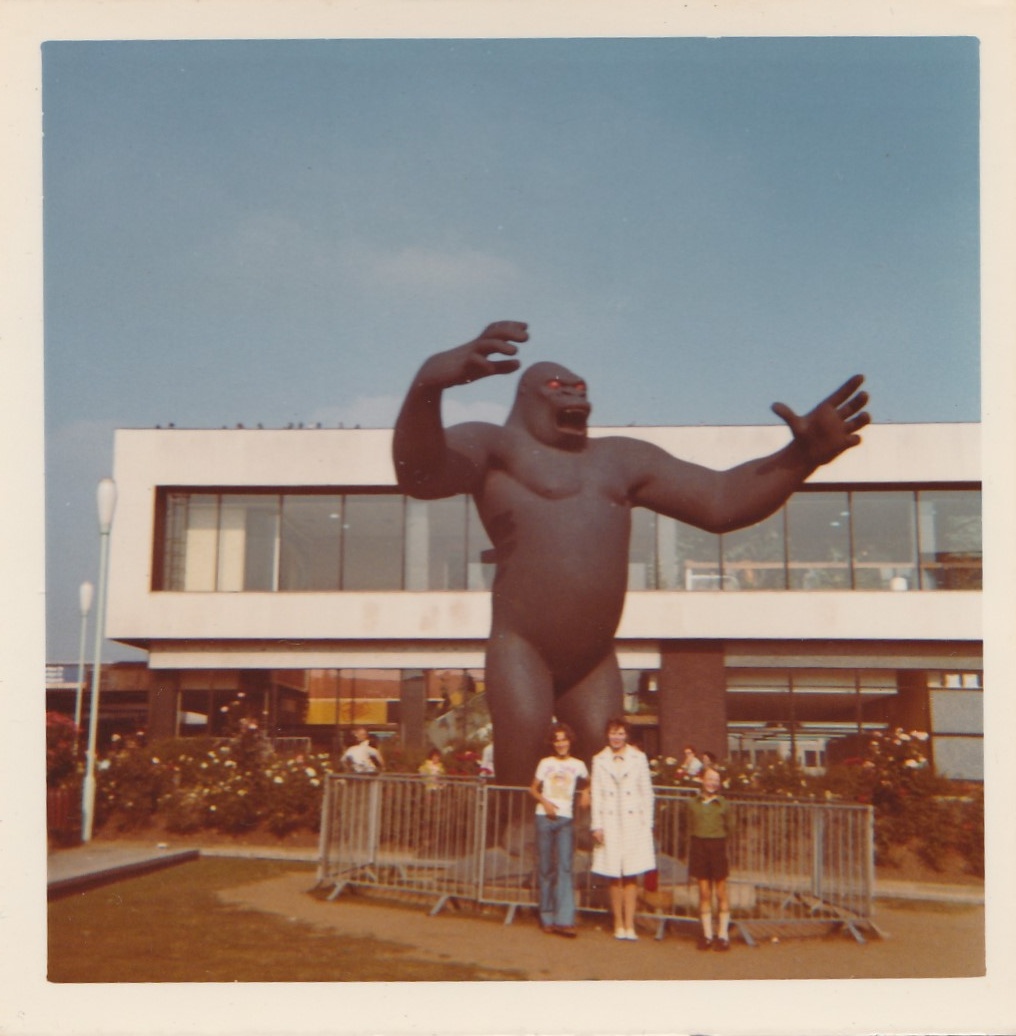
This is what Art was in 1970's Birmingham. King Kong was greatly loved by many in the city, but the council could not work out why anyone should spend so much on art. It ended up instead on some garage forecourt, dressed as father Christmas. The knees and the body associated with it are mine, together with my mother and a French exchange student


Technically I'm a Brummie.

I say technically, because I was actually born in the black country, an area of industrial Britain, which has much in common with Birmingham, but is fiercely protective of its separate identity .

We moved into what is now Birmingham when I was 4, and I lived most of my formative years there, until moving onto university. It wasn't however Birmingham when we moved, but the Conservative caliphate of Royal Sutton Coldfield (Emphasis on the Royal). It was a largish town on the edge of Birmingham consisting of large bustling town, the huge area of open parkland called Sutton Park, multiple hidden private roads containing the mansions of the rich and famous, and us. At the time it felt like joining a exclusive club. Every year, as residents, we received car stickers that allowed us free entry into the park (and bizarrely permission to collect Holly), while the common folk of Birmingham, just over the border, were made to pay like the plebs they were :)

That all stopped in 1972, when the conservative members of the local  council (that is to say the entire council) decided to merge with Birmingham. So no more car stickers and overnight I became a Brummie. (Why is still a bit of a mystery, and I have never met anyone who lived there at the time who thought it was a good idea. The best explanation was that at a stroke, the conservatives added a block of tory Councillors onto the otherwise left leaning Birmingham council).

During my childhood and adolesence, although only 30 minutes away by train, Birmingham itself felt distant and disconnected from me. We may go in once, twice a year to Birmingham and therefore was a big event. Birmingham of the 70's and 80's it had to be said was not exactly a great place to go. The centre was dominated by the Bull Ring shopping centre, plonked on top of the architectural disaster that was New Street train station. My memories of it are of a labyrinth of dim passages, spreading out in a haphazard way. It is said when they knocked it down to build the present shopping center,  they found Japanese soldiers hiding since the 2nd world war, who found better cover than jungles and could pop into top shop once in a while for some camouflage chic..

Our visits had a bit of a ritual assocated with it. It usually started with a trip to Habitat. Habitat was a store famous for selling designer furniture. This was before IKEA came along and showed that you could furniture could be well designed and low price. We never bought anything there, instead we just went in to stare at the masses of white formica.

The other shop we ended up in was Mikado, a shop which for some reason specialized in selling Japanese objects. Never sure how it ended up in deepest Birmingham and the only thing I can remember buying all were incense sticks, which never were used. Then there was Beatties, the giant model shop, where I would spend my time nose pressed up at plastic kits I could not afford. Finally, just outside the bull ring was Hudson's bookshop, a giant sprawling mass of literature, where I spent many a happy an hour perusing the shelves.

Apart from the 70's retail experience, the other reason for visiting was the two museums, the Natural History and Art museum and the science museum.

The art museum is still based near the council offices, and we were often dragged their by my mother because she was doing a art degree and she had a thing for the Pre-Raphelite Brotherhood, which rather fortuitously Birmingham art gallery is famous for. However at the time the main attraction was always the full size fibre glass T-Rex with a button that made to raw(this was as close as we ever got to animatronics then)

The science museum used to be based at the Gas street basin, a nexus of canals which at the time was pretty ugly and polluted. (someone at this point mentions that Birmingham is that it has more canals than Venice. This is true in the same way that Malawi has more mosquitoes than Brixton ). I really loved the science museum, with its strange eclectic mix of old machines and modern technology. I especially loved and was fascinated by a mechanical turk, with which you could play fox a geese. It is one of my 1st memories of automation, and may well of set my path to where I am today.

Unfortunately the museum is no more,  with most of the exhibits being subsumed into the Millennium point, where you can pay a huge amount to watch your kids press buttons for half an hour. The exhibits still exist, but they are hidden on the bottom floor which is a great pity because they define why Birmingham came to be.

Ok you may ask, apart from the major nostalgia kick, why am I telling you my life story?(yes why? - ed).

Well, Birmingham has in recent years gone through a bit of a Renaissance.  A lot of the architectural excesses has been torn down and replaced with iconic buildings. More importantly a nascent art scene has started to grow up and photographers such as Verity Milligan, 
Ross Jukes, and Tim Cornbill have started to show the city in a new light.

I recently had reason to be in the city, so i thought I would make a day of it. So I thought I would re-visit the city of my youth and re-evaluate it through adult eye. The following blogs are about what I found....