Showing posts with label Glass. Show all posts

Friday, 16 October 2015

The glass ceiling

Last night we had this years first club competition on a theme which was chosen about a year ago.

I must admit that I quite like these sort of competitions.Because we are restricted to a narrow subject say compared to landscapes, I find it makes me work and more rewarding harder to find a shot that fills the brief. It also levels the playing field somewhat, so the photography is less about the expense of the gear and more about imagination and fulfilling the shot.

This seasons theme was glass. It is interesting that most of the  club members seem to of thought the same thing when they heard the theme, which was buildings and mirrored glass surfaces. In the end there were a few of those in the competition, ranging from London landscapes to world trade centers.
 However some missed the brief entirely by concentrating on the general city scape rather than the glass itself. The ones that I liked best were those which were almost abstract in their simplicity by playing with the glass surfaces.

There were also a lot of churches and stained glass windows. I must admit I have a problem with photos of art works such as these. The term the judge used last night was 'a good record shot' and that is all they are to me. If you are going to take a picture of say a statue, you have to have something else in context, such as people's reaction to it, otherwise it is not really your work that is being judged, but the original artist.

It was also interesting that a lot of the 'big' guns of the club did relatively poorly last night. That is not because their photos were poor; far from it, but more because instead of creating a photograph that matched the brief, they tried to bend their usual photos to the subject like landscapes (with titles like transparent sea). To me perhaps this shows a lot of specialization.

It was also good to see that one of the winners on the night was taken not on a expensive DSLR, but a camera phone (albeit an expensive camera phone). In this case it was a skylight in a factory taken in a panorama.

This is why themed competitions are so fun. It rewards the imagination over the equipment.

So how did I do?


This got 19....
While this one 16...Why?

This one did well,

But this one was close to winning

Good marks here, but perhaps needed cropping

Probably my biggest fail. Probably cropped too nuch


I must admit when I first heard the competition my thoughts were on initially to take buildings. However it quickly transpired that I would have little opportunity to take such images. I did go to the Victoria and Albert, specifically to take pictures of glass(it has a very good glass staircase), but I failed to get anything useful.

So instead my thoughts turned closer at home with all my images were taken indoors. Not everything worked. My attempts to take glasses and bottles on a mirrored black surface did not really work as well as I would like, and I had a number of failures to take glass against various lit backgrounds. However by staying close to home allowed me to experiment far more than if I had tried to take images on location

I must admit my prints marks were a little disappointing, however he DPI's did really well, with all 3 being kept back for later consideration. In the end, 2 of them got 19 marks and was only a whisker away from winning(again!).

I couldn't complain about the winning entries, both by Simon Pearce , who is pretty good at this sort of thing.

And the next subject is?


By tradition, at the end of the competition a new theme is chosen. This year it was chosen as

Emphasis

which I must admit had all of us scratching our heads and heading for the dictionary. The challenge will be expressing such an abstract term to the judge via photos and i expect an even more diverse set of images next year. I already have come up with some ideas, so 12 more months of work begins now...


Sunday, 11 October 2015

Just a minute....

A lot of people suggest that only in a free society can art truly flourish. While there is no doubt some truth in that, freedom can also be hurdle for trying to create great art.

For example if I asked someone to take a photo of anything, the chances are that the  the huge variety of options would results in an inability to narrow down the available choices to the best shot. It is almost when provided with a free choice, the brain shuts down due to the large number of choices, a bit like a child given free range in a sweet shop.

However if I asked someone to take a picture of say a particular tree, then they could spend ages analyzing the best angle, when the best light would be and different ways of taking the image. By narrowing the options down, it allows you to concentrate on achieving the best possible image.

One such situation is the annual MPS themed competition where you are asked to take images based on a single word. This time it was glass, and I've had a year to try and think of suitable images.

I have to admit not all my ideas proved feasible or even came off as I hoped, but the ones that were meant that I could spend a lot of time trying to get the best possible image.


However yesterday I had an even narrower brief. The website, Kujaja held a project called one minute on Earth. The idea was for photographers around the worldto take a picture at the same time  i.e 10th of October 10:10 a.m and upload them to create a photo book.

I decided to have a go, so I duly went of to my local town, half an hour before the appointed time, to find possible locations.

You quickly realize that this is not as easy as it sounds. First you have to find a spot that is

a) great photographically
b) something to photograph will be there at the specific time.

You also quickly realize that 60 seconds is not a lot of time  to take a photo, and you will only have two or three shots.

In truth it is essential in these sort of situations to have local knowledge since you do not have much time to find possible locations.
 
As it was, I not sure I got the image I wanted, but the strictures put in made me me think a lot about photographing ordinary daily life.

I also learned a lot taking part, namely
  1.  The best places are those with people in static situations such as cafes's. I feel it should be about the story of what people are doing at that particular point in their lives.Landscape and buildings while important change little through the year, so do little to define a period of time.
  2.  Find a spot and setup 10 minutes before. Do not doubt yourself and try and second guess at the last minute. 
  3. Choose the position for photographic reasons as much as who and what is around e.g. The lighting, angles, etc.
  4. Talk to people around you about the project so that they won't be surprised when you whip out your camera at the appointed time.
  5. It would bea  great opportunity to get a group of photographers together to cover different areas and situations. After all you cannot be in two places at once.
One thing I did do right however was my choice of lens. In 60 seconds you cannot faff about changing lens, so what you have at the start is what you are stuck with(unless you are lucky enough to own multiple bodies).

I could of gone with my 50mm prime, but I felt the photo needed the context so I could not frame people two close and the background needed as much as possible be in focus.

I could of gone with my 28 - 210mm, but in the end  I went with 18-24mm to show as much as the surroundings as possible. While there would be some distortion at the wide, I thought that it would meet the brief best. In the end I think that was the right choice.

This sort of exercise is great practice for those high pressure situations where you get one opportunity for a shot (parties, weddings, sports events) and well worth practicing. While initially I wasn't happy with the shots and felt I could have done better, in the end it came out better than I thought.
10th October 10:10 a.m

Update 16/10/2015

I lately realized that I made a mistake with the one minute photo. Unfortunately I had not read the brief carefully enough and now realise they were looking for outdoor shots that showed the state of the sky and weather around the globe. If I had realised this at the time I would probably take another shot. As it was I am not the only one to get this wrong, and to be honest I prefer my approach. Landscapes are nice, but peoples life's are the greater quantum and I think it is more important to record. As it is, I can probably justify it due to the windows in shot, however there is a lesson to more carefully read the brief in these situation.


Wednesday, 19 August 2015

Smash and Grab

 This is an update on the fun I have smashing glass. I blogged here about my attempts to photograph light bulbs being destroyed.

Since then I have refined my techniques a little.

The diagram below is the basic setup


 Basically it is a swinging arm, with a hammer attached, directed towards a unsuspecting light bulb. The camera is opened before the swing and at the opportune moment the flash fires taking the image.

When we left it last time I was having problems attaching the hammer, keeping the bulb still on impact and getting only one flash.

These problems have largely been solved. The hammer is now attached using a couple of metal strips with bolts through them. I added extra bracing behind the bulb to stop it going back on impact.

The multiple flash took a bit of working out. The problem was the hinge which formed 1 part of the switch did not move out the way enough when hit by the bolt, This caused the bolt to scrape against the hinge edge, so causing the multiple flash. This was solved by making the bolt hit the center of the hinge, and putting insulating tape on the edge.

I also put black cloth at the end of the garage so we have a cleaner backdrop.

The original intention was to fine tune the contact point by moving the bolt in and out. However it worked out easier to move the work bench.

Below is the setup in all it's glory. Note the pristine work conditions.

The way it works is that I hold the pendulum to one side, activate the camera in bulb mode using a remote trigger. Let go of the arm and hopefully once the flash has gone, let go of the camera remote. It is then a process of picking through the broken glass in order to setup the next shot.

Here is a closeup of the trigger. I was tempted to build a electronic delay  trigger and certainly a sound triggered system may of been easier, but the low tech approach worked too.


So what are the results? Certainly getting there. One thing I learned was the duration of the flash is based on the power. The lower the power the shorter the flash. So I have moved the flash closer and set the camera ISO higher

As I mentioned before, my original intention was to break bottles, but they proved rather resilient for that. Because of size constraints I am limited to the maximum swing of the pendulum. Still now I have perfected the technique I may give it another  go at some time.

Sunday, 21 June 2015

Breaking Bad

To learn anything requires you to repeat an exercise in the same conditions and measure your improvements.

In outside photography this can be a problem, because there are so many variables such as the light, the subject, and the position of the camera. even the lens used and the camera settings.

While often you can extrapolate from one photo to another, it is sometimes nice to be in more controlled conditions.

One way this can be done is via indoor photography. Here you can play around to your hearts content, with all sort of parameters while at the same time taking photos of the same subject.

Of course to do this it is great to have a room set apart for your studio. Unfortunately if you have a growing family, you are unlikely to be in that sort of situation, so instead have to work round the ordinary detritus of human life.

In my case this is the garage. Now like most garages, it has been many years since a car was ever parked in it, and we would struggle to even get a bike in nowadays. Needless to say then it is not ideal as studio,since we  have to fight around tools, drink and various large quantities of wood I have collected  over the ages "just in case" I ever decide to start a carpentry business.

However it has a number of qualities which any studio should have. It is out of everyone's way,. meaning I will not be disturbed. Outside light can be shut off if needed, and with a little re-arranging enough space can be had to set up tripods etc.

The project


 I have always wanted to try my hand at high speed photography, and I had a project in mind to achieve this, and this is where the garage came into play.

The project was to record  the breaking of glass.

Now there appears to be two ways to do high speed photography. Either open the shutter at a high shutter speed in strong light at the opportune moment, or leave the shutter open in the dark and fire a flash at the optimum moment(or a combination of both).

Now both of these require am accurate method of triggering at the opportune time, but the former method is likely to be the hardest, since there would always be a lag between shutter press and activation. So I therefore decided to do the latter.

For this I purchased a radio trigger for my flash. This meant that I could position the flash away from the camera with the trigger close to the subject I wanted to take. Also the trigger had a 3.5 mm din socket that would allow me to trigger the flash by connecting two wires together at the correct moment.

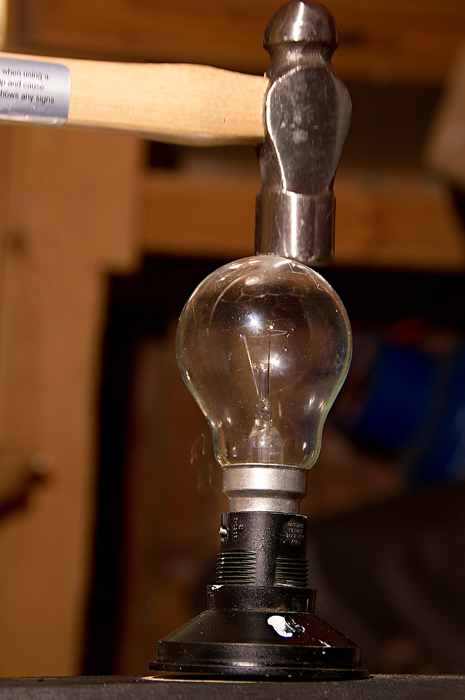
Although  this sounds complex, the real difficulty was triggering the flash at the right moment. The idea was to swing a hammer on a pendulum and at the bottom of the arc meet a glass object. At this point I wanted to trigger the flash.

Now there are a number of ways I could do this. A electronic method could be rigged that triggered the flash if a light beam was broken, or on a sound. However to keep it simple I put a bolt on the pendulum that at some point on the arc would hit a hinge, so make electrical contact and fire the flash. The bolt was used so I could adjust it. The hinge's purpose was so that in theory it would only fire once, since the hinge would fold out of the way.

So how did it go? Well initially I was going to try it with bottles, but I found out that bottles are   actually very hard to break, so I substituted them old type light bulbs which proved far more fragile

This is one of my 1st goes.


As you can see, it worked but the flash fired too early, so although the bulb is breaking it is not quite enough to be easily visible.

However this one was far more successful.


Still I think I can do better. For example the bulb holder has mover as the hammer hit, and it is just a few moments too late.  However I have already learnt some important lessons.

1. I thought I would need to do this in total darkness, which made me nervous of swing a hammer on a pendulum in pitch black with me and camera equipment around. However it turns out that if I set a low ISO, dim lighting is adequate.
2. Triggering is harder that I thought. The mechanism at present sit fires multiple times, which means I have to manually close the shutter, before the 2nd flash. Also adjustment is not as easier than I thought, so i will probably need to redesign the  trigger.
3. Glass gets everywhere, so put sheeting under the work bench and have a way of removing the light bulbs from there holder such as pliers.
4. Get a bigger hammer!. Actually securely attaching the hammer to the pendulum is one of the challenges I need to master. At present I user tie wraps, but they tend to come loose.
5. I will need a lot of bulbs.

Still it is promising. I am tempted to make a electric flash delay that would give be more control on when the flash goes off, but we will see. What I do know is that I will need a lot more light bulbs...