The Guardian newspaper published an article recently about the Christmas Dad and the impossibility of buying presents for them. Basically, they are men who have achieved a point in life where they have everything they need. I have realised that I am indeed in that category. I am in the fortunate position to be debt-free, reasonably well paid, and every year I am a nightmare to buy presents for.
Around November, my wife always starts asking for a Christmas present list, and after much soul-searching, the best I can ever come up with is books.
Not that I need more books. I have a birthday late in the year, and again I ask for books, which I might be lucky to have completed any of them by Christmas. In fact, I calculated that I have probably enough unread books to keep me going for an entire year of continuous reading. However, any other present would be too expensive or too complicated to explain, and the fact is, if I had really needed it, I probably would have already bought it.
So what do you get for the person who has everything?
Everything but time itself
The weird thing about growing older is that life never turns out as you expect.
I had assumed, as I move into my 7th decade, that I would have more time to spend on hobbies, but the truth is, as you grow older, you instead accumulate responsibilities, which in turn eat into your so-called "free" time.
I have around the house, multiple half-baked projects that I never really get a full run-up to complete. In my youth, I would spend weeks doing these sorts of things, but now I am lucky to spend a day a month.
So what do you get for the person who has everything? The answer is time.
My wife is always telling me I need to take my holiday earlier. The problem is, I always feel guilty in doing things on my own. I love both my wife and family, and I want to spend time with them, but when I do, I constantly want to go and do things on my own terms.
So with that in mind, I decided to take a "me" day and go to London to see a photography related exhibition and with a bit of luck a little photography
The 1st question was which one?
My first thought was the Victoria and Albert.
I love the V&A. It is like the the world's biggest and best attic, but photography is just an addendum on top of everything else and gets subsumed into the huge morass of objects.
I there decided instead to go to the National Portrait Gallery(NPG) which despite going to London many times, I had never visited.
It was also hosting the Taylor Wessing Photo Portrait Prize, so it seemed as good as anywhere.
National Portraits
The NPG is hidden behind the larger and more prestigious National Gallery on Trafalgar Square, and as such gets far less footfall.
The NPG is in itself a bit of an anachronism. I mean, why have a gallery based on one genre? After all, we don't have a National Landscape gallery or a National Still Life gallery. The other thing which differentiates it from all the plethora of other galleries in London is that it is the one gallery in which photography and painting are held in the same value and displayed equally. So next to a Gainsborough could be a Bailey.
Also, all the pictures shown represent people, living or dead, who had desires, prejudices and ideas just like those viewing them. The test of a great portrait is how well the character of the subject is expressed to the viewer.
In this regard, the skill of a portrait photographer needs to exceed that of a portrait painter, since while the latter can modify their image to show the character of the subject, a photographer is limited to only what they see in the studio at the time.
I will admit that I am very poor at taking photographic portraits.
Here I am not alone. In a recent club competition, the judge bemoaned the lack of good landscape photographs entered in the end-of-year show. I am willing to bet, however, that the represention of portrait photography is even worse.
What is considered portraits in these sorts of competitions can be split between glamour photography, where a model is paid for a pack of paparazzi wannabees to take shots or portrait montages consisting of heavily HDR'd black and white images showing sentimental story lines that are laid on so thickly it would make a pre-Raphaelite brotherhood painter blush with embarrassment.
However, neither of these are true portrait photography. They are too artificial, contrived. A good portrait has to bare the soul of the sitter and provide some measure of the person's life or character to the viewer.
Looking at some of the images in the portrait prize exhibition made me realise why few portraits do well in club competitions. The view of a portrait's worth is very much driven by the viewer's experiences and prejudices. How you engage with the image is based on so many individual aspects that no two people will view the same image in the same way
For example, in the portrait prize exhibition, I was not particularly drawn to the winning photos. The one that stood out for me was this one.
If I entered this as a club competition entry, the judge would complain about the arm across the image, the cluttered background, and the bright spot in the top left. It fails to meet the standards that what we are taught in clubs defines a good photo.
However, having teenage daughters myself, I recognise the look on the subject's face. It is one I have been subjected to many times. It is a combination of gained confidence, the arrogance of knowing they know best, combined with the "I am only allowing this image to be taken under duress" look.
However, to anyone who has not tried to photograph similar people, it would not have the same resonance.
Selfies
I greatly enjoyed the NGP. Again, a relatively unique aspect of the museum is that the images tend to be in chronological order, with the earlier portraits on the upper floor. You can therefore track the progression of the portrait from a pure propaganda device where images stood in for the individual presence, such as the Tudor images of kings and queens, to more personal representations of self.
Close to where I live, we have a building purported to be the oldest continuous working photographic studio in the world,
W.W.Winter. As well as a working studio, it has an excellent museum attached, with many thousands of plates being restored. The NGP brought it to mind with its exhibition of small personal photos from the 1800s, some famous, but many unnamed
It always reminds me how incredible the portrait photograph must have been when they first became available. Before photography, pretty much everyone in the world had no way to refer back to how they looked as a child. At the opposite end, unless you were very wealthy, no one had images of what their relatives and ancestors looked like. I have a plethora of both images from my family, and that ability to place an image onto a name, even of those I never met, is incredibly valuable to me and connects me with my ancestors, as I hope my images will connect me to mine.
However, one portrait image type has become linked to the modern age, and that is the selfie. In fact, its history goes back a long way, with the first being recorded in
1839, and I'm willing to bet there are older ones which did not survive, since the desire to record our presence is a strong instinct.
Since I finished at the gallery relatively early, I left with what else to do with my day. I always come out enthused by such exhibitions, and therefore decided to try and take some images in Trafalgar Square amongst the Christmas tourists and market.
I wasn't really sure what to take, but I watched all tourists taking selfies, I decided to take images of people recording themselves. One of the things about London that I always take a little getting used to is that people rarely take notice of other people, even those pointing cameras at them. This can make London quite a lonely place, but for street photography, it is great, because you are unlikely to get the aggression found in smaller places
 |
The classic single selfie
|
 |
The group shop
|
 |
The setup
|
 |
The multiple selfie
|
 |
The watcher
|
 |
The mum selfie
|
 |
The teenager selfie
|
 |
The family selfie
|
Big in Japan
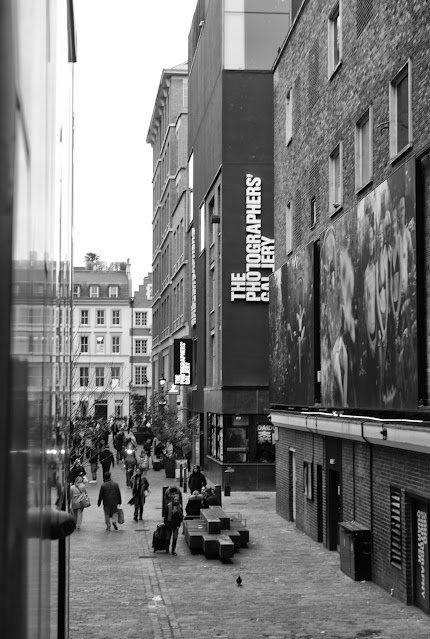 |
The Photographers Gallery, lurking off Oxford Street, London
|
After the square and feeding myself on a traditional German bratwurst served by an Indian with a London accent, I was not really sure what to do with myself. I decided to head for Oxford Street, in the classic faith over experience moment that I could do some late Christmas shopping. As I perused the satnav, I noticed I would be passing by
the Photographers Gallery. This is the only really true photographic gallery in central London, so it seemed the perfect place to head for.
The gallery had an exhibition by a Japanese photographer,
Daido Moriyama. In many ways, it was very much the antithesis of the NPG, with stark, heavily contrasted, black and white images, with no clear link or subject. Many of the images were brutal of people like sex workers and were often uncomfortable viewing, and again were the direct opposite of club photography, where the desire seems mainly to create images with the minimum of conflict.
Daido purpose seems to be an attempt to deconstruct photography to an almost minimalist state. Although unsettling, I greatly enjoyed the exhibition. I am planning to go to Japan in 2024, and I was fascinated that, although native Japanese, Daido seem to take the same fascination in Japanese idiosyncrasies that I do. It felt like a very western view of Japanese culture.
 |
You are not in camera club land any more
|
 |
All your analog needs...
|
Finally..
So, how was my Christmas present?
I really enjoyed the NGP, but more importantly, I enjoyed the opportunity of taking it at my own pace. Even more so, the photographer's gallery. I would not inflict this on my family, but I savoured the opportunity to peruse at my leisure
The more important question was what did I come out of it? Well, a better appreciation of the art of the portrait, some nice street photographs and a new view of Japan.
More critically, I came away with a stronger realisation that you take photographs for yourself. Whether someone else likes them is a bonus; the most important thing is that you yourself know you did the best job you could
I'll leave you with a few more images that I took that day
Happy Christmas 2023
 |
The eyes have it. King Charles III and Malala Yousafzai together
|
 |
Marge Wallis Simpson
|
 |
An example of how a photograph can misrepresent a character. This man could be anyone's grandad, but was responsible for multiple massacres in the West Indies
|
 |
Murderous sociopaths - the very definition of Christmas
|
 |
The last supper
|


