Showing posts with label Landscape. Show all posts

Saturday, 22 January 2022

The Iron Giant


My wife and I have our differences over sunrises. My wife assumes that a decent sunrise is a predictable event, while I know from practice that whatever the forecast says, there is no true way of evaluating a sunset other than looking out the door well before the sun has risen. Even then I have driven miles in the dark only to find cloud has rolled in obscuring the sun.

This in turn creates conflicts,  since she expects at least 48-hour notice for any photography trips, while I generally don't always know whether it's worth going out till the morning in question.

The other problem is she frequently asks why, if I am going out, why she could not come. Apart from the fact, I am an unsociable bugger when in photographic mode, sunrises by their very nature are early in the morning. I find I can get out of the house in about 15 minutes, my wife's record is about  an hour. 

However, sunrises won't wait, and typically you want to be there an hour before the sun rises above the horizon. To be honest, I'm not great about this either. A combination of laziness, inertia, lack of confidence can stymie your efforts to get out the door at an ungodly hour, or set off too late and then kick yourself as the sunrise of sunrises occurs while you are still driving to your destination. (alternatively, you can do what I did once and arrive 2 hours too early and have to kick your heals in pitch blackness)

I bring this up because I did actually manage to get out for the sunrise today. 

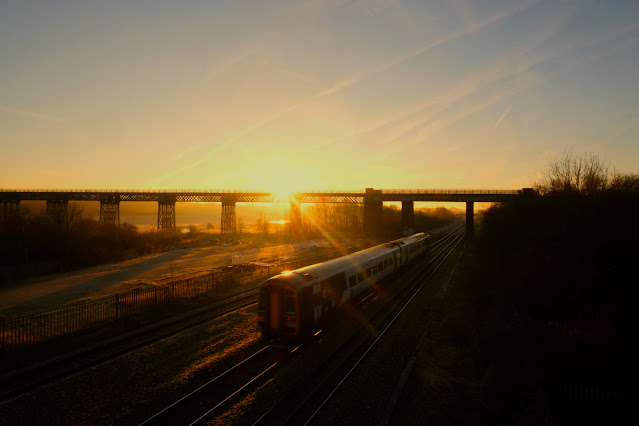
I have been planning this trip for a few weeks. My target was Bennerley viaduct near Ilkeston, about a 20-minute drive and because we are basically still   in winter, it meant that I could get going at a reasonable time.

This blog post is not about sunrises however but Bennerley viaduct and the possibilities to the photographer

The Iron Giant

Bennerly viaduct is a disused railway viaduct spanning the Erewash Valley between Awsworth (Nottinghamshire) and Ilkeston (Derbyshire) in central England. It was built in 1877 but closed to rail traffic in 1968.

Unlike most viaducts, it is built from a lattice of ironwork, making it appear as a giant spider web. The reason for this is it is built over an area of coal mining subsidence, so need greater flexibility than a brick built structure could offer. 

In truth, it is amazing it has survived at all. It managed to survive Zeppelin attacks in the 1st world war, and the bombing of the 2nd, together with the more serious government attacks via the Beeching cuts in the 1960's. The only reason it survived then was due to its construction methods, it was deemed too expensive to demolish and for many years lay isolated. As such, it is almost the only surviving example of this sort of bridge and certainly the most accessible.

 That is until a concerted effort was made by local people to restore the viaduct and convert it into a cycling/walking path. The Friends of Bennerley Viaduct was set up to fundraise and manage this. 

When I first visited in 3 years ago, the bridge itself was still off limits, and access was not clear. However, just this month (Jan 2022) it was announced that the bridge was open to visitors. As a result the 1452 feet long viaduct rising 60 feet above the Erewash river is now open to all and I felt it was time to investigate the site more fully.

Perils in the dark

To plan my visit, I checked the photo ephemeris site to check which direction the sun would appear. Then I had to work out from Google maps whether I could get to where I wanted to go and how.

One of the challenges of visiting a new site for a sunrise is that you will be stumbling around in the dark with no real idea how to get where you want to g   It appeared that there was an area of waste ground  behind the site that would provide the best angle to catch the sun, but although google maps is fantastic it would not tell me whether the pathway shown was open or how to get to it. I would just have to hope for the best.

When I woke up, and looked outside my window, the sky was clear. While this was good, I was hoping for a bit of cloud, but part-time snappers cannot be choosers, so creeping out of the house, and into the car, it was a quick jaunt up the M1 and I arrived at least an hour before sunrise.

As I said, I had no idea of how I was going to get to the viaduct and first signs were not hopeful, facing a low gate with a danger "construction traffic" on it. Assuming that this was a hangover from the reconstruction work I climbed under it and set along a wide paved path that I hoped would take me to my target (It was only when I got back to the car in daylight, I found a full functional path next to it)

The path to the viaduct itself was easy, despite the dark. The next challenge was that I had to cross the river Erewash to get to waste ground on the other side. On Google Maps it seemed to show a bridge, however what it did not show was a substantial gate across it. Initially, it looked like I would have to clamber over it, until I noticed that a large amount of the wire netting had been removed, allowing me to easily duck under it.

Why here?

So why did I want to photograph this bridge? Well, firstly, I love a new location and the new access offered a number of possibilities. Sitting in the middle of the Erewash valley with no buildings nearby, it allows you to explore the angles with little compromise.

Also being a lattice structure, it allows the light through. My hope was that I could photograph the sun through the lattice as it rose

As it was, I spent a period of time trying out different angles. One of the things I loved was the way it seemed to tail off into the distance, creating a Lacey ribbon in the sky.

One thing I quickly realised was that the sun through lattice effect was going to be challenging because the sun would need to rise above some low hills, meaning I needed to be higher. A drone would be perfect in this situation, and I am sure that this will be a major destination for drone photographers in the future. However, not owning one I had to do something else


Viaduct in the blue hour


As the light grew, I noticed a pedestrian walkway over the nearby rail line, which would give me some needed height. I decided therefore to try there. The next challenge was to find it in the dark, which I eventually managed. This gave me a higher angle, so I could capture the sun well before ground level.

One of the things I tried was to capture the silhouettes of joggers and cyclists on the bridge to provide scale. Even this early there was a lot of traffic, which is a testament to the success of the project.


An early morning walker crosses the bridge

Yes, its a train. Get over it  


One advantage, being up high, was that I now had more time to explore the viaduct, so I worked my way down and tried to find the entrance. I later found that I could have continued over the walkway and followed the canal to the entrance ramp, however instead I headed across the waste ground to find the East path. 

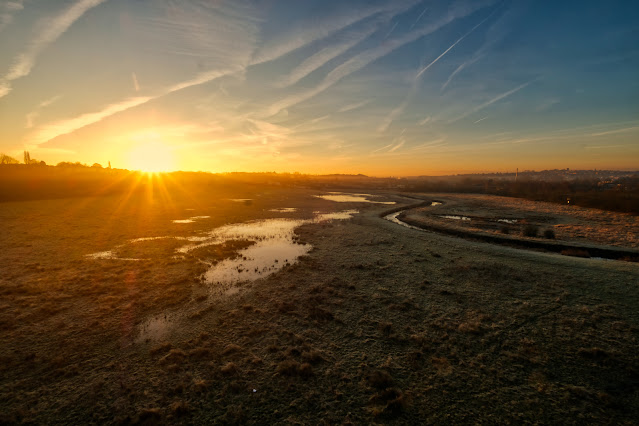
From the viaduct you are afforded fine views of the Erewash valley, and it would be great to come back on a misty day


View from a viaduct

The Erewash valley

Conclusion

One of the joys of photography is finding new locations. Bennerley offers a lot both in the structure itself, the location and historical perspective.

It will definitely be on my photography location list and  I recommend anyone in the area to have a look

Being in the open affords good access for landscape photographers and sunrises and sunsets shots should be possible, although check the sun angles before hand.


Information

Bennerley viaduct is located between the Erewash Canal and the disused Nottingham canal

Parking can be had at the Newton Lane Car Park, Awsworth Road, Ilkeston 

To access the area underneath the bridge, there is a path from Awsworth road, where you can also access the railway crossing

Access paths are pretty good, with only a bit of scrambling to reach the Northside of the bridge.




Tuesday, 29 December 2020

Return to Spurn point


In the summer of 2019, I made a journey out to Spurn point near Hull, which is pretty well the closest coastline to where I live. It was a long journey, made early in the morning, in order to catch the sunset, a task I pretty well failed to do.

In retrospect however I did enjoy my time there, but somehow as a photographer, I felt I had left something on the table. I had not really made the best of the opportunity, and felt I really needed to go back.

So this year I decided to go again. Instead of summer, this time it would be autumn, meaning I did not need to get up so early, and hopefully the skies would be more conducive for photography. I also hoped to catch some of the autumn bird migrants making their way from Scandinavia to the east coast. 

Of course this was 2020, so one complication would be that the UK was still under Covid restrictions, and I had to be mindful to ensure I stayed isolated and be aware that there maybe be little in amenities.

For the trip I had a few new pieces of kit. Firstly I had a variable ND filter, which I hoped to use to take long exposure sea shots. I had my new 85mm lens, which I have really fell in love with due to its shallow depth of field and sharpness. Finally, I had got 2nd hand Fuji XT-10 converted to IR. This had replaced my full spectrum A-6000, with the benefit that it could use the batteries and lenses from my XT-2. October is not a great season for IR photography, but I took it along anyway

Go East

The journey itself was uneventful. I am always a little wary of long car journeys early in the morning, but the time ticked by quickly on the motorway journey to Hull, then it was a case of winding my way through the lanes that connect Hull to the point itself. 

I arrived in total darkness, in an empty car park, and I set about getting my kit together. Unlike last time I made sure I had both hat and water on me.

 One decision was whether to take my long 150-400mm lens, or come back for it later. In the end I decided to take it, since if I decided to head on, I would have it with me. Also, I was hoping to see large flocks of knots on the shoreline that often congregate at this time of year creating spectacular patterns in the sky as the wheel about.

As befitting the implicit rules of photography, because I had arrived in plenty of time for sunrise, the sun did not really appear, as I started to walk along the beach.  I decided to head up the beach. Despite the low cloud, it was a remarkable pleasant day for October and it felt as if I had the beach to myself. Despite the lack of spectacular sunrise, there was a bit of colour in the sky above the cloud. I took a few shots along the beach, with the dark sand contrasting the sky, and the rocks jutting out like dinosaurs bones


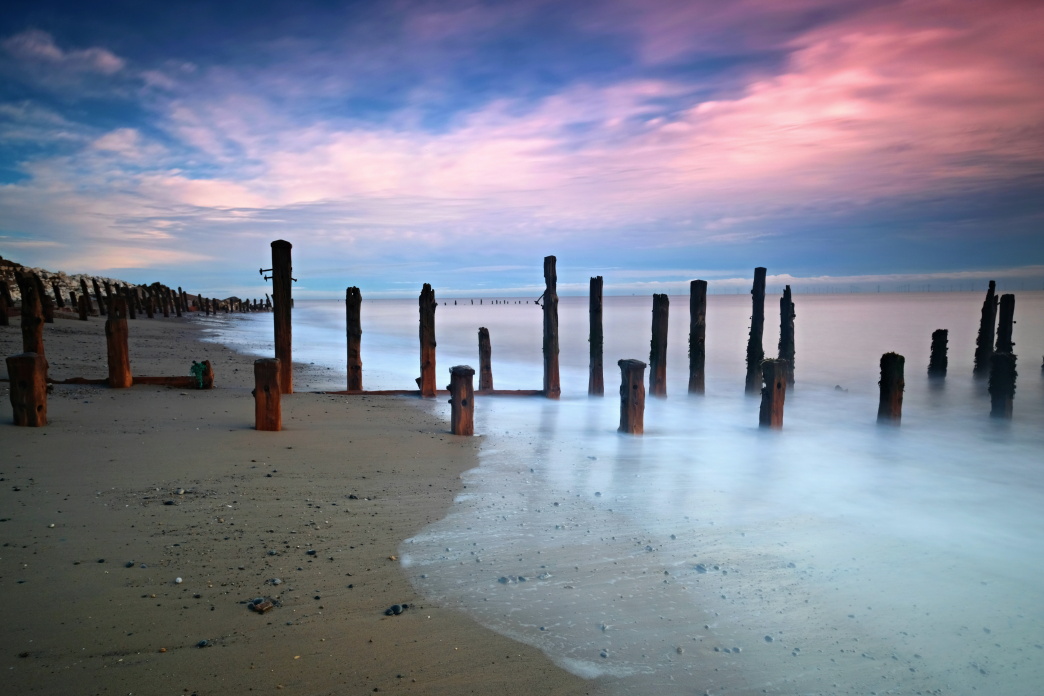
My main plan was to take some long exposures of the groynes as the tide went out. One of the reasons I had chosen this day, was that high tide would coincide with sunrise.

I had just set up the camera for some long exposure shots when another guy with a camera, ambled up to me, totally ignoring social distancing as I hurriedly backed away. Apparently he was a portrait photographer from Hull, who decided to do pretty well the same as me. Actually we had a nice chat and would bump into each other most of the day. Saying that the beach, this far from the car park was pretty well deserted.


Although my main intention was taking landscape photo's I also hoped to take some bird photo and as I wandered up the beach line, small flocks of knots flew ahead of me. It was not the large masses that I had hoped such as they got at Snettisham , further down the coast, nor the size I had seen at a previous visit, but still I had a chance to get some movement shots of these fascinating little clockwork birds. I hoped to take more I came back, but as I returned, the flocks seem to have departed meaning these were the only shots I got.


A seal of approval

Nor was the only wildlife I saw that day. As I travelled down the shoreline I saw what I assumed was a seal carcass, up against the dunes. As I got closer I realised it was in fact alive, and I wondered whether it was injured, but it seemed healthy. I was not really sure what to do in this situation. I always mindful in these situations that such animals are not pets, but wild animals and need to be treated with respect. Nor did I want to stress it out or cause it to panic. As it was we stared at each other for a few minutes, like some adolescent boy coming across a foreign topless sun bather, until we came to an understanding that I was going to respect its personal space, and it would be happy to have a few images.

After a while I moved off, and I spied it shuffling back into the sea, belying any idea of injury. Obviously like me, it had just wanted some beach time, and had now decided the sand was getting a little too crowded and was off to find a quieter spot. For me however it was a fantastic encounter of an animal I had never had the privilege to meet so close.  


Flotsam and Jetsam

One of the things that I had realised from my last trip was that there were lots of small objects around the beach, which were worthy of photographic interest. This time I took more note, and noticed the beach had large amounts of discarded fishing gear, such as nets, lobster pots. While an ecological time bomb and environmental eyesore, the bright colours of the synthetic rope contrasted against the brown hues of the beech. Also, an old fence post, battered in exposure with the North Sea also provided some interesting subjects. I use largely my Viltrox 85mm for this. Since I acquired this lens, it has become a firm favourite, with the ability to create photos with sharp and narrow focus with lovely bokeh proving great for this sort of detail work.


A kick in the groynes

As usual my target was the lighthouse which stands out at the end of Spurn head. Last time I was annoyed that after walking so far I had not made the final few yards and gone up the lighthouse which is now a visitor centre. This time I made it, only to find it was closed due to the ongoing health crisis. Anyway I sat down to have a quick snack, only to find I had added a little jetsam myself by dropping my plastic water bottle somewhere on the beach. Fortunately it was not as hot as last time, so I was not as struggling, but it was irritating.


As I started the walk back along the old coast road, I found I was struggling. I have been suffering for a little while with a heel injury (technical name - Plantar Fasciitis or old man foot as I call it). On the beach it had not been a problem, but on the road it was painful, making progress slow. I was also tired, and in truth the road view is not as stimulating as the beach. However, to entertain me an RAF A400M was doing training sweeps over the head and for a while I did a few shots as it flew. 


The journey back to Spurn car park always seems to take much longer than the outward journey, so I was pleased when I could leave the coast road and join the beach again. It was full daylight by now, and I sort of assumed that any long exposure would be pointless, but it seemed a good opportunity to try my new variable ND filter. Unfortunately another photographer had exactly the same idea and there was a sort of lazy, casual foot race to cross the uncovered rock pools to the nearest groyne, a race I lost, so I had to move down the beech to a less promising area. 

However, even given that I spent a happy 30 minutes taking shots of the water moving in and out. As is my wont, after a while I got bored with the classic shots and added a little ICM. Pleased with the results I tried the same thing as I walked along the shoreline. Not classic landscape shots, but I really like the results because it implies the movement of the sea


Eventually I got back to the car park at 2 o'clock, only to find it jam packed with cars. Spurn is a very popular bird watching spot, and there were groups of twitchers wondering around carrying telescopes the size of small drainpipes. I toyed with the idea of joining them, but I decided I really was not in the mood, so I packed my kit away and went to snaffle a bacon sandwich from the Yorkshire wildlife centre, which despite the pandemic was still open.

With the sandwich and coffee in hand I hobbled off to the coast edge, and sat on a bench to breath in the view. I nodded to an ageing birdwatcher who was scanning the sea line for birds, who then ambled off. Just five minutes later a short eared owl, the 1st I had ever seen in the flesh, swooped into the grass only 10 yards away, before flying off surrounded by an entourage of crows who had taken exception to its presence. 

Of course, I had no camera on me to record this encounter, but it reminded what I love about Spurn head. It is always throwing surprises, usually when  you least expect it.

Reflection

So did I get what I wanted out of this trip? I believe so, certainly more so than my first trip. I am always in awe of people who can rock up to a location, see the shot they need and perfectly execute it.

I have found repeatable I just cannot do that. To get the best out of a location I need to connect to it and I cannot do that in a day. As a part-time photographer one of the frustrations is that I often don't feel I have the time to just sit and judge the character of a scene. Therefore, my images are often too random, tacking a plethora of shots, rather than focusing on the best one.

To revisit a location like this is a luxury and a welcome chance to reflect on a landscape and get the images that truly shows how I see it. I can't wait till the world returns to normality, and I can visit again