Showing posts with label Spurn Point. Show all posts

Tuesday, 29 December 2020

Return to Spurn point


In the summer of 2019, I made a journey out to Spurn point near Hull, which is pretty well the closest coastline to where I live. It was a long journey, made early in the morning, in order to catch the sunset, a task I pretty well failed to do.

In retrospect however I did enjoy my time there, but somehow as a photographer, I felt I had left something on the table. I had not really made the best of the opportunity, and felt I really needed to go back.

So this year I decided to go again. Instead of summer, this time it would be autumn, meaning I did not need to get up so early, and hopefully the skies would be more conducive for photography. I also hoped to catch some of the autumn bird migrants making their way from Scandinavia to the east coast. 

Of course this was 2020, so one complication would be that the UK was still under Covid restrictions, and I had to be mindful to ensure I stayed isolated and be aware that there maybe be little in amenities.

For the trip I had a few new pieces of kit. Firstly I had a variable ND filter, which I hoped to use to take long exposure sea shots. I had my new 85mm lens, which I have really fell in love with due to its shallow depth of field and sharpness. Finally, I had got 2nd hand Fuji XT-10 converted to IR. This had replaced my full spectrum A-6000, with the benefit that it could use the batteries and lenses from my XT-2. October is not a great season for IR photography, but I took it along anyway

Go East

The journey itself was uneventful. I am always a little wary of long car journeys early in the morning, but the time ticked by quickly on the motorway journey to Hull, then it was a case of winding my way through the lanes that connect Hull to the point itself. 

I arrived in total darkness, in an empty car park, and I set about getting my kit together. Unlike last time I made sure I had both hat and water on me.

 One decision was whether to take my long 150-400mm lens, or come back for it later. In the end I decided to take it, since if I decided to head on, I would have it with me. Also, I was hoping to see large flocks of knots on the shoreline that often congregate at this time of year creating spectacular patterns in the sky as the wheel about.

As befitting the implicit rules of photography, because I had arrived in plenty of time for sunrise, the sun did not really appear, as I started to walk along the beach.  I decided to head up the beach. Despite the low cloud, it was a remarkable pleasant day for October and it felt as if I had the beach to myself. Despite the lack of spectacular sunrise, there was a bit of colour in the sky above the cloud. I took a few shots along the beach, with the dark sand contrasting the sky, and the rocks jutting out like dinosaurs bones


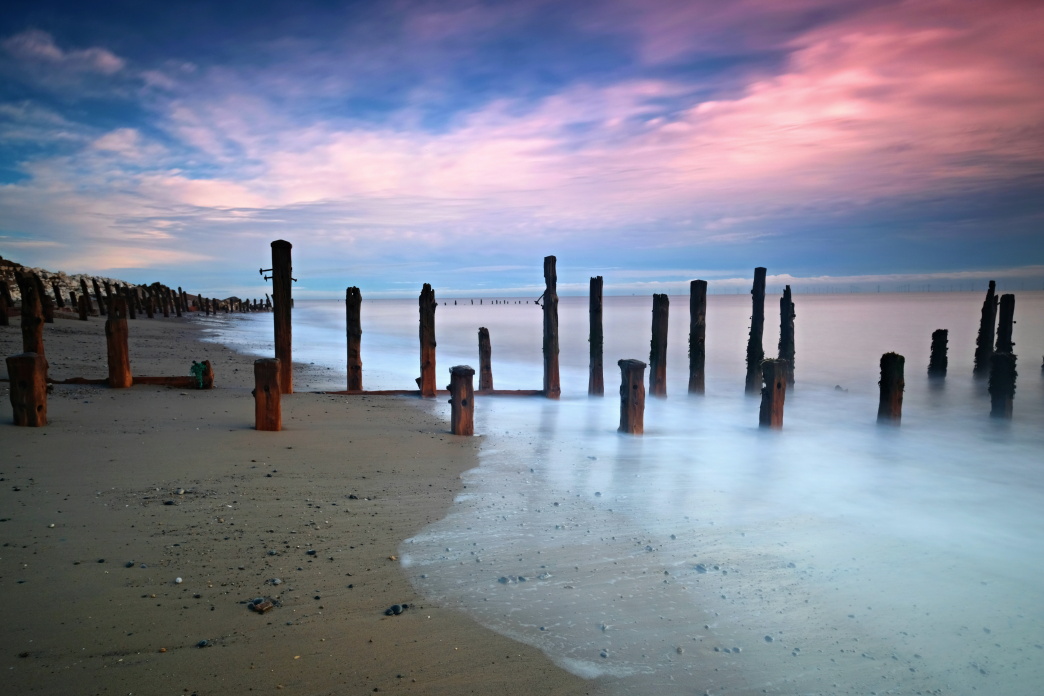
My main plan was to take some long exposures of the groynes as the tide went out. One of the reasons I had chosen this day, was that high tide would coincide with sunrise.

I had just set up the camera for some long exposure shots when another guy with a camera, ambled up to me, totally ignoring social distancing as I hurriedly backed away. Apparently he was a portrait photographer from Hull, who decided to do pretty well the same as me. Actually we had a nice chat and would bump into each other most of the day. Saying that the beach, this far from the car park was pretty well deserted.



Although my main intention was taking landscape photo's I also hoped to take some bird photo and as I wandered up the beach line, small flocks of knots flew ahead of me. It was not the large masses that I had hoped such as they got at Snettisham , further down the coast, nor the size I had seen at a previous visit, but still I had a chance to get some movement shots of these fascinating little clockwork birds. I hoped to take more I came back, but as I returned, the flocks seem to have departed meaning these were the only shots I got.


A seal of approval

Nor was the only wildlife I saw that day. As I travelled down the shoreline I saw what I assumed was a seal carcass, up against the dunes. As I got closer I realised it was in fact alive, and I wondered whether it was injured, but it seemed healthy. I was not really sure what to do in this situation. I always mindful in these situations that such animals are not pets, but wild animals and need to be treated with respect. Nor did I want to stress it out or cause it to panic. As it was we stared at each other for a few minutes, like some adolescent boy coming across a foreign topless sun bather, until we came to an understanding that I was going to respect its personal space, and it would be happy to have a few images.

After a while I moved off, and I spied it shuffling back into the sea, belying any idea of injury. Obviously like me, it had just wanted some beach time, and had now decided the sand was getting a little too crowded and was off to find a quieter spot. For me however it was a fantastic encounter of an animal I had never had the privilege to meet so close.  


Flotsam and Jetsam

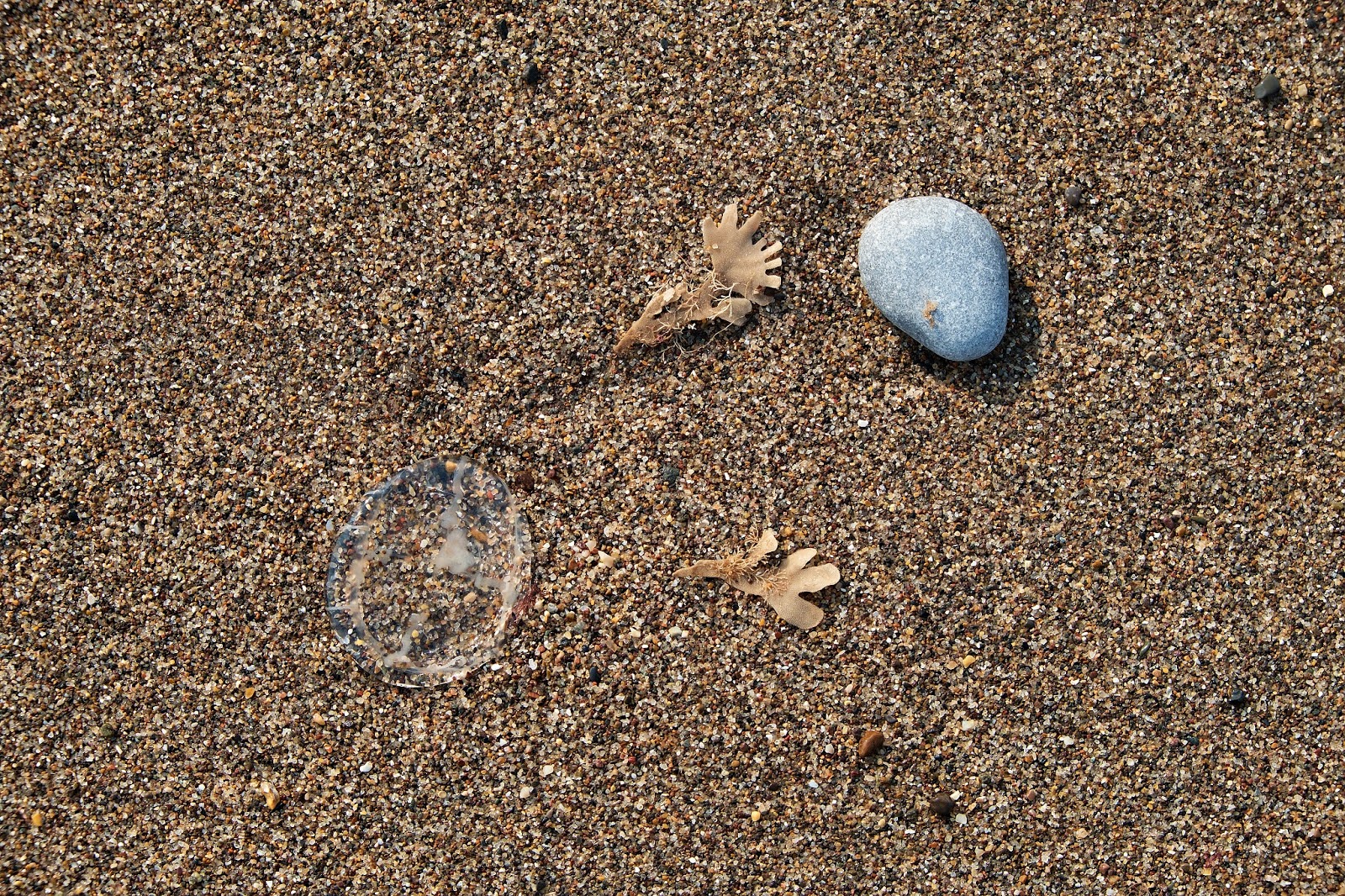
One of the things that I had realised from my last trip was that there were lots of small objects around the beach, which were worthy of photographic interest. This time I took more note, and noticed the beach had large amounts of discarded fishing gear, such as nets, lobster pots. While an ecological time bomb and environmental eyesore, the bright colours of the synthetic rope contrasted against the brown hues of the beech. Also, an old fence post, battered in exposure with the North Sea also provided some interesting subjects. I use largely my Viltrox 85mm for this. Since I acquired this lens, it has become a firm favourite, with the ability to create photos with sharp and narrow focus with lovely bokeh proving great for this sort of detail work.


A kick in the groynes

As usual my target was the lighthouse which stands out at the end of Spurn head. Last time I was annoyed that after walking so far I had not made the final few yards and gone up the lighthouse which is now a visitor centre. This time I made it, only to find it was closed due to the ongoing health crisis. Anyway I sat down to have a quick snack, only to find I had added a little jetsam myself by dropping my plastic water bottle somewhere on the beach. Fortunately it was not as hot as last time, so I was not as struggling, but it was irritating.


As I started the walk back along the old coast road, I found I was struggling. I have been suffering for a little while with a heel injury (technical name - Plantar Fasciitis or old man foot as I call it). On the beach it had not been a problem, but on the road it was painful, making progress slow. I was also tired, and in truth the road view is not as stimulating as the beach. However, to entertain me an RAF A400M was doing training sweeps over the head and for a while I did a few shots as it flew. 


The journey back to Spurn car park always seems to take much longer than the outward journey, so I was pleased when I could leave the coast road and join the beach again. It was full daylight by now, and I sort of assumed that any long exposure would be pointless, but it seemed a good opportunity to try my new variable ND filter. Unfortunately another photographer had exactly the same idea and there was a sort of lazy, casual foot race to cross the uncovered rock pools to the nearest groyne, a race I lost, so I had to move down the beech to a less promising area. 

However, even given that I spent a happy 30 minutes taking shots of the water moving in and out. As is my wont, after a while I got bored with the classic shots and added a little ICM. Pleased with the results I tried the same thing as I walked along the shoreline. Not classic landscape shots, but I really like the results because it implies the movement of the sea


Eventually I got back to the car park at 2 o'clock, only to find it jam packed with cars. Spurn is a very popular bird watching spot, and there were groups of twitchers wondering around carrying telescopes the size of small drainpipes. I toyed with the idea of joining them, but I decided I really was not in the mood, so I packed my kit away and went to snaffle a bacon sandwich from the Yorkshire wildlife centre, which despite the pandemic was still open.

With the sandwich and coffee in hand I hobbled off to the coast edge, and sat on a bench to breath in the view. I nodded to an ageing birdwatcher who was scanning the sea line for birds, who then ambled off. Just five minutes later a short eared owl, the 1st I had ever seen in the flesh, swooped into the grass only 10 yards away, before flying off surrounded by an entourage of crows who had taken exception to its presence. 

Of course, I had no camera on me to record this encounter, but it reminded what I love about Spurn head. It is always throwing surprises, usually when  you least expect it.

Reflection

So did I get what I wanted out of this trip? I believe so, certainly more so than my first trip. I am always in awe of people who can rock up to a location, see the shot they need and perfectly execute it.

I have found repeatable I just cannot do that. To get the best out of a location I need to connect to it and I cannot do that in a day. As a part-time photographer one of the frustrations is that I often don't feel I have the time to just sit and judge the character of a scene. Therefore, my images are often too random, tacking a plethora of shots, rather than focusing on the best one.

To revisit a location like this is a luxury and a welcome chance to reflect on a landscape and get the images that truly shows how I see it. I can't wait till the world returns to normality, and I can visit again


Monday, 24 June 2019

Spurn Point

Spurn Point


Unless you have like me,  lived in the Midlands for most of your life you probably won't understand the attraction the sea has. I am sure that if you have live on the coast, you can get blase about the ocean, but I on the other hand are fascinated by the sea and I am never happier than when I am sitting on a dune, eyes closed, listening to the breakers roll in.

It was one of  those rare days where I found that I had a whole day on my own and with no pressing jobs or other distractions that I could therefore devote to photography.

So where to go? 

Obviously I could only get so far  in a day and usually I would head to the peak district, being only an hour up the road, but I felt I wanted to be a bit more adventurous, so I decided I would head to the coast.

This presented an issue. The nearest coast is probably the Wash, but I do not know it well and it is not the most photogenic of places, plus the roads to get there are actually quite poor meaning that although close in miles it was actually a long way in terns of time. Alternatively there was North Wales where access was better but I had no idea where to go and no time to find out.

I decided therefore to head for Spurn point. Spurn point is that bit of land jutting into the North sea that looks like giant bogie hanging from the bottom of Hull. The majority of the journey is via motorway, and I had been there before once before on a bird watching trip and I remembered an area of sand dunes, rich with birds and other wildlife. Being on the east coast I wanted to get there for sunrise and this meant starting start off by 3 a.m, for a 6 o'clock start.

Apart from talent, one thing stopping me doing better at landscapes is that I am not really a morning person, therefore this would be a challenge. However I prepacked everything I needed (check camera 4 times!), decided that I would forgo my normal breakfast and shower routine and made sure all I needed to do is roll out of bed and into the car.  This was just as well since the alarm clock did not go off on schedule, and I awoke at 3:30, meaning I was already 30 minutes behind schedule.

"Bugger" I thought

The worst thing about waking up and then getting into a car at that time in the morning, is that your senses are not fully awake. Driving is a sort of surreal experience as your brain tries to confirm whether you are actually awake or whether this is just some sort of anxiety dream. It is fortunate that there is not much danger of hitting anyone at that time in the morning since it took me at least 20 miles before I was fully awake.

The next issue was that the quickest motorway route towards Hull was closed overnight and my sat nav had therefore sent me on a 20 minute diversion. I actually did not realise this until I found myself coming up to the pylons of the Humber Bridge. It meant that I was now 50 minutes behind schedule and it was already getting light as I worked my way through Hull. Still, on the map it seemed like I did not have far to go. Unfortunately as I exited Hull, the dual carriage ways were replaced by small winding lanes meaning that progress reverted to a seeming crawl.

It soon became clear that I was going to miss the sunrise. Still, I consoled myself , it was probably not going to be that good anyway. This illusion was quickly shattered as I crested a small hill and was greeted by a giant orange ball, just burning off early morning mists.

Double bugger.

I had a dilemma. Try and find a place to stop and take photos , or carry on. I decided to push onward, but about 10 miles from my destination I gave up and parked next to a abandoned caravan park where I managed to capture some images of the sun rising behind an offshore windfarm.

An almost perfect sunrise - just 30 min too late


I eventually arrived 10 minutes after sunrise and I grabbed my camera bag and tripod and made my way to the coast in the hope catching its last throws . On the way I passed another photographer coming back clutching his Nikon P9000. "Just missed a great sunset" he said as I passed him. "Yeah, but at least I've got a real camera", I wished I had said as I stumbled over the dunes. It was clear that the memo had arrived to all other photographers in the area which said  "Ok, chaps Tony is already feeling pretty bad about bollocking up his day, so lets make sure we kick him in the nuts when he gets here to make his day complete"

Still, I was here and the morning was still fresh, the ocean was calling  and I had the whole day to play with, so what to do?

Here I made a mistake. I should of gone back to the car, got some coffee and decided on my next course of action. Instead I wondered up beach to Spurn point itself.

IR image of the sea defences


You cannot actually drive very far up the Spurn headland and it is off limits to all public vehicles. One change that occurred since I was last there was that the old roadway has been washed away in parts and on some high tides is actually cutoff. Presumably one day it will become Spurn island. The only way to get to the end is to walk or cycle, However as I trudged off I neglected to pack a hat or water, something I was about to regret.


There were some great detail shots to take. I regret not taking more of them


My first plan was to take pictures of the groynes as the tide went out using long exposure. However it was clear that it was already too bright, even with a 10 stopper to get a long exposure. I therefore took images of details on coast details as I walked further down the coast. In hindsight, I should of perhaps concentrated on this, but instead tiring of the trudging on soft sand I headed inland to the coast road and onward to the end of the spit.


As I did I trudged down the road,  I was surprised to see a deer watching me from the dunes. I would of thought that seagrass and lack of freshwater would stop deer living there, but apparently they are quite common.

The deer was as surprised to see me as I was to see it


Spurn point is pretty flat and therefore the old lighthouse stands out. It is now abandoned but can be used as a viewing platform so I headed towards it.  After a long walk I arrived there and I tried taking a few images on the beach trying to use the reflections of the tidal pools. I had also bought my IR converted A6000 , but the big problem was there was absolutely no cloud. Even one. would of provided some background, but it was one of those rare UK days where the sky was empty. This meant the IR shots dis not really work. In fact anything with the sky in was problematic.


Spurn Light House

What I would of done for a few clouds


I sat down just below the lighthouse and realized it was 8 O'clock in the morning and I had been going for 5 hours, with nothing to eat and drink. It was also getting very hot, and I neither had suncream or a hat . I therefore decided to head back to the car, forgoing the trip to the top of lighthouse and lifeboat station, telling myself that I would comeback after breakfast.


However the walk back took a lot longer than I expected and it became obvious that I had walked a lot further than I realized. The road was rapidly subsumed by sand, making walking it a lot harder and by the time I got back to the car park I was pretty shattered.  I grabbed breakfast, coffee and some water and headed to the beach where I sat on the sand dunes closed my eyes and dozed for a while to the sound of the surf.


By this point, it was almost noon and the beach was getting busy with fisherman and dog walkers. In hindsight I should of gone back down the beach looking for more beach details, but instead I decided to see what birds I could see. One of my memories of Spurn Point in my visit before was the richness of bird life. This mainly occurs during the spring migration season since Spurn sticks out into the North sea and is often the first landfall of birds travelling north to south in Spring. When I was last here I remembered vast flocks of knot wheeling out to sea, plus firecrests, waxwings.  However this time of year,  it was way past the main migration time and the tide was a long way out, meaning things were quieter. 

Got a few wildlife shots like this Kestrel, but generally pretty disappointing


Curious sheep - in IR

I don't have a native long lens for my Fuji,  so I had decided to try mounting my Sony Tamron 150-600 via an adapter and manually focus it. However I had not bought a monopod, meaning I would have to carry the lens on a strap. I headed down to the  nearest hide, and took images of a pair of dab chicks on the water, then headed across the sea path to Kilnsea looking for sea birds.

Carrying the long lens was actually quite tiring and the light was harsh. I went to a few hides, but there were not many birds and around. However I took a few shots but when I later reviewed the images, I was disappointed by the combination of manual focusing and no stable platform producing really no worthwhile images.

I considered wondering up the point again, but to be honest I was pretty shattered by this point so I stopped at the rather good visitor centre and had a bite to eat and a drink and after wondering up the road some more decided to call it a day. However on the way back I made a diversion at the Humber bridge, for a few shots

Lessons Learned

This in many ways was an experiment in whether I am capable of getting up in time to do serious landscape photography. In a way it was a success. I got up, drove for 2 hours and almost got their in time. However I was not expecting how bad my decision making would be that time in the morning. If I had been more awake I would perhaps made better photographic decisions and made sure I had things like water and sun hat on me. 

I now realise that there were shots I could of got, especially of beach details. It is also a good lesson on how essential clouds are in landscape photography. The lack of any cloud cover meant that the photos would always  be mediocre and in situations like this you should try and find images that do not rely on the sky. 

Spurn Point as a photographic location


So is Spurn point worth visiting as a photographic location?


Potentially yes.

It is relatively accessible and it certainly has the features like breakwaters, groynes etc, plus other features like the lighthouse. The tide does come in a long way and the south side on the Humber mouth is more of amud flat and is not as scenic as the North. You need to be aware of the tide tables, and since it is on the East coast, you will need to be there at Sunrise. The best time to go is probably early Spring, when the Sunrise is at a more civilised time and birds are migrating.

Be prepared for a long walk to the end of the point from the Car Park and be aware that high tide can cut you off. In truth, a bike would be a far better method of getting around.

I would love to go back again, and take pictures of some of the more structural details. This time however I would remember to take water and a hat with me.


Humber Bridge (a short history)


Some may not know much about the Humber bridge, so here is a short potted history.

The Humber bridge is a suspension bridge across the River Humber connecting Hull on the North side with Grimsby on the South. When it was built, it was the longest suspension bridge in the world(It is now number 10). As a architectural marvel, there is still little to beat it in the UK (You could contend that the Forth crossing is more attractive), however as an economic investment, it has been a flop.

The idea at the time seemed a valid one.  Build a bridge that would connect the North and South of the Humber, so avoiding the long drive up and around the Humber or the Humber ferry. However whoever proposed it failed to notice one point. Most of the traffic from Hull and Grimsby goes to cities like Sheffield or Manchester. To do this you go West. Even going to London it makes more sense to head West to the M1, then head South. Ironically the motorways built to connect both the North and South of the bridge provide excellent connections to the M1 motorway so removing the much of the potential bridge traffic.

The only people who benefited from the bridge were people living on the East coast, wanting to transit between Hull and Grimsby or head to the East coast towns. Problem is that there is little industry here and both Hull and Grimsby are very different places economically. So while the bridge is great if you live in Hull and want to visit your cousin in Grimsby, there is little  benefit for freight traffic.

Initially even  those who did want to travel, could be put off by the high toll charges required to recover the investment. In an attempt to encourage traffic, the toll is now about a £1 but it is hard to see how this can covers even the cost of the toll operators, never mind the bridge maintenance cost. It also appears to have made little difference to the traffic numbers.

 Still, despite being a white elephant, it is still worth visiting and going over. There is a visitor center on the North bank, but most park on the Northern foreshore, under the bridge itself. There you can get great views of the grey ribbon stretching over the Humber