Friday, 3 June 2022

4 lessons for being a wedding photographer


If I was going to make a list of the world's most stressful jobs, it would go something  like this

1. Surgeon
2. Secondary School Teacher
3. Wedding photographer

Number 2 and 3 may surprise some people, but they both had the same elements in that they require a high level of responsibility over events that they have little control. For example, most parents expect teachers to get little Tarquin to Oxford independently of their ability or desire to work. Wedding photographers have a similar combination of factors in that they are made responsible in creating an image perfect record of a couple's most important day, at an event that may have little control. If they make a mistake, there are no do-overs, no repeats, they are just left with the online trashing and hate of all the parties involved. No landscape photographer ever had a tree publicly scorn them because they did not capture them on their day of full bloom.

I am always been in awe of wedding photographers and the level of responsibility that they take on, especially since relatively you don't really make much money out of it. It used to be a wedding photographer could eke out a reasonable living, but with digital, covid and the fact everyone has a smartphone it must make it a tough gig. I mean, at least a surgeon makes a bit of cash for their skills, while a wedding photographer is looked down on generally as an unwanted expense.

Even saying that, I have always wanted to have a go at wedding photography. I guess it is because it is in my mind the pinnacle of the event genre, and I wanted to see if I could rise to the challenge. So when my niece announced she was getting married, I hoped that I might be asked to take the photos.

However, no call came in, and I must admit this hurt a bit (it was almost as painful as when the church bought a photo from someone else for the Christmas card image). I mean wasn't I the person renowned for hanging around family do's recording them for posterity? Wasn't  I that person who hounded her through her teenage phase trying to get an image of her despite her best attempts not to be caught? 

There was however no malice in the snub. The wedding had been organized on what could be called the anarchic principle, or the so-called field of dreams concept as in if you set a date something would happen. Basically, it was assumed that people would bring cameras and something good would come out of it.

The second issue was I was not actually invited to the wedding ceremony. Again I hasten to add this was not because I had fallen out with the family or had committed some unforgivable family faux pax. It was more that they had decided on a civil partnership in Oxford registry office and decided that there was only room, for parents and direct siblings, so we would be only attending the later reception (It should be noted at this point that my niece, due to an accident of her schooling, could have chosen to of got married at Peterborough Cathedral. This, with no insult intended to Oxford registry office, would have been a far better location photographically speaking). However, due to a paperwork mistake the partnership was upgraded to a full wedding, and suddenly we were on the list again (although we were not informed of this until a week before the event), so my again my realisation of being wedding photographer for the day was on again.

Generally at weddings I am that annoying bloke which professional photographers at best barely tolerate, but some secretly loathe. The guy with the gear who is always sneaking in to get that shot setup by the pro, and has to be put up with because they are on the guest list. This time however I would have more flexibility on taking shots and this raised a big issue. I am terrible taking photos of people. 

In these events, you need to be the sort of person who can connect and link with your subjects. I struggle to do this. Generally, I hate asking people to do things that I would hate doing myself, and being prodded by a photographer is one thing I would hate. What is more annoying is that my brother-in-law would be there (he has to, he is the father of the bride). Despite owning a 10-year-old Sony A-series camera and the inability to tell the Exposure triangle from his elbow, he almost always gets better shots than me at these types of events. Basically he is the kind of person that dropped into an event with 100 strangers, at the end he would be on first name terms with all of them and best friends with at least half, while I would struggle to remember the Christian name of the host. I always thought we would make the dream team. He could set up the shot, and I would take it. As it was, I would have and do my best.
This left the big question to be answered.... Which lenses to take. 

Since we were also taking enough party food to feed the Ukrainian front and a top layer of wedding cake that had to be protected at all costs, space in the car was limited. A zoom however seemed essential, but I also wanted to take some primes for portrait shots. 

I have 3 primes that I use, 23mm and 35mm f2.0 and a 85mm f1.8. However the 23mm and 35mm are not that fast and as the light dimmed in the evening  I felt I would need something a bit faster. So justifying to myself that new lenses were needed, I went looking at what was out there. Unfortunately the Fuji fast primes, as good as they are, are a bit pricey. Fortunately, Sigma had decided to enter the Fuji lens space and brought out 3 fast primes, a 16mm, a 30mm and a 56mm f1.8. These were tempting because, while not perhaps quite as sharp as their Fuji equivalents, they were half the price. However, I felt all 3 would be a bit much, so I decided to get two. But which ones? 

In the end I went with the 30mm and 56mm, hoping my 14mm Fuji prime would be good enough for wide shots and taking my 23mm 2.0 to fill in the gap. This left the zoom. In truth, apart from the 400mm, I have never liked Fuji zooms. For example, there is no good constant aperture 28-70mm in the Fuji line up which is pretty well the standard kit in an event shooter bag, but I put in my 18-135 as my zoom of choice. Adding to my bag was a flash. I don't generally like flashes, but with the event barn dance scheduled in the evening I thought it may come in useful.

However, this was not my only new kit. I had decided many months before that as a present to the bride and groom I would create a book of images taken on the night of guests who could write their own messages. To do this I had purchased an Instax Mini Evo camera (Review here )which allowed photos and printing. My plan was to go to each couple at reception, get an image, give them a card to write a missive and present it at the end. The plan seemed so good in my head, however things did not turn out as hoped. Firstly the couple had their own Instax camera which was passed around, and secondly the marquee which held the food was so cramped it was impossible to move. So instead I just took images when I could, got my daughter to stick them in the album and presented that. The couple seemed appreciative, but it was not the kind of thing I had planned.

The wedding

The bus we missed...


So how did it go. The plan was to arrive at the in-law's house at 8:45 where once we had dropped off our dog at some friends of the couple, we and the wedding party would be taken on a vintage bus, the 30 minutes to Oxford. We arrived at 8:40, only  to see the bus being waved off, with us not on it. Fortunately, some friends of the grooms parents took pity on us, and one took the dog off us while the other rang the bus and asked it to stop while they gave us a lift to catch up.

Once on the bus, I positioned myself on the top deck to try and take photos. Not sure if anyone else has ever tried taking photos on top of 1960's double-decker going along country roads, but let us say the ICM effect was more CM than I. Still, we got there and after a few shots outside next to the bus, we went into the registry office itself. This is where I learnt lesson 1.

1. Always have your camera on

Weddings are a set of orchestrated moments, with random events in between. You need to capture both. While the organised bits were fine, sometimes I would turn off my camera to save battery. This was why I missed the 1st married kiss. Of course, there was no reason to turn the camera off. I had enough spare batteries to power a tesla, it is just something I always do. It was often at those moments were essential events happened. The 1st kiss, a look, a hug. This is why the pros have the big battery packs. That 5 second period as your camera comes out of standby is an eternity in these situations.

Just missed that kiss....


After we congregated outside the registry office which is in a busy part of Oxford, where we tried to take the obligatory group shot. I thought I had done pretty well in that I made sure that all the camera settings were correct, and took a number of shots to ensure that at least one was correct. It was only when I got back I found that every single image has someone looking away or blinking. Fortunately there was enough material to construct one good image from all of them, but here is lesson 2


2. Exist outside the moment


The before and after after some tweaking

What makes a great astronaut, pilot, etc is that when all things are going wrong they can raise themselves above the chaos and do what is needed. Wedding photographers must have the same ability. They must be able to rise above the chaos of the location, and people, and concentrate on the fundamentals in getting the image. I thought I had done well to make sure the camera was set up, but in doing so, I had forgotten to organise my subjects, given clear instructions, making sure everyone was looking in the same way, etc. In these situations, a partner to do these sort of things is useful to take some of the pressure off.


3. Plan your photos
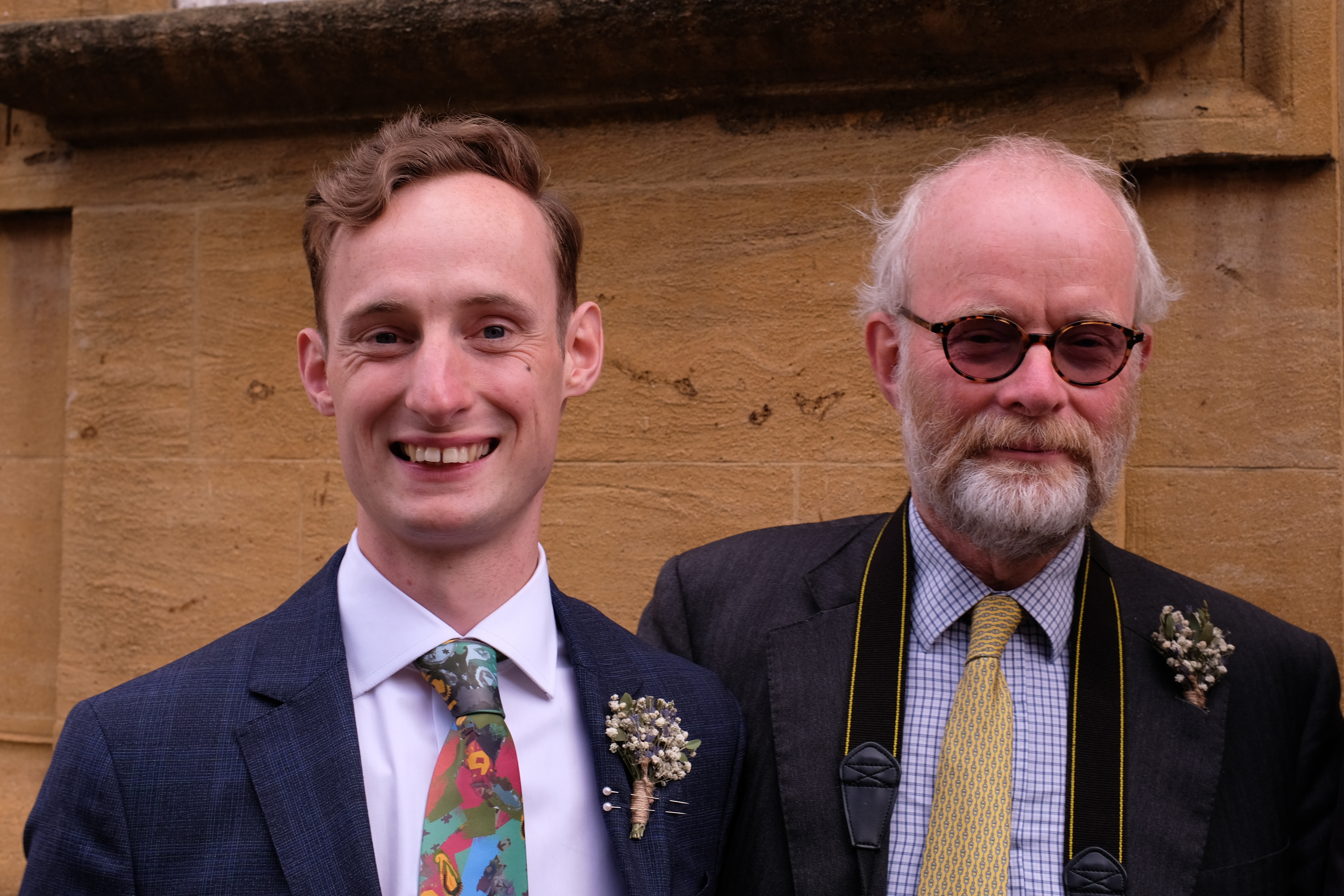
The groom and father. One I did get...


I thought however I had done a pretty good job in getting some images, but it was only when I got back that I realised I had made a fatal mistake. While I had plenty of photos of the bride and groom, there were many people I did not get images of with the happy couple. Such as

  • The Grooms Parents
  • The Brides Parents
  • The Brides grandparents
  • My Family
  • Me
In hindsight, the problem was is that I was used to weddings where I was on the periphery and someone else  was orchestrating it. I did not realise that someone needed to fill that hole, and that person should of been me. Now I realised I should of taken control and organised everyone, but of course that was not my job, but it just highlights the essential role a proffesional wedding photographer fills. It is not just the photos, it is the organisation of the day to get all the required images. This is why coordination and communication with the photographer and wedding party is essential in these situations
 
Finally we made it back to the reception and again unfortunately I reverted to my shell. One of irritating things for me was that there was a photographer at the event who took some great images of the reception and he was a 10 years old lad who borrowed his dad's camera and just went around asking people for images. This was the task I had set out to do, but I failed at thsi point. To be fair he did have a few advantages. Firstly when a 10 year asks to take a picture its cute, when a 50+ year old bloke does it, it can be a bit creepy. Secondly it was interesting that the lower portrait angle acheived was a attractive, but I am not sure my knees are up to it, and finally he did not suffer (I hope) the effect of too much alchol. 

So Lesson 4, Grasshopper - Embrace your 10 years old child

To be honest I am still pretty mad about myself for not getting all the images and then not doing more at the reception and have been beating myself up all week. However on the plus points, there are some images I really like and I have been having fun with some of the photoediting, one talent I can rely on.

As for the lenses, the zoom got the most use, followed by the 14mm. To be honest the 56mm and 85mm did not really get a look and in, and I need to work out what the 56mm can be used for, falling into unfamiliar territory for me.


The conclusion


In conclusion, I am still in awe of wedding photographers (even more so) and i'm glad my living does not depend on it, because I would not hire me. 
 
Saying that I learned a lot, not least that a professional wedding photographer still has an essential role to play in this world of smart phones, if you want to capture those irreplacable moments.

Would I do it if called again? Hopefully I could put some of my lessons into play, but I'm not sure I could take the responsibility...


Saturday, 22 January 2022

The Iron Giant


My wife and I have our differences over sunrises. My wife assumes that a decent sunrise is a predictable event, while I know from practice that whatever the forecast says, there is no true way of evaluating a sunset other than looking out the door well before the sun has risen. Even then I have driven miles in the dark only to find cloud has rolled in obscuring the sun.

This in turn creates conflicts,  since she expects at least 48-hour notice for any photography trips, while I generally don't always know whether it's worth going out till the morning in question.

The other problem is she frequently asks why, if I am going out, why she could not come. Apart from the fact, I am an unsociable bugger when in photographic mode, sunrises by their very nature are early in the morning. I find I can get out of the house in about 15 minutes, my wife's record is about  an hour. 

However, sunrises won't wait, and typically you want to be there an hour before the sun rises above the horizon. To be honest, I'm not great about this either. A combination of laziness, inertia, lack of confidence can stymie your efforts to get out the door at an ungodly hour, or set off too late and then kick yourself as the sunrise of sunrises occurs while you are still driving to your destination. (alternatively, you can do what I did once and arrive 2 hours too early and have to kick your heals in pitch blackness)

I bring this up because I did actually manage to get out for the sunrise today. 

I have been planning this trip for a few weeks. My target was Bennerley viaduct near Ilkeston, about a 20-minute drive and because we are basically still   in winter, it meant that I could get going at a reasonable time.

This blog post is not about sunrises however but Bennerley viaduct and the possibilities to the photographer

The Iron Giant

Bennerly viaduct is a disused railway viaduct spanning the Erewash Valley between Awsworth (Nottinghamshire) and Ilkeston (Derbyshire) in central England. It was built in 1877 but closed to rail traffic in 1968.

Unlike most viaducts, it is built from a lattice of ironwork, making it appear as a giant spider web. The reason for this is it is built over an area of coal mining subsidence, so need greater flexibility than a brick built structure could offer. 

In truth, it is amazing it has survived at all. It managed to survive Zeppelin attacks in the 1st world war, and the bombing of the 2nd, together with the more serious government attacks via the Beeching cuts in the 1960's. The only reason it survived then was due to its construction methods, it was deemed too expensive to demolish and for many years lay isolated. As such, it is almost the only surviving example of this sort of bridge and certainly the most accessible.

 That is until a concerted effort was made by local people to restore the viaduct and convert it into a cycling/walking path. The Friends of Bennerley Viaduct was set up to fundraise and manage this. 

When I first visited in 3 years ago, the bridge itself was still off limits, and access was not clear. However, just this month (Jan 2022) it was announced that the bridge was open to visitors. As a result the 1452 feet long viaduct rising 60 feet above the Erewash river is now open to all and I felt it was time to investigate the site more fully.

Perils in the dark

To plan my visit, I checked the photo ephemeris site to check which direction the sun would appear. Then I had to work out from Google maps whether I could get to where I wanted to go and how.

One of the challenges of visiting a new site for a sunrise is that you will be stumbling around in the dark with no real idea how to get where you want to g   It appeared that there was an area of waste ground  behind the site that would provide the best angle to catch the sun, but although google maps is fantastic it would not tell me whether the pathway shown was open or how to get to it. I would just have to hope for the best.

When I woke up, and looked outside my window, the sky was clear. While this was good, I was hoping for a bit of cloud, but part-time snappers cannot be choosers, so creeping out of the house, and into the car, it was a quick jaunt up the M1 and I arrived at least an hour before sunrise.

As I said, I had no idea of how I was going to get to the viaduct and first signs were not hopeful, facing a low gate with a danger "construction traffic" on it. Assuming that this was a hangover from the reconstruction work I climbed under it and set along a wide paved path that I hoped would take me to my target (It was only when I got back to the car in daylight, I found a full functional path next to it)

The path to the viaduct itself was easy, despite the dark. The next challenge was that I had to cross the river Erewash to get to waste ground on the other side. On Google Maps it seemed to show a bridge, however what it did not show was a substantial gate across it. Initially, it looked like I would have to clamber over it, until I noticed that a large amount of the wire netting had been removed, allowing me to easily duck under it.

Why here?

So why did I want to photograph this bridge? Well, firstly, I love a new location and the new access offered a number of possibilities. Sitting in the middle of the Erewash valley with no buildings nearby, it allows you to explore the angles with little compromise.

Also being a lattice structure, it allows the light through. My hope was that I could photograph the sun through the lattice as it rose

As it was, I spent a period of time trying out different angles. One of the things I loved was the way it seemed to tail off into the distance, creating a Lacey ribbon in the sky.

One thing I quickly realised was that the sun through lattice effect was going to be challenging because the sun would need to rise above some low hills, meaning I needed to be higher. A drone would be perfect in this situation, and I am sure that this will be a major destination for drone photographers in the future. However, not owning one I had to do something else


Viaduct in the blue hour


As the light grew, I noticed a pedestrian walkway over the nearby rail line, which would give me some needed height. I decided therefore to try there. The next challenge was to find it in the dark, which I eventually managed. This gave me a higher angle, so I could capture the sun well before ground level.

One of the things I tried was to capture the silhouettes of joggers and cyclists on the bridge to provide scale. Even this early there was a lot of traffic, which is a testament to the success of the project.


An early morning walker crosses the bridge

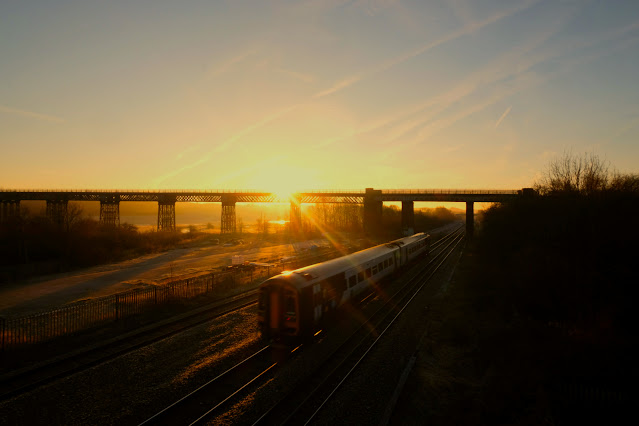
Yes, its a train. Get over it  


One advantage, being up high, was that I now had more time to explore the viaduct, so I worked my way down and tried to find the entrance. I later found that I could have continued over the walkway and followed the canal to the entrance ramp, however instead I headed across the waste ground to find the East path. 

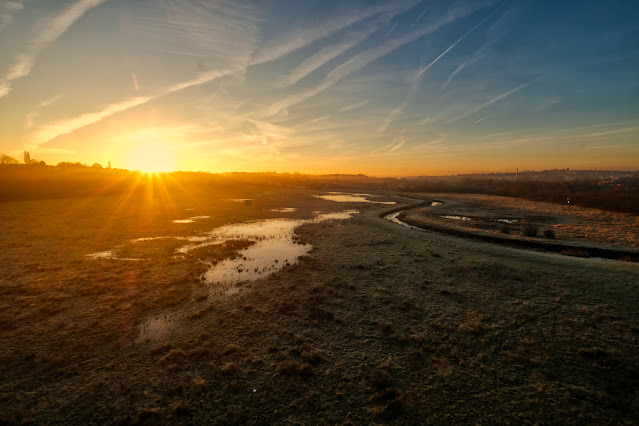
From the viaduct you are afforded fine views of the Erewash valley, and it would be great to come back on a misty day


View from a viaduct

The Erewash valley

Conclusion

One of the joys of photography is finding new locations. Bennerley offers a lot both in the structure itself, the location and historical perspective.

It will definitely be on my photography location list and  I recommend anyone in the area to have a look

Being in the open affords good access for landscape photographers and sunrises and sunsets shots should be possible, although check the sun angles before hand.


Information

Bennerley viaduct is located between the Erewash Canal and the disused Nottingham canal

Parking can be had at the Newton Lane Car Park, Awsworth Road, Ilkeston 

To access the area underneath the bridge, there is a path from Awsworth road, where you can also access the railway crossing

Access paths are pretty good, with only a bit of scrambling to reach the Northside of the bridge.


Tuesday, 28 December 2021

Unplanned obsolescence


One question I get asked a lot as a photographer and member of a photographic society is "my partner/husband/friend passed away and left a lot of cameras do you want them"

This always raises a dilemma because a) we want to help, and anything photography related is always of interest, and b) it will almost always result in receiving kit which is basically worthless and then working out what to do with it.

Let us be clear that some kit will always have value. For example, anything with Leica stamped on it will always have value. Also, some pre-war kit has nostalgic/historic value (not box brownies, however - there are so many out of there). Additionally, some old lenses have value, ironically because they were so poor, they can be used to create interesting artefacts. Old USSR lenses like the Zenith Helios lenses are especially popular.

Most kit offered don't fall into that category. It is things like low-end modern DSLR's and compact digital cameras. The unfortunate thing is that although some of these items might have been expensive when bought only a few years ago, today they have basically no value even in almost new condition.

I raise this dilemma because recently my recently widowed wife's uncle asked if I would be interested in his ex-wives cameras. I said in a moment of weakness yes, and this Christmas a large parcel arrived with a ton of old cameras. 

I was intrigued to what was inside and as you can probably guess  there was no Leica, but a number of digital compacts, all virtually unused (it was clear she was a serial camera buyer). However, although of little or no value in themselves, they do pander to my other interest of camera and photography history. So in the rest of this blog, I will use them to highlight recent camera history.


Exhibit 1

Built 2002
 
Price when new £720 (£1200 in 2021 prices). Value now - £0

When we got married, we were too poor or cheap to get someone to film it, so my wife's aunt, Jenny, did it for us. In fact, it might be this very camera she used. Unfortunately, it turned out that this sort of camera, rather than being the future, was just a brief interlude.
 
Storing the image on a miniature videotape, it meant rather than storing your memories forever, in a few years you were left with the issue of what to do with the mountain of plastic piling up in your loft. (Our wedding video was converted to DVD a few years later).

However, the technology on these sorts of cameras was superb. Not only did you have a digital camera that supported a good zoom lense and good speed reproduction, but the effort required to support a moving tape robust enough to faithfully record images while withstanding jolting etc was impressive.
 
Unfortunately, it had a number of issues. Tapes made the cameras large, you could only record for about 15 minutes at a time and there was no easy way to edit them, and sharing them was basically inviting everyone around to your house.
 
Despite the technology and cost, such cameras quickly died out when video cameras capable of recording to memory cards started arriving, meaning they are about as welcome as a mail order bride to a daughter's wedding.
 

Exhibit 2


Canon Ixus 70  2007 Cost when new £179 (2021 Price £264 )
7.1 Mpixels 1/2.5" sensor
Focal length (equiv.) 35–105 mm F2.8–4.9 
 
Value today £30
 
The Ixus 70 represents a whole load of cameras around in 2007. They were small (the Ixus 70 is about the size of a large matchbox), had a reasonable zoom range and were very popular.
 
Playing with it, it is hard not to see why. it is easy to carry around, very well-built and takes reasonable images in good light (even if the so-called viewfinder is a bit of a joke). 

So why don't we see such cameras around today? The easy answer is a mobile phone can do all that plus a lot more. I remember I bought a small such camera for my wife and I quickly found the issue when I tried to use it. Battery life was not great, so the camera spent a lot of time off. When something happened that I wanted to take an image of, I had to turn it on which took up to 1/2 second, by which point the moment was missed. 

Also, when photos started being shared, the lack of connectivity spelled the death-knell for these sorts of cameras, and I am sure many people have them cluttering their desk draws. We get offered these cameras all the time  and I still have not come up with any use for them apart from technological curiosities. 

Exhibit 3


Samsung Galaxy Camera (2013)

Price new £799 (2021 Price £975) 

Price now  £100

16.3MP backlight-illuminated CMOS sensor

21x zoom with 23-481mm equivalent focal length and OIS

F2.8-5.9 maximum aperture

ISO 100-3200

If I could have bet in 2013 what the camera of the future would look like, it would be this one.

Not only was it sleek, well-built and gave a good sensor and zoom lens, it boasted a huge rear screen covering the entire rear of the camera. It also had the kind of user interface that a Sony owner would weep for, with intuitive manual settings, touch to focus etc.

On top of that, the camera was driven by android OS, the same seen in mobile phones allowing to connect to Wi-Fi to share images and add apps such as Snapseed, so you could edit your images on your phone. You could even but a SIM card on and connect to mobile networks. 

One interesting quirk is that instead of full SD cards, it takes microSD cards, which reduces its footprint a bit.

It did and does now feel the way cameras should be, but it turned out to be just a brief experiment and not followed up on. OK, there were some complaints that image quality was not that great, but it was more than that.

The 1st reason is that Samsung decided to get out of the camera market in 2016, which came to a shock to many since they were quite highly regarded. However, the management of Samsung saw, probably quite rightly that the market for cameras was shrinking and since they were not a big player it was better off investing elsewhere. 

The reason for the shrinkage was again that cameras were being  incorporated into mobile phones. In many ways a camera like this should have been a good competitor since the lens and sensor size was streets ahead of the mobile of the day (for example the iPhone at the time had a 1/3.2"sensor in front of a plastic fixed lens), however the problem was why carry this camera around and a mobile? When a mobile would do 90% of what the camera did, without spending £800 for the privilege.

However, camera UI's, their lack of flexibility and inability to customise them is still an issue in modern cameras. It is a pity that this attempt could not of been carried forward to DSLR's, A definite might have been.

Exhibit 4


 Panasonic HX-WA20 (2012)

£250 when new (£314 in 2021)

Price now £69

1/2.33in CMOS 9.8 Mpx

7.5x optical zoom (28-280, F4 -20 )

This one is a bit of a peculiarity. Although bought out in  2012, it would be hard to guess that it is 10 years old, and it is the one camera that i would think about still using today.

Obviously the camera is designed to be video centric, however it does offer a usable stills function. The interesting thing is the form factor. The truth is that camera design has pretty well stagnated. Yes there are tweaks here and there, but the fundamental design is not fundamentally different to the 1st SLR's 60 years ago. 

The strange thing is that SLR's were designed as they are because the camera spool had to be pulled across the aperture. However, despite being no film or canister, cameras are still designed as if they are doing exactly that. There have been attempts to move away from that for, but design conservatism has meant they have generally failed. 

This camera is interesting since it shows an alternative design strategy, although largely it is designed as a video centric device. However, again, with cameras video capability being a major selling factor nowadays, the question has to be asked whether the SLR blueprint is really a good form factor for video?

However, this has nothing to do with why I would still use this camera. It has a trick that mobile phones still struggle with. It is waterproof up to 3m. When I went diving in 2019, I bought a small waterproof Fuji, but this would have worked nicely, with big controls. 

Unplanned obsolescence

So my unexpected gifts have given me to look at recent history of camera technology. One of the weird thing is that apart from the video camcorder, none of these devices are unusable and would take fine photos today, but are basically considered junk.

If you bought say  Nikon F mount in 1963, you could almost get a lifetime of usage out of it. Now the usable life of a camera can be measured in months. For example, the DSLR manufacturers seem to bring out a new product every 6 months. There is often little wrong with the existing camera, but this forced obsolescence means that usable products are discarded before they even get a scratch.

To me, this seems wasteful and unnecessary. One way it could be improved is enforcing software upgrades. Fuji were the 1st to introduce the concept of kaisen, where the life of a product could be extended by software, and other manufacturers have gone some way in doing that, but it could be better.

 I am always interested in the maker community who re-use and re-purpose technology. However, if manufacturers were encouraged to provide methods of software updates and also after a period of time provided the source code, a lot of hardware would not go to waste. 

However, there is little benefit for manufacturers to do this unless forced by law, so I expect the draws and landfills of the land will continue to get filled with fully functional, but obselete devices for years to come


Saturday, 2 October 2021

Big eyes

I get bored very easily with "standard" photography. While it is great to get that iconic photo of a landscape, after a while I tend to go to any technique that differentiates an image, be it ICM, different angles, etc. This is one reason I am always looking for lens that are different, quirky or just weird. 

This is also one reason why I am generally  banned from going into charity shops by my wife. Apart from my predilection to buy books, I am always on the lookout for old camera equipment. This is even less likely than finding decent books, but secretly you hope to uncover a Leica, which the fool at the checkout has priced for £2.50. However, failing that, I am always a sucker for old lenses, but again I never had much success.

However, recently I was perusing a local charity shops while my wife was otherwise distracted taking the dog to the vet.  After discarding the usual Dan Brown's, I found 2 lenses in the corner of the shop. One was an old Tamron zoom which did not hold much interest, but the 2nd one was more intriguing. At 1st glance it looked like the front end of a CCTV camera, and I could not decide whether it was worth a punt. At this point I was saved by the bell in the form of a call from my wife asking to be picked up, so I put it down and went home.

However, the next day, I could not stop thinking about it, so I snuck out at lunchtime and picked it up. for the ridiculous price of 10 quid. 


When I got it home, I googled it, but I was no more the wiser.


 It was clearly some sort of wide angle/fisheye, made by AICO in Japan, but it did not seem to have any sort of mount, not even a screw in M42. It had a screw that looked like it would fit into a filter mount, but it was not quite the right size.


The mystery was eventually solved when we found information on Series VII adapters. These were a class of filters and lenses that could screw on to the front of an existing lens to add extra reach or wide-angle capabilities. 

To try it out, I got a 50mm to Series VII converter and attached it to the front of a 18-55 zoom. Obviously the lens itself has no aperture control, or focussing. However, being a fisheye, it does not need much focussing anyway

The Results

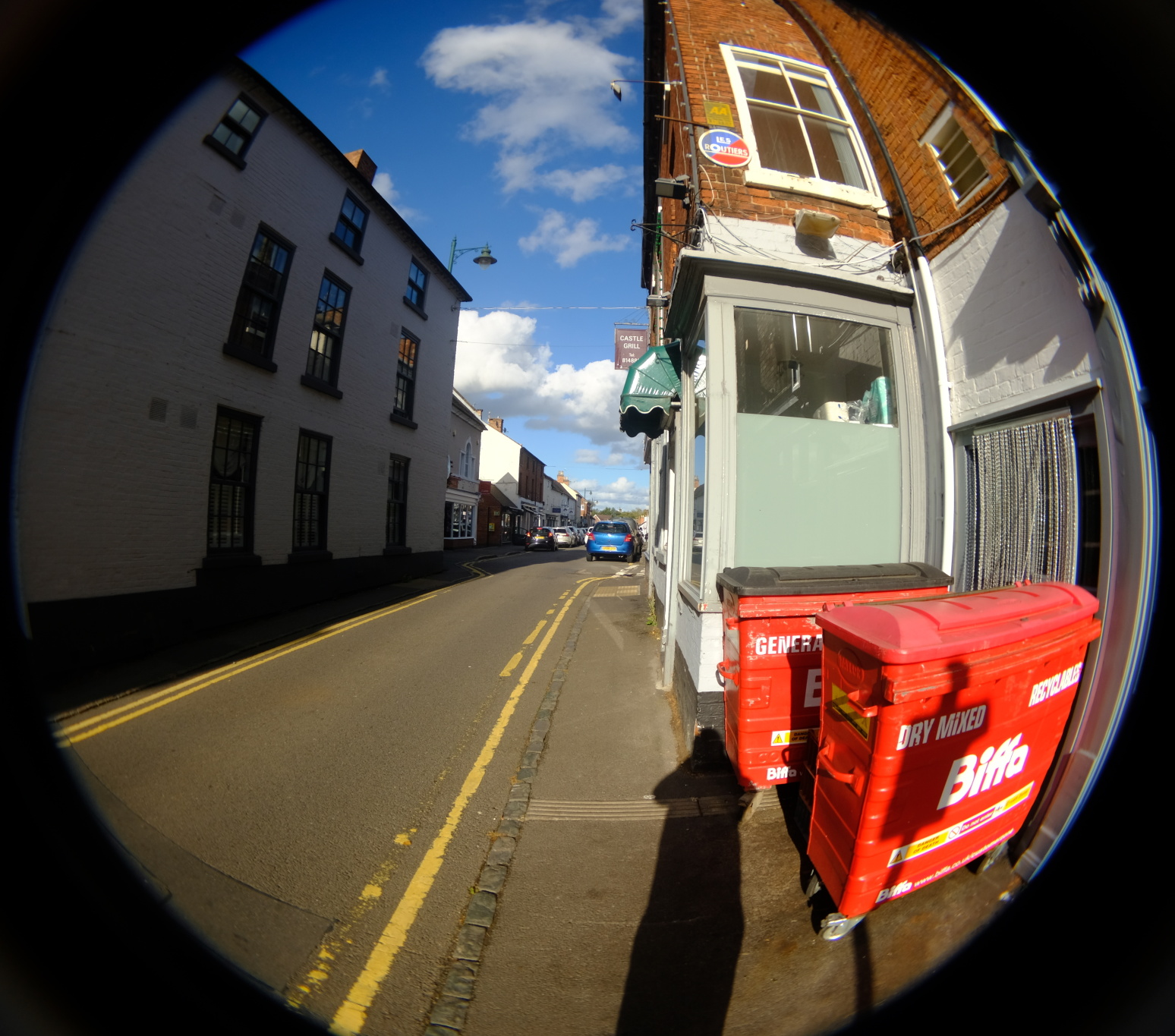
I have never had a true fisheye before, so I was a bit surprised by the initial results. Rather than a full image, the lens only created a port hole effect, having a circular image. It was a bit like the effect of using one of those crystal balls, without the need to find where to place it on the ground. Looking at other fisheye, this seems pretty standard. Of course being attached on a zoom I could decide how much of an effect to have by zooming into, so magnifying a certain area, but I actually liked the effect in certain scenarios. 

One issue was really bad flare, and it was best when no strong lights were being picked up. However, it was really good for pictures of streets where the fisheye effect showed up most strongly. It will be interesting to see the results I will get in say a forest environment


Conclusion

Buying an old lens is not about photography perfection, but breaking the mold. Photography should be about pushing the limits, and playing with different pieces of glass helps push us in different directions. While the lens may not get used much, there will always be a project or use that will come around, which we will dig it out. For that alone it is £10 well spent 


Saturday, 26 June 2021

NFT and the art of the deal

This last year has been a tough one for anyone whose primary source of income was through photography. 

Any face to face activity, often the bread and butter of full time photographers, has been severely curtailed by Covid-19 leaving photographers to rely on things like print sales to make ends meet.

However, just when things were at their bleakest, a new proposed saviour appeared over the horizon with the letters NFT printed on their tee-shirt. 

But what is a NFT, and is it the new messiah or just a very naughty boy?

So what is this NFT?

Simple put  an NFT is a new way to monetise the sale of digital images. It has come largely to the fore through some photographers like Neil Burnell selling digital prints for prices for the kind of money that traditional print sellers could only dream off.

Since then social media has been awash with photographers trying to get to grips with NFT's, with some resorting to almost evangelistic zeal in extolling others to get on board. As a result, there has been somewhat of a schism formed between photographers who see this as the next great thing, and others who have doubts and feel more cautious.

So what is exactly is an NFT, and why is it being sold as the future of photography? 

NFT stands for Non-fungible token, which rather than a method of selling photos sounds like a foot disease. 

To explain what it is, lets ask a simple question. Which of the two images below is more valuable?

If you said the image on the left, I'm afraid no playtime for you

The answer is that they are in fact both equally valuable being purely digital images and in themselves contain no intrinsic value.

This is because although such images take effort to make, in a world where both creation and delivery of photographs is now a purely digital exercise they can be easily duplicated and disseminated. This means in economic terms, supply constantly outstrips demand and as everyone knows not all rare things are valuable, but all valuable things are rare.

Unlike say a print whose reproduction can be limited and controlled, there has not been up to now a similar method to put limits on a digital image. This is where NFT's come in. 

An NFT is a digital document that due to the process in which it is created (which we will not go into here, because it involves a lot of maths and very few people understand it anyway) is guaranteed to be unique and non-reproducible. This is what the Non-fungible means. Not only that, but it contains an unchangeable ledger where each token is linked to a previous copy and therefore can record a chain of ownership. A NFT can be associated with a digital item and uniquely identify it. 

So what does that have to do with photography? 

Well, a photographer can now attach link an NFT permanently to a single instance of a digital image and in doing create an unique image and sell or auction that image. One (bad) metaphor used of a signed baseball card (or pannini football sticker to the majority of the world). There maybe 1000's in existence, but only one signed by a sportsman it represents.

If you are thinking why would anyone want to buy a digital image, that looks like all the other copies  just because it has a unique signature, join the club. But that is what is happening on websites setup to trade these things, and significant amounts of money are being used to purchase them so clearly there is a demand.

NFT's are intractable linked to the concept of electronic money. You mayof heard of bitcoins, the  payment method of coice for ransomware proponents. Well NFT's are linked with a similar currency called Etherium and these are used to purchase NFT's which can then be converted to the sort of hard currency banks etc are happy to deal with.

Money, Money, Money

So we can now raid our back catalog of digital images, attach a NFT, auction them off and retire happily, right? 

Well maybe, and certainly some commentators have suggested that if you are not doing this you are 'crazy' . However like any get rich quick scheme, it is worth investigating exactly what you are getting into before jumping in with both feet.   

So what follows are my thoughts on what things you may need to think about and where this might be going in the future.

First thing to think about is who is actually buying these items and where is all the money coming from?

Caveat emptor

So why are people purchasing digital prints by spending the kind of money that would allow them to buy 20 physical versions?

My guess is that, like most new things, the purchasers will come in 3 waves. 

Firstly, are those idle rich who always want to be first just for bragging rights. i.e. the kind who queue up to buy the first iPhone, limited edition records etc. While money being used to purchase these images may look a lot to a starving artist, to some people a couple of thousands is the kind of money they spend on a good lunch and certainly no hardship if you want to brag on your next super yacht meeting with Bill Gates and Roman Abramovich

The second wave will be investors and speculators. The kind of people who are not so interested in the art, but the hope that its price will increase over time. However, both these groups are the early subscribers and limited in number. 

The 3rd wave will be the vast majority people who buy into things like this as it becomes part of normal behaviour.

However, to anyone hoping to get rich, there is a danger that the first wave has already moved on, and the second wave are now holding back to see where the market is going. Whether the vast majority of people will ever come to see a digital print as anything other than a curiosity is open to question. Maybe it is just my age, but the idea of getting the kids round in 20 years’ time to download my original Burnell, doesn't seem likely. 

Maybe I'm behind the times with this, but the point is that I would not mortgage the house on the ability to sell photos this way. The market could already be saturated, and there is anecdotal evidence that after the initial enthusiasm (see wave 1 and 2), the market has cooled considerable.

To see why this maybe the case, let me introduce you to the hype curve. This is a known phenomenon in the tech world and basically almost all new technology follows it.

The first stage is where everyone gets excited about some new technology. Early evangelists extoll its virtues and tell everyone that they need to get in on it, creating a huge wave on enthusiasm. This reaches a peak, where people start finding that the initial promises are not met and people move onto the next big thing. Then eventually after the hype has died, a better, more realistic expectations are formed and some use is made of the product, but not to the extent originally envisioned. 


My thoughts are that at the moment we are just below the peak of inflated expectations, and maybe anyone who wants to get into this, needs to be aware that the hype and good times may not last forever.

But why should you care, as long as there is money to be made? Well, the point is that none of this is free. Websites advertising NFT's aften charge an upfront fee, and if the hype crashes you may find you are spending money in a dying market.

Also, because you are buying and selling in a so called crypto currency, there is also a danger that any value will fluctuate wildly as the valuation of the currency changes. Because such currencies are not backed by things like government bonds, they are more prone to variation. For an Ethereum coin has reduced in price from $4000 to $1700 in just over a month so it is well to be aware that markets are extremely volatile

Legal Eagle

Another problem is whether buyers actually understand what they are buying? 

Purchasing always involves some manner of contract between buyer and seller, but NFT's and the whole concept of ownership of digital items creates a whole range of new issues that national laws have not caught up with yet. 

Take the issue of copyright. The assumption is that when you sell a picture, you are selling a single image, but you retain its copyright.

Problem is with all copyright questions; it is based on a concept developed 100 of years ago which does not sit well in the digital era. Firstly, is the buyer aware of this or is there an implied right when someone buys an image.  Secondly which law does this come under? The jurisdiction of the seller, the buyer, where the auction site is hosted?  

These legal questions will now doubt in time be answered, but for now it is worth being aware that we are in uncharted territory legally about what rights the seller and buyer actually have and while the market remains buoyant this maybe moot, if the prices drop (or plummet), speculators might actually come back and ask what their money has actually bought. 

Another legal grey area is what happens if a photographer mints (NFT jargon for create) a second image exactly the same as the 1st one. Is there anything in the rules which indicates uniqueness? Where does enforcement responsibility lie?

Then, there is the issue of what happens if someone sells an image which is not theirs? Again, you would hope the original artist can use copyright law to protect their rights, but like we stated above, where would you sue?

However, the more likely problem in the short term is the rise in scams. Take a population that are in need of money, add something which promises easy access to said money, add a touch of incomprehensible technology, and you have an area ripe for exploitation by fraudsters and scam artists. No doubt we will see  the rise fake sites, people offering non-existent consultancy, or other such rich quick scams (A Nigerian prince wishes to help you sell your image, etc).

So basically, be very careful you understand the terms and conditions you are signing up for, what fees are due, and whether the site is valid. 

The Environment

 A lot of photographers I know, especially those working in wildlife and environment are very conscious of their responsibility to the world around them.

One big area of concern has been on how NFT's affect the environment. To explain this you have to look at how NFT’s are generated.

Unlike normal money whose value is based on some intrinsic value, things like NFT are based on making computers do work to generate them to locate a secret code. The codes are so designed so that as computers get faster, the work required to generate them increases, therefore limiting supply.  

 However as anyone who has run a rendering program with a laptop sat on their legs, work requires energy. How much energy? well, recently police raided a house they thought was a Marijuana farm by its heat signature and the fact they were illegally siphoning a large amount of electricity from the grid. Instead of a normal farm however, they found a server farm searching for bit-coins. 

As another sign of how much power is being used to sustain things like NFT's, China recently cracked down on bit-coin farming. As well as causing the price of crypto currencies to drop, the electricity consumption in China dropped virtually overnight by the equivalent of the production of 7 nuclear reactors.

So this activity is taking a lot of energy to basically generate nothing physical and there are serious questions whether if you care about the environment you should be encouraging it so that you can sell a few pictures? 

Conclusion

So should photographers buy into the NFT hype and start auctioning of there digital prints? There is no doubt the rewards of some of the early users have been spectacular and I'm as keen as anyone to see photographers and other digital creators gain their just reward from their efforts.

but...

As well as Caveat emptor we have Caveat Venditor or seller beware. Any transaction involves risk, but the problem with NFT's is that it is too early to really understand what risks you are taking on.

Also it has to be said I am a bit concerned that the debate about NFT's has been distilled down to two camps, those who evangalise it and others who are very negative. As photographers we should all understand there are many shades of grey, and so it is with this debate.

The danger is that hyped expectations will in the end back fire, so If you want to go down this path, make sure you understand what you are selling, your legal exposure. Make sure the sites you using are valid and trusted and you use common sense cyber security principles such as good one time use passwords. Do not pay large upfront fees, and be aware of any ongoing costs.

More importantly, do not assume that you will sell much or in fact anything. There is nothing wrong in dipping your toe into new technologies, but do not assume that things will change overnight, if at all.

In short, like any undertaking, do not get pushed by others to take risks you do not fully understand, and be wary of any claims of instant riches.

And yes, I still feel uneasy of living in a world where digital objects are given equal value to physical representations, and I don't think I'm alone in that. Maybe we are entering a brave new world where value is only represented in 0 and 1's rather than ink and paper, but part of me feels I would not like that world, but maybe it is only a sign of age and the next generation brought up on Instagram and Facebook have no issues with it. 

My biggest worry is that I have reached an age, where I would dismiss something just because it is new.  However my gut feeling is that this is not one of those occasions. However if I'm wrong, contact me in 20 years to tell me how stupid I was.  You can even attach a NFT and sell it to me :)