Showing posts with label Rain. Show all posts

Sunday, 10 November 2019

Dinorwic Quarry (Day 1)


It was a 20 minutes drive to get from the campsite to the Quarry car park, the so called bus stop.

The car park is just that, a bus terminus just outside Dinorwic village, that heads down to a outward bound site.

The bus stop

The gate to the adventure


As I arrived, the promise of sun was replaced with the more usual grey, although for once it was not actually raining. My plan was to have an easy first day, heading up to the quarry, getting my bearings and then heading down to the Anglesey barracks.  I packed my camera kit in my Lowepro normal camera rucksack and set off with my tripod on my shoulder.

It was here I made my first mistake. Lulled into complacency by the abatement of rain I did not pack my waterproof trouser. This was a decision I would come to regret.

The path to the quarry is via a wide gravel path  that passes through scrubby woodland and moss laden walls. You are greeted with a sign that says in both Welsh and English that the quarry itself is off limits and should not be accessed. It then proceeds to add ambiguity to the statement that if you ignore the above clauses you do it at your own risk.

A Warning - in two languages

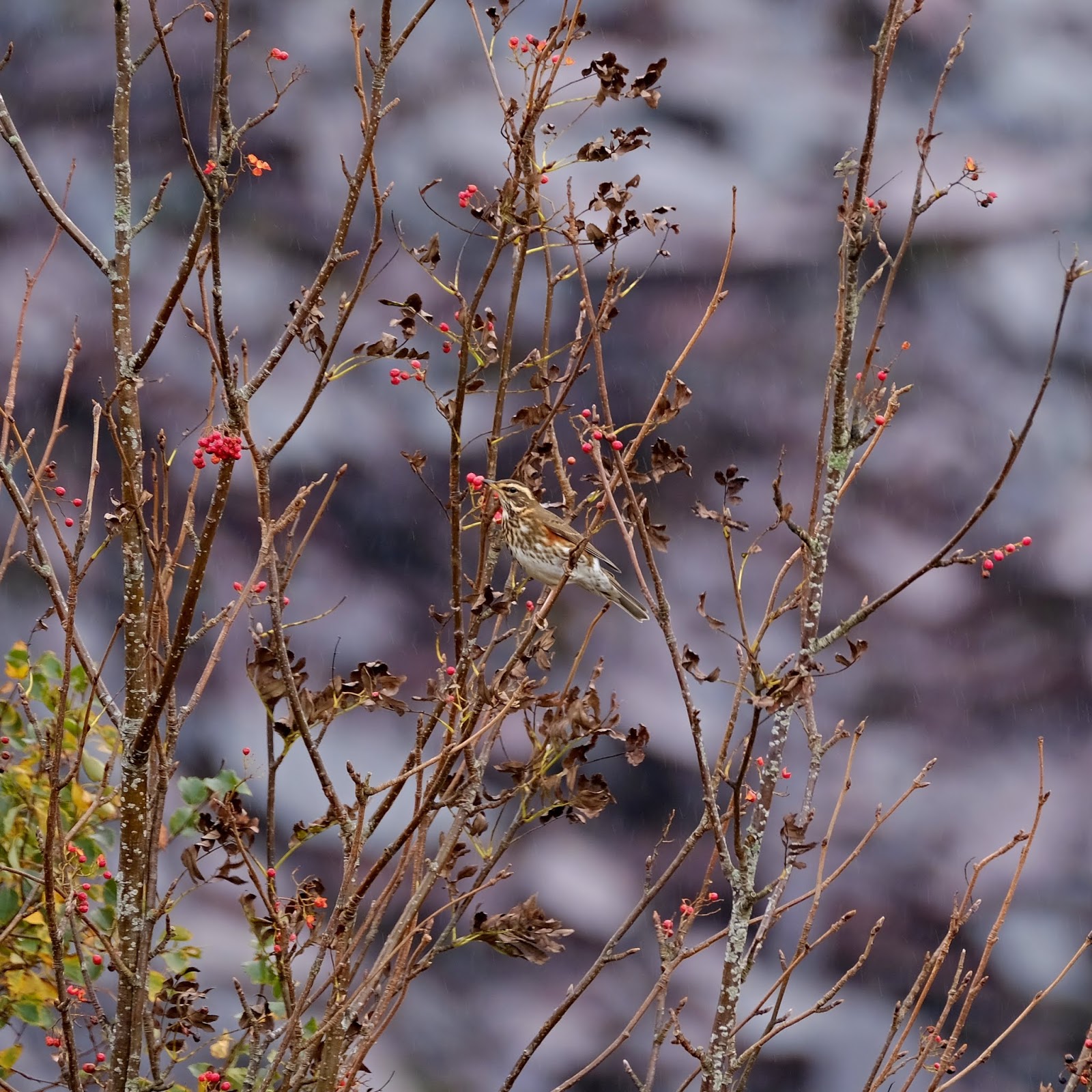
Suitably chastised I climbed up the path to where it opened near a long slate building and a scrappy wire fence and where I could see the quarry for the first time. I was briefly distracted by herd of wild goats, who calmly eating the scrubby grass nearby. A flock of redwings (the first I had seen that autumn) flew overhead into the trees to raid the berries in the nearby trees.


That is a great set of horns


Redwings - coming over here, taking our berries,...


Here I could get a great view of the quarry and the lake beneath me. A bit further on I was met with two swing gates. I knew from videos that one led down the a set of abandoned buildings called the Anglesey barracks (They have no military function, they served as workers cottages ), while the other led past the quarry itself and potentially inside it. It was always my intention to do the barracks first, but I could not resist the lure of exploring the place I had heard and seen so much of. Therefore I headed down the path that led past the quarry to view the terrain for  next day.

I climbed over a low wall and tried to take a few shots of the vista below. As I did, the mist turned into persistent rain and it became increasingly difficult to keep the rain water of the lens. I wasn't worried so much about the camera, since Fuji are well weather sealed, but the rain kept hitting the lens and blurring the image and I was left wishing I had an umbrella to cover the lens front.

Mountains in the mist


I followed the main path a good 800 yards intending to follow the path down the hill, but then I noticed I could squeeze into the quarry past a gate and I could see to my left there was a set of slate paths that led up to a old winch house. The temptation was to much so I squeezed through and attempted to find a way up. My worry had been that the paths would be difficult top traverse, but as it turned out, if you took your time they were no worse than many a mountain path. However I was pleased that I bought a hiking pole since descending could be tricky as the loose slate had a tendency to slip underfoot.

Add caption


I reached a mid level and I explored the area around a huge axe shaped rock left exposed by the quarrying and I had a great view of Snowdon, albeit through the low cloud. One of the things that struck me was the contrast of the plants against the slate and i spent a while trying to capture both the low lying plants and the trees.


There were also the buildings which created great focal points in an otherwise bland moonscape


After an hour I headed up to the top level. By this point the rain was becoming incessant  making it nigh impossible to get decent shots. Both my camera bag and trousers by this point (and I was not regretting taking waterproof trousers) were soaked and my lens cloth was a sodden mess so reluctantly I headed down.

Once back at the swing gates, I was tempted to head down to the barracks. However the path had turned into a torrent and I was not  sure how easy it would be to get back up. So instead I headed back to the car and the campsite to cook lunch and plan for the next day.

However I was here and already I could see why photographers loved the place. Hopefully the weather next day would be better and I was looking forward to exploring the place.



Dinorwic Quarry (The Arrival)


Obviously it was Greg Whittons fault

Ever since I discovered his youtube videos, I have wanted to visit Dinowig slate quarry. I had this vision of me striding along the slate paths, tripod in hand and capturing those iconic Welsh landscapes. I had now decided it was now or never, so this  October I duly set off for my first solo 3 day photo expedition to deepest, darkest Wales.

What could go wrong? 

For a reason which I am still struggling to remember, I decided I would camp. I think at the time I had an idea that this would be a stepping stone to doing wild camping at a later point. I was also attracted by the flexibility and independence camping would give me. Being a veteran of many a family camping holidays, staying in a tent held through surprises, but this would be the first time I had done it on my own. Additionally it was in an area and time of year not renowned for its inclement climate.

When I announced my plans to my family, my two daughters looked to my wife for reassurance that this was not a metaphor for the beginning divorce proceedings . My wife on the other hand is well versed with my flights of fancy and therefore went into organisation overdrive in order to combat my world class ability to procrastinate. I found myself forced to decide on menus, tents, campsites; all decisions if left to me i would of postponed to the day before departure, if not later. Its times like this that you really appreciate your partner.

In the mean time my daughters had came to terms with my foible by announcing to anyone that asked, that I was going to Wales "to find myself". Personally I would hope that if and when I get a midlife crisis, I will find a more expensive and comfortable method of expressing it. However there was some truth to their expression. I am at an age where fear of injury and illness have become more than flights of fancy. It was an opportunity to see whether I was still up to this sort of adventure or whether I should consider more gentle pursuits.

The issue of potential injury became more prevalent in my mind when the bloke who put the idea in my head, Greg Whitton, announced that he had severely crocked himself walking in Wales. Now Greg is an experienced walker and climber, and the idea that he could so easily and seriously injure himself, really made me think whether I wanted to do this. I would be on my own, in an unknown terrain and likely not to be on the well trod beaten path. If I fell and injured myself, there was a good chance I would be in serious trouble. Did i really want to take this risk?

In hindsight this was a probably good thing (well, not for Greg, obviously ), because it made me seriously think about precautions, such as taking medical and survival kit, emergency provisions etc.  I also promised to my wife that I would text her before setting out with my plan, and text her when going back to the campsite

So fully equipped, all I had left to do was set the date. My plan was to arrive when the weather was optimal, and there were some Autumn colour in the trees. I had one of the last 3 weeks of October in mind, but my diary kept filling up until, to my chagrin, I found I was left with only possible weekend. I instantly started praying to the weather gods for good weather and scanning weather sites. I quickly found that when it came to weather forecasting in Northern Wales, you would be better off studying chicken entrails. The forecast would change, often hourly. The BBC one in particular was vague, forecasting sunshine and showers which is  the weather man equivalent of throwing your hands in the air and saying "work it out yourself".

As it was as I waved farewell to my wife and set off on the Friday morning I still had no idea what weather I would get

As I drove west over the top of wales I was greeted by a magnificent double rainbow over Conway Bay. "A good omen" I thought, totally ignoring my physics training that said if you are driving toward a rainbow, you are going into the rain. Sure enough as I turned south into Snowdonia, the sun was left behind and the skies increasingly turned gray and threatening and as I arrived at the campsite it was in torrential rain.

The Arrival

My home for the next few days


There is only one thing worse than camping in the rain, and that is putting up a tent in the rain. The camp website had promised a warm and convivial welcome on arrival. Instead I found a deserted site with a sign explaining the numerous payment methods for a pitch. The camping field itself turned out to be a wet, sloping field with long grass. There appeared to be no pitch marking per se, so I made my best guess and proceeded to pitch my tent and deposit the various items within it. An hour later, I was finished and as I looked out, the sun decided to make an appearance vastly improving the vista.

For the first time I got a view of the quarry on the other side of the valley. One thing that the videos and photos fail to convey is the scale and the steepness of the quarry. From a distance it looks like a giant had has swept half a mountain down the hillside leaving a giant grey scar behind it and the slopes look forbidding and something normally only tackled with a team of Sherpa's.

The quarry from Llanberis. Lot bigger than I expected


I had two main objectives for the trip. First obviously was to take photos. I had no great illusion on whether I would take ground breaking images, I just did not know the area well enough. This was going be a pathfinder expedition to explore the site and find places I may want to return to.

Secondly I was going to map the place. Now obviously there are OS maps of the area, but they are remarkable detail free. Because this is technically private land, there are no public footpaths so there are no obvious routes. Before coming out I did an extensive search for a map, but pretty well failed. Terms like the bus stop, Dini's hole and the grand staircase were flung around on videos, with no indication of where these were and how to access them. The best I got was by studying Google satellite views and making  guesses. I therefore set the task of creating a map for me and any who wished to follow me.

After quick lunch and I set off to see the quarry close up for the first time.

More to follow...


Dinorwig

Dinorwic (or Dinorwig in Welsh)  is the site of a former slate quarry, which was shutdown in 1969. It is just one of reminders of industrial Wales which powered Victorian Britain and has left an indelible mark on the landscape. 

What makes it special is its location and its history. It is situated in Snowdownia national park, just under the auspices of Snowdon itself, Wales's highest mountain. It provides a superb tapestry of mountain landscape and naked industrial slate. The other thing that makes it special is that since closing down in the 60's little has been done to change it or make it tourist friendly. It is almost as if the workforce had been whisked off by a giant spaceship and the remain left to the ravages of time. This provides a great backdrop of industrial archaeology to add another dimension to any photos taken there.  


Sunday, 9 November 2014

Location, Location, Location

Sutton Park Exmoor Pony - seemingly unaffected by the rain and oblivious to visitors(dogs or human) 

It is easy to get hung up about where you take your photographs.

When you see photos taken in Italy, China and other exotic locations, it is easy to fall into the trap of saying that your own photographs would be so much better if you too had access to such places.

For example John Wesson, a local photography club member and TV star , frequently commutes to to Kerry in Ireland, which is about as far West as you can go in Europe without standing in the Atlantic. There is no doubt that the area is stunning, as are his photos, and some part of me says if only I had the same opportunities, I too could reach the same standard 

But another part of me knows that this is just an excuse. If you look around your local area, there are plenty of places close by where you can take great photos if you show a bit of imagination. 

Also the location itself is only one part of the equation. If you go for a week to say, Venice, the first 3 days will consist of just trying to find the best photo shots. This is why so many photos get taken from the same location. We see photo's of the location on sites such as 500px and instantly gravitate to them because it is easier and quicker that trying to find new and different viewpoints. This results in photos that are best derivative, but not extraordinary.  

This is where local knowledge and and appreciation of your surroundings become important. John takes great photos not because he is in a beautiful location, but he know the area intimately and for any given weather and time of year knows where to go to get the best shots(Admittedly John's skill plays a fair part). 

This is why taking photos in your local area can work to your advantage. 

The problem is that as they say familiarity can breed contempt. For example I used to live in the North of the country close to the Peak District where from my kitchen window you could see the low hills of Kinder Scout. Despite the views and vista's on offer just 10 minutes away, it was amazing how many of the locals would spend hours going to places like the Lake District to walk and ignore their local area.

I realised recently that I was guilty of the same when I was trying to work out where to go to take photos of trees for a project I have in mind. I wanted an area with a wide diversity of tree types.  I looked on Google maps to try and work out where such a location might be. There were a number of possible areas. The problem was how long would I have to spend wandering around finding the right shot.

Then I had a epiphany. I grew up just outside Birmingham. One of may happy hunting grounds was Sutton Park  where I would often spend the whole day cycling and walking(Remember this was in the days when parents were happy to let their children disappear for the whole day, with no hope of contacting them). 

Sutton park is the last remaining remnant of King Henry VIII deer hunting grounds and as such is one of the few remaining areas of untouched wood and heathland in the Midland area. Not only that, but I knew the area intimately, meaning that I had a good idea of the locations I wanted to go to. However because of my familiarity with it, up to that point I had not realised how unique and special the area was.

Unfortunately, as so often happens, the weather gods did their best to spoil my day, by providing persistent rain, interspersed with brief periods of torrential rain. This meant that I did not really get the photos I wanted(and the ones I did like were often spoiled by rain smears on the lens). 

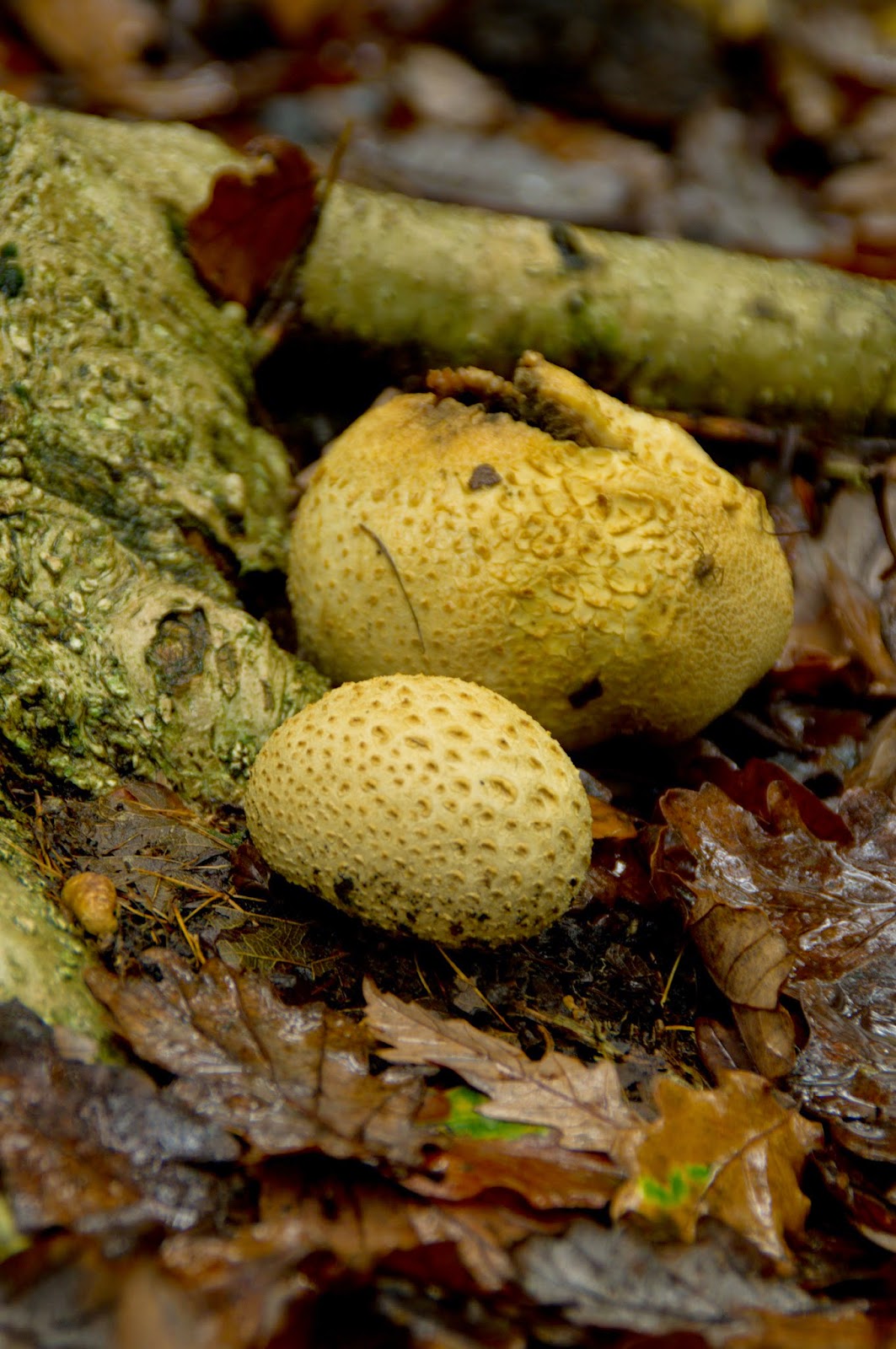
However I did have a fun time putting my new tripod through it's paces. Using it in anger, so to speak, for the first time outdoors has convinced me I made the right choice and it will be a great addition to my equipment. I was especially impressed by it's versatility, allowing me to take landscapes and macro shots with great ease. 

Couple of puffballs, say the macro capabilities of the new tripod

So although I did not get any great shots, I can be content with knowing that the locations are out there, it is only my technique I need to improve and that is under my control.


Friday, 30 May 2014

50 shades of grey skies

Ah the British weather. The occasional photographers implacable foe.

Just when your appointments have been cleared, you have a thumbs up from your domestic boss, and you set out to some photogenic landscape location with camera in hand, it is almost certain the time that the weather gods will turn against you.

This being Britain, you expect little in terms of good weather and it does not normally disappoint. But is it too much to hope for a small patch of blue? Some fingers of light poking through the cloud? or at the very least heavy thunder clouds with dramatic contrast?

Apparently it is. Because too often in these situations you end up with the sort of grey background which you could use to set your white balance by (if it was not for the continual drizzle associated with it)

Someone's who makes their living through photography may just shrug there shoulders, hit the hotel bar and wait for conditions to improve. But for those of us who have to sneak their photography out between busy lives, there is nothing more disheartening to wake up and see another rain washed grey sky. All we can do is grit our teeth and hope something will come out of the day, or at least something that is capable of being salvaged by the patron saint of average photos, St Photoshop of Adobe

And so it was that I went on my first ever canal trip. I dutifully perused the weather forecast and realised that unless a mix up of  Michael Fish proportions had occurred, the many shots I envisioned of gaily coloured narrow boats reflected in water set against an azure background were going to be severely curtailed.

The plus side of these situations is that they force you to be test your limits. Yes you would rather be under a clear blue Nordic sky, but you are here, you have a camera and it is up to you to try and make the best of it. As it says in the Faulkener's  novel Moonfleet,  "Ita in vita ut in lusu alae pessima jactura arte corrigenda est" (Translation " As in life, so in a game of hazard, skill will make something of the worst of throws"). Which should probably be the motto of occasional photographers everywhere.

The danger in these situations is that you give up photographing and resort to snapping everything that moves in the hope that something, anything will come out, even by accident.

Now photo's are digital, the cost of this is small. However in days gone by with film there was always the danger of wasting £5 on developing 36 shots of a flat featureless landscape or 24 pictures of an out of focus Mallard. The main danger now is only to your pride and self esteem.

The important thing however is taht you are there with camera in hand. No, the chances are that they will not be ranked highly on the next club competition (unless the theme is average photos taken on a grey, wet weekend), but the ones that show some any ember of promise can be used as lessons in the future on what to do when inevitably this situation arises again.


Even the ducks had boots on