Wednesday, 7 August 2019

Jujutsu Photography


Photography has many genres,  landscape, portrait, sport,  to name but a few,  but surely the most challenging and difficult must be holiday photography.

Now to be clear I am not talking about the photographs which is used to decorate those glossy holiday brochures. Nor am I talking about travel photography, which is where you go off to some exotic location purely to take photographs. Holiday photography is when you go somewhere with your partner and kids, primarily as a break, but at the same time you try and sneak some photography in.

The first challenge is just finding the time to take images. However understanding your partner is, at some point there will be a conflict between your desire to take photos and your responsibilities as a parent and partner.  When the kids want to be driven to the beach, it is not a good time to suggest you instead hike up a mountain in 40 degrees heat, to get that panorama shot. In the end you just have to fit the photography in those small irregular gaps in the holiday schedule, which is not very conducive to carefully crafted images .

The second issue are holiday location themselves. For example this year we went to Dubrovnik in Croatia. The Dubrovnik old city is a wonderful old medieval town on the azure Adriatic coast and should be a photography dream. However its beauty and accessibility also means you will be joined by thousands of other tourists, all jostling to try and do exactly what you want to do.

In Dubrovnik this has been exacerbated recently by being one of the filming locations for something called game of thrones, which apparently is not a Croatian game show, but some fantasy TV series.  Seriously though, I think at least 50% of the visitors were more excited by visiting the set of fictional kingdom, than the actual history that they were walking through.

One of the original Game of Thrones story boards


Anyway I digress.

The problem is that old town Dubrovnik is not a big place. It is about the size of a large village, and you can easily cover it in about 2 hours. Add the thousands of visitors all armed to the teeth with cameras, and pretty well every angle of Dubrovnik has been photographed to death at some point.

This is fine if all you want is a memory of your visit, but if you are trying to to create some unique viewpoint or an image that stands out from the crowd.... well good luck with that. (As lovely as Dubrovnik is, it can be a difficult place to get a photo, due to the fact there seems little control over what is put on the outside of buildings. Perhaps understandable considering the heat there was a plethora of air conditioning units, which are as ugly as sin and it is difficult to avoid in any image. If I ever do a book on Dubrovnik, it will be called Cats, Swifts and air conditioning units )

Not sure all residents are as enthused with Dubrovnik's new popularity


Then you have to contend with the tourists themselves. Put a large number of people in a small area, all trying to achieve the same thing and you will get conflicts. Basically everyone is jostling trying to get that iconic shot (which will all look the same) and sometimes they almost came to blows as people tried to get a clear shot of some film backdrop.  Basically unless you are very lucky your shot will have tourists in them, and unless you want to spend months photo-shopping them out, you just have to accept this.

To get around this and after getting special dispensation from my wife (who said "fine, just don't wake me up"), I went into the town at 6 a.m, which was the earliest bus I could get. I thought that I could take some shots before the madding crowd arrived, only to find that this was the time when deliveries were made across the town meaning people were replaced by vans and lorries delivering essential supplies of bottled water and lager (Same thing? - Ed). Of course I could of gone in at 3 a.m. and got some nighttime shots, but a) After previous bad experiences I hadn't taken a tripod and b) I was reliant on public transport who for some reason decided that catering for lone photographers was not a big part of their business plan.

Apparently this was in Game Of Thrones (The stairs, not the dress)


One solution would be what I call the Chinese system, because it seemed common among a number of people from the far east. Basically you get a women to dress up in some white or colorful dress and then spend the entire day going around the town to take shots taken of them posing in front of various landmarks, like they are creating a new great leap forward poster. However the women in my life seem far less compliant, and when I suggested it to them, all I got was sardonic laughter.

The biggest issue however is that pace of trying to cover an area in 7 days is that you get very little time to emphasize with a place. In a perfect world I would like to spend 3 or 4 days trying to get a feel of a place and create a narrative in my head on what the  location meant to me and how I would best express it. Paul Sanders in a talk said that he sometimes spends days in a location waiting for  it to talk to him. Which is nice, but on holiday I am lucky if I have 10 minutes. I am sure there are some people who can arrive in a new destination and instantly take a great photo, however for us mere mortals time is required to create some sort of emotional connection with a place.

In truth by the 3rd day, I was getting a bit frustrated. I had taken loads of images, all of them pretty boring and obvious and I could just not see how I was going to capture the place. For a break I visited the rather wonderful war photography exhibition. It was while I was looking at the thought provoking and harrowing images there that I realised what  I was doing wrong and a solution for those times when your photography is just not going to plan.


I loved the juxtaposition between the normality of the girl and the images she was viewing 


Jujutsu Photography

""      "Gentle, soft, supple, flexible, pliable, or yielding". 
"Jutsu   "The art of manipulating your opponent's force against themselves.

The martial art of Jujutsu was designed to allow someone to overcome a stronger opponent by using their strength against themselves.

It comes into play on the days where as a photographer you feel overwhelmed by forces outside your control, be it weather, time pressures or people and often you feel you want to give up. This is where Jujutsu photography may offer you solution by using the very forces against you for your benefit.

As an example on how it works when  I was in Dubrovnik, I was frustrated because I could my images felt obvious and fellow tourists kept getting in may way.

The answer? Instead of railing against the fact there are too many tourists, make the photograph and narrative about the very problem which is hindering you. In short take photos of tourists and how they affect and interact with places like Dubrovnik (in hindsight I was probably unconsciously influenced by the work of Martin Parr who has been doing this sort of thing for years).

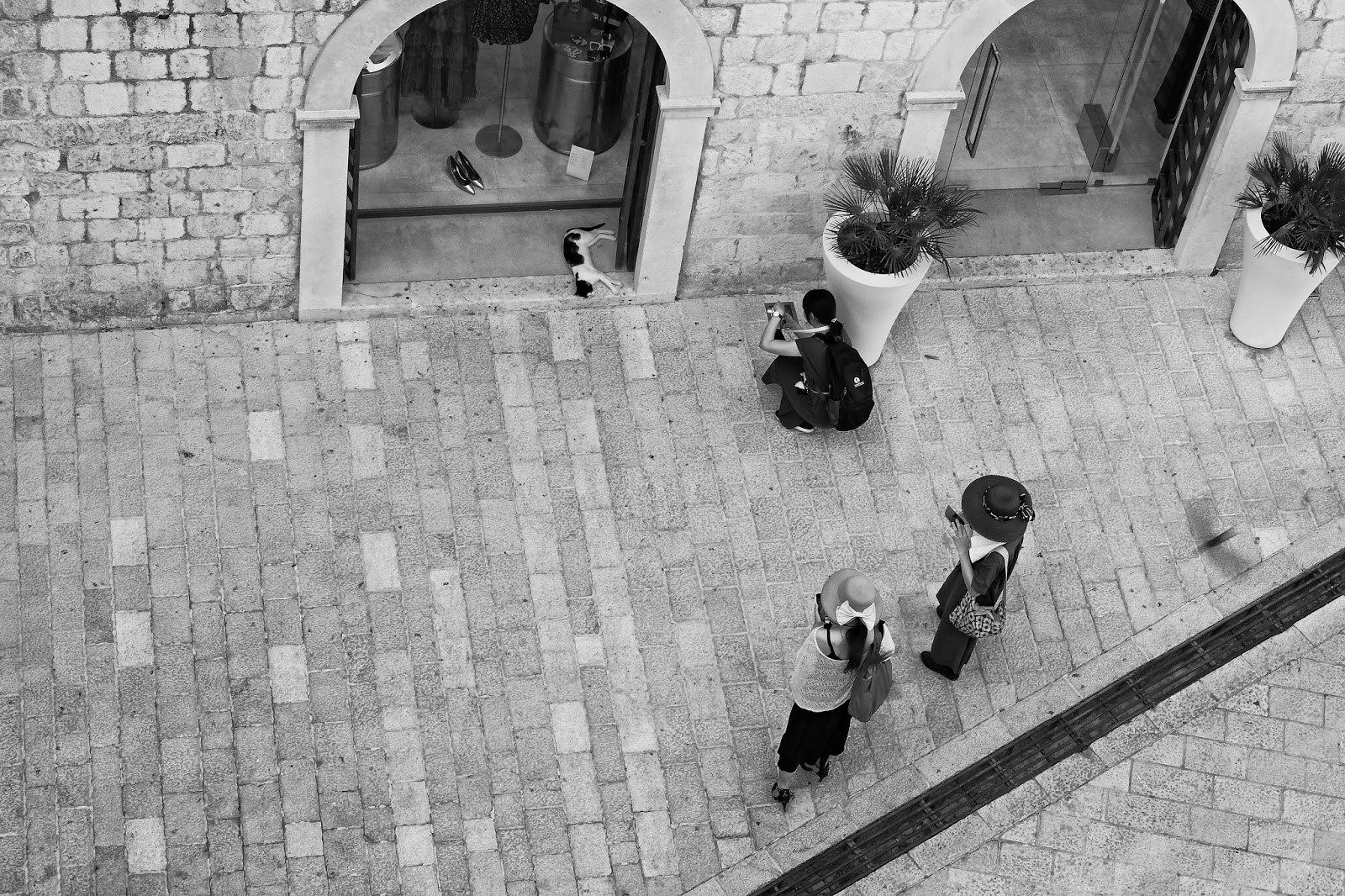
So I stopped concentrating on the town, and instead starting to photograph the people.


This did mean stepping out our comfort zone because I have always found street photography difficult. In a place like Dubrovnik however it was relatively easy, because most people are distracted so are not aware of you. I put on a 23mm prime on my camera, and just took photos at waist level and went up the main thoroughfare trying to snap tourists.

I am not saying that images I got are great, but to me they tell a far more compelling story than some old church. Also the images are unique and to me provides a very compelling narrative, and far more memorable that just some image of a building. By converting them to black and white we lose city and concentrate on the people, so that the tourists could be any tourist hot spot.


There are many situations where the Jujutsu principle comes in useful.  If the it is raining all day, take macro pictures of the raindrops. If the sun is too bright, photo the shadows. In the end it is about accepting that you cannot control everything and being brave and adaptable enough to do something different  new when your original plan is not working.

In the end of the day, great shots are usually the ones that no one planned, because if they were that obvious, the photo would already of been taken. By not being rigid and bending with the wind rather than fighting the forces against us, as photographers we will be less frustrated and also hopefully get better shots.


The selfie


Apparently pre-wedding photo are a big thing in places like China, so you often see women in places like this dressed in there bridal clothes


Monday, 24 June 2019

Spurn Point

Spurn Point


Unless you have like me,  lived in the Midlands for most of your life you probably won't understand the attraction the sea has. I am sure that if you have live on the coast, you can get blase about the ocean, but I on the other hand are fascinated by the sea and I am never happier than when I am sitting on a dune, eyes closed, listening to the breakers roll in.

It was one of  those rare days where I found that I had a whole day on my own and with no pressing jobs or other distractions that I could therefore devote to photography.

So where to go? 

Obviously I could only get so far  in a day and usually I would head to the peak district, being only an hour up the road, but I felt I wanted to be a bit more adventurous, so I decided I would head to the coast.

This presented an issue. The nearest coast is probably the Wash, but I do not know it well and it is not the most photogenic of places, plus the roads to get there are actually quite poor meaning that although close in miles it was actually a long way in terns of time. Alternatively there was North Wales where access was better but I had no idea where to go and no time to find out.

I decided therefore to head for Spurn point. Spurn point is that bit of land jutting into the North sea that looks like giant bogie hanging from the bottom of Hull. The majority of the journey is via motorway, and I had been there before once before on a bird watching trip and I remembered an area of sand dunes, rich with birds and other wildlife. Being on the east coast I wanted to get there for sunrise and this meant starting start off by 3 a.m, for a 6 o'clock start.

Apart from talent, one thing stopping me doing better at landscapes is that I am not really a morning person, therefore this would be a challenge. However I prepacked everything I needed (check camera 4 times!), decided that I would forgo my normal breakfast and shower routine and made sure all I needed to do is roll out of bed and into the car.  This was just as well since the alarm clock did not go off on schedule, and I awoke at 3:30, meaning I was already 30 minutes behind schedule.

"Bugger" I thought

The worst thing about waking up and then getting into a car at that time in the morning, is that your senses are not fully awake. Driving is a sort of surreal experience as your brain tries to confirm whether you are actually awake or whether this is just some sort of anxiety dream. It is fortunate that there is not much danger of hitting anyone at that time in the morning since it took me at least 20 miles before I was fully awake.

The next issue was that the quickest motorway route towards Hull was closed overnight and my sat nav had therefore sent me on a 20 minute diversion. I actually did not realise this until I found myself coming up to the pylons of the Humber Bridge. It meant that I was now 50 minutes behind schedule and it was already getting light as I worked my way through Hull. Still, on the map it seemed like I did not have far to go. Unfortunately as I exited Hull, the dual carriage ways were replaced by small winding lanes meaning that progress reverted to a seeming crawl.

It soon became clear that I was going to miss the sunrise. Still, I consoled myself , it was probably not going to be that good anyway. This illusion was quickly shattered as I crested a small hill and was greeted by a giant orange ball, just burning off early morning mists.

Double bugger.

I had a dilemma. Try and find a place to stop and take photos , or carry on. I decided to push onward, but about 10 miles from my destination I gave up and parked next to a abandoned caravan park where I managed to capture some images of the sun rising behind an offshore windfarm.

An almost perfect sunrise - just 30 min too late


I eventually arrived 10 minutes after sunrise and I grabbed my camera bag and tripod and made my way to the coast in the hope catching its last throws . On the way I passed another photographer coming back clutching his Nikon P9000. "Just missed a great sunset" he said as I passed him. "Yeah, but at least I've got a real camera", I wished I had said as I stumbled over the dunes. It was clear that the memo had arrived to all other photographers in the area which said  "Ok, chaps Tony is already feeling pretty bad about bollocking up his day, so lets make sure we kick him in the nuts when he gets here to make his day complete"

Still, I was here and the morning was still fresh, the ocean was calling  and I had the whole day to play with, so what to do?

Here I made a mistake. I should of gone back to the car, got some coffee and decided on my next course of action. Instead I wondered up beach to Spurn point itself.

IR image of the sea defences


You cannot actually drive very far up the Spurn headland and it is off limits to all public vehicles. One change that occurred since I was last there was that the old roadway has been washed away in parts and on some high tides is actually cutoff. Presumably one day it will become Spurn island. The only way to get to the end is to walk or cycle, However as I trudged off I neglected to pack a hat or water, something I was about to regret.


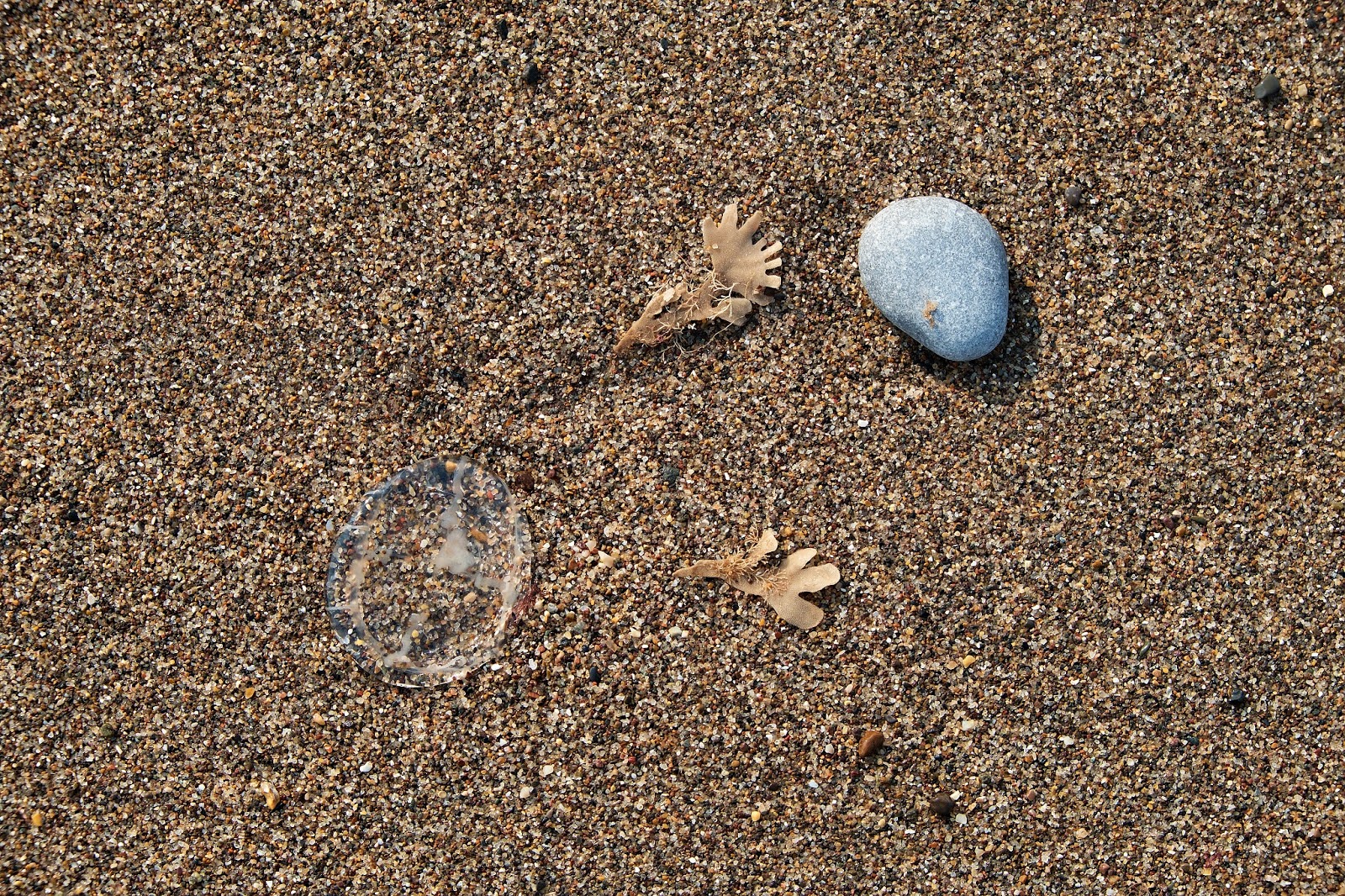
There were some great detail shots to take. I regret not taking more of them


My first plan was to take pictures of the groynes as the tide went out using long exposure. However it was clear that it was already too bright, even with a 10 stopper to get a long exposure. I therefore took images of details on coast details as I walked further down the coast. In hindsight, I should of perhaps concentrated on this, but instead tiring of the trudging on soft sand I headed inland to the coast road and onward to the end of the spit.


As I did I trudged down the road,  I was surprised to see a deer watching me from the dunes. I would of thought that seagrass and lack of freshwater would stop deer living there, but apparently they are quite common.

The deer was as surprised to see me as I was to see it


Spurn point is pretty flat and therefore the old lighthouse stands out. It is now abandoned but can be used as a viewing platform so I headed towards it.  After a long walk I arrived there and I tried taking a few images on the beach trying to use the reflections of the tidal pools. I had also bought my IR converted A6000 , but the big problem was there was absolutely no cloud. Even one. would of provided some background, but it was one of those rare UK days where the sky was empty. This meant the IR shots dis not really work. In fact anything with the sky in was problematic.


Spurn Light House

What I would of done for a few clouds


I sat down just below the lighthouse and realized it was 8 O'clock in the morning and I had been going for 5 hours, with nothing to eat and drink. It was also getting very hot, and I neither had suncream or a hat . I therefore decided to head back to the car, forgoing the trip to the top of lighthouse and lifeboat station, telling myself that I would comeback after breakfast.


However the walk back took a lot longer than I expected and it became obvious that I had walked a lot further than I realized. The road was rapidly subsumed by sand, making walking it a lot harder and by the time I got back to the car park I was pretty shattered.  I grabbed breakfast, coffee and some water and headed to the beach where I sat on the sand dunes closed my eyes and dozed for a while to the sound of the surf.


By this point, it was almost noon and the beach was getting busy with fisherman and dog walkers. In hindsight I should of gone back down the beach looking for more beach details, but instead I decided to see what birds I could see. One of my memories of Spurn Point in my visit before was the richness of bird life. This mainly occurs during the spring migration season since Spurn sticks out into the North sea and is often the first landfall of birds travelling north to south in Spring. When I was last here I remembered vast flocks of knot wheeling out to sea, plus firecrests, waxwings.  However this time of year,  it was way past the main migration time and the tide was a long way out, meaning things were quieter. 

Got a few wildlife shots like this Kestrel, but generally pretty disappointing


Curious sheep - in IR

I don't have a native long lens for my Fuji,  so I had decided to try mounting my Sony Tamron 150-600 via an adapter and manually focus it. However I had not bought a monopod, meaning I would have to carry the lens on a strap. I headed down to the  nearest hide, and took images of a pair of dab chicks on the water, then headed across the sea path to Kilnsea looking for sea birds.

Carrying the long lens was actually quite tiring and the light was harsh. I went to a few hides, but there were not many birds and around. However I took a few shots but when I later reviewed the images, I was disappointed by the combination of manual focusing and no stable platform producing really no worthwhile images.

I considered wondering up the point again, but to be honest I was pretty shattered by this point so I stopped at the rather good visitor centre and had a bite to eat and a drink and after wondering up the road some more decided to call it a day. However on the way back I made a diversion at the Humber bridge, for a few shots

Lessons Learned

This in many ways was an experiment in whether I am capable of getting up in time to do serious landscape photography. In a way it was a success. I got up, drove for 2 hours and almost got their in time. However I was not expecting how bad my decision making would be that time in the morning. If I had been more awake I would perhaps made better photographic decisions and made sure I had things like water and sun hat on me. 

I now realise that there were shots I could of got, especially of beach details. It is also a good lesson on how essential clouds are in landscape photography. The lack of any cloud cover meant that the photos would always  be mediocre and in situations like this you should try and find images that do not rely on the sky. 

Spurn Point as a photographic location


So is Spurn point worth visiting as a photographic location?


Potentially yes.

It is relatively accessible and it certainly has the features like breakwaters, groynes etc, plus other features like the lighthouse. The tide does come in a long way and the south side on the Humber mouth is more of amud flat and is not as scenic as the North. You need to be aware of the tide tables, and since it is on the East coast, you will need to be there at Sunrise. The best time to go is probably early Spring, when the Sunrise is at a more civilised time and birds are migrating.

Be prepared for a long walk to the end of the point from the Car Park and be aware that high tide can cut you off. In truth, a bike would be a far better method of getting around.

I would love to go back again, and take pictures of some of the more structural details. This time however I would remember to take water and a hat with me.


Humber Bridge (a short history)


Some may not know much about the Humber bridge, so here is a short potted history.

The Humber bridge is a suspension bridge across the River Humber connecting Hull on the North side with Grimsby on the South. When it was built, it was the longest suspension bridge in the world(It is now number 10). As a architectural marvel, there is still little to beat it in the UK (You could contend that the Forth crossing is more attractive), however as an economic investment, it has been a flop.

The idea at the time seemed a valid one.  Build a bridge that would connect the North and South of the Humber, so avoiding the long drive up and around the Humber or the Humber ferry. However whoever proposed it failed to notice one point. Most of the traffic from Hull and Grimsby goes to cities like Sheffield or Manchester. To do this you go West. Even going to London it makes more sense to head West to the M1, then head South. Ironically the motorways built to connect both the North and South of the bridge provide excellent connections to the M1 motorway so removing the much of the potential bridge traffic.

The only people who benefited from the bridge were people living on the East coast, wanting to transit between Hull and Grimsby or head to the East coast towns. Problem is that there is little industry here and both Hull and Grimsby are very different places economically. So while the bridge is great if you live in Hull and want to visit your cousin in Grimsby, there is little  benefit for freight traffic.

Initially even  those who did want to travel, could be put off by the high toll charges required to recover the investment. In an attempt to encourage traffic, the toll is now about a £1 but it is hard to see how this can covers even the cost of the toll operators, never mind the bridge maintenance cost. It also appears to have made little difference to the traffic numbers.

 Still, despite being a white elephant, it is still worth visiting and going over. There is a visitor center on the North bank, but most park on the Northern foreshore, under the bridge itself. There you can get great views of the grey ribbon stretching over the Humber


Thursday, 6 June 2019

A tale of two books


Good things come to those who wait, and this is especially true when pre-ordering books.

Two such books arrived through the mailbox recently, both very different, but in other ways intrinsically  similar. This is my review of them

Solargraphs by Al Brydon

JW Editions 2019

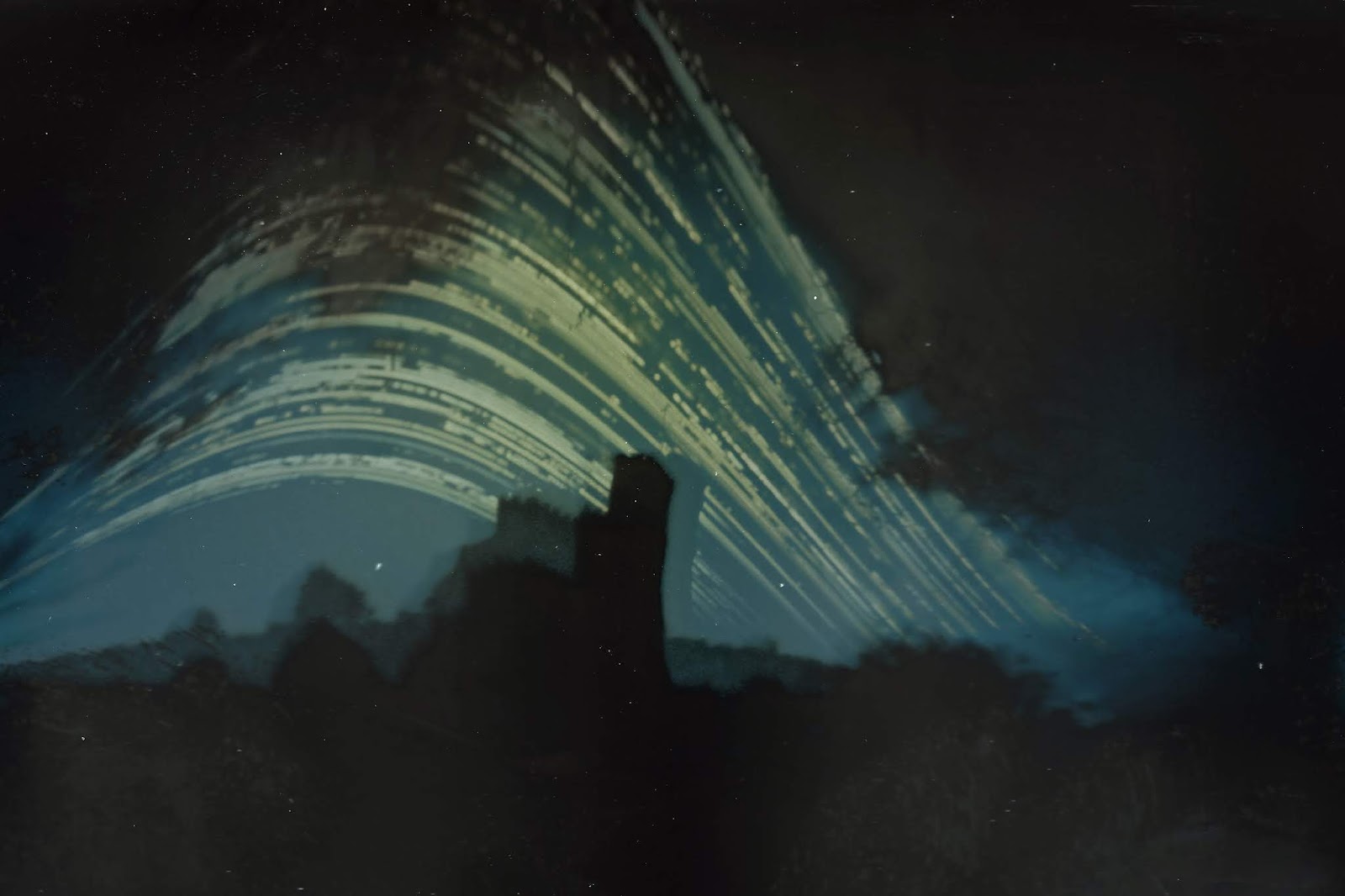
For those of you who don't already know, a Solargraph is photography stripped back to its very basics. It consists of a piece of photographic paper strapped to some sort of housing, normally a beer can, and a rudimentary pinhole lens made in the front. It is then left somewhere with a view of the sun for 6 months or more and a vague image largely consisting of the sun as it tracks across the sky.

I've had a go myself, and I find it, compared to normal photography very cathartic due to the fact that there is little to do once they cameras have been made and installed rather than wait and hope for the best.

I got to know Al Brydon's work when I visited  his exhibition together with a number of other artists at the Argentea gallery in Birmingham as part of the Inside the outside exhibition. The truth is that I was intrigued by the the fact that Solargraphs could anything other than a play thing and the idea that they may have some commercial value never occurred to me. In the gallery, they were printed on large silk sheets in a way that brought out the shape and tones of the finished work.  When I saw that he was going to create a book of his solargraphs I knew I needed to have it.


In many ways the book is quite different to the prints I saw in December. Solargraphs generally are dark, and matt paper tends to emphasize this, but in other ways the images become less a simple image of the sun but something more elemental and foreboding.

In his forward, Al emphasizes two aspects of Solargraphy  that attracted it to me in the 1st place. Firstly was its very randomness. The more I get into photography, the more I find myself rebelling against the nature of photographic control. Some photographers seem only happy if they can manipulate  the very pixels themselves, while to me achieving such perfection is akin to death itself, being both cold and soulless. Apart from where you place your beer can, you have absolutely no control over the final image. In fact many of the most intriguing images are those that have been somehow distorted by the effects of long weather exposure.

The other aspect is playing with the nature of time. Maybe its my background as a physicist, but I have always been intrigued by how we can use photography to explore how we perceive time, from freezing an instant, imposing two points of time on top of each other or smearing time across seconds, minutes or in the case of Solargraphy days and months. In a way a solargraph shows how the world appears to a tree, tracking the sun as it transits the sky across the year. and some of the most intriguing images are those taken in forests, with the sun shown against the silhouettes of trees. I had originally eschewed forestry areas for my solargraphs, not wanting the track of the sun to be interrupted, but I know realise that the very obstruction that defines the image, not the sun itself.

Many of the images show the effects of water damage. Normal photographic rules would indicate that these were to be discarded, but in this case nature itself is the artist and they add a intriguing texture onto the image.

As Al says in his forward however, you cannot approach these images as photographs, but instead as an abstraction. The images and shapes although hewn from the real world, create images that allow us to cast on their own emotions. I found the images to be be quite dark and foreboding, a bit like when you find yourself lost in directionless forest.  The pockmarks and water stains at the same times talks to me of decay which is a reminder that one of the natures of time and universe is that order and life is not a natural state and all things end.

My only real criticism of the book is that I would of liked perhaps more explanatory text of both the process and why these images were chosen. However this is a book with hidden depths using a process which seemingly simple is capable of creating huge complexity.

Abstract Mindedness by Doug Chinnery

Kozu books 2019

I have always felt that I discovered Doug Chinnery. Yes, he had been around for long before I became aware of him, but I am proud of the fact that I was drwan to his work well before I became aware of the artist.

Let me explain

I was wandering around Bakewell in 2016 and I wandered into a photographic exhibition. On one side was the usual set of images, perfectly composed, created and photo-shopped to an inch of their lives. On the other was a set of B&W images of woodland, random and blurred. I can't remember any of the images of the 1st set, but the woodland images have stayed with me today and obviously had a great impact on me and how I felt about photography.

This was before I started on my photography education, and before, via social media, I came to realise that Doug, together with his partner in crime, Valda Bailey had for many years been both educators and pioneers through light and land tours and experimenting in using the camera as more than a tool to record objects and more as a tool for self expression. So when Doug announced a book, I did not hesitate to put my order in.

For Doug however, the book is not a simple exersise in cataloging work. As he has himself bravely documented, Doug has in recent years been suffering with mental health issues. Even the term mental health can be terrifying to some, suggesting some sort of wide eyed madness, but in truth it is a term that is often abused and covers a huge range of conditions, suffering a wide range of people. In Doug's case it consisted of deep depression, which is debilitating enough for anyone, but for someone who's livelihood is an artistic endeavor, it can be crippling.

Often doing art,  as long as it is removed from the pressure of completion can be therapeutic and as Doug writes in the forward, often just partaking in a creative process  has been enough to keep the black dog at bay for at least a few hours. I have always been intrigued by how art and the mental process is linked. Some of the artists I admire most had there own issues. People like Van Gogh, Edvard Munch  and Carl Federick Hill all struggled with mental health issues, and it is an intriguing question on how there condition affected their art. That is not to say that mental illness is a requirement to create great art, or having a mental illness means you will be a great artist, however by studying the nature of the illness, it may provide an insight on how it is that some people can escape the rigors of the banal and create truly original art work.

You would expect that having to complete the book while suffering from depression, that it would consist of dark and forbidding images, but very few fit that category. In many ways the images are the opposite of the Solargraphs, being colourful, light and bright. Strangely only what you might call traditional landscapes have a dark, mournful quality. In fact one of them is to me the most powerful expression of depression. It consists of a mountain, dark against a grim sky, with only the summit lit and on the the right just appearing out of mist is a hint of rainbow just appearing.

Most of the others images  range from abstract to just expressive. However each is masterwork in the use of a camera as more than a instrument of recording to a true creative tool and they would not be out of place if you saw them hung in a art gallery.

Accompanying the images are verses composed by Doug himself. Doug is dismissive of the quality of his poems, and I do not have enough knowledge to comment one way of the other. However, they have a honesty and poignancy that adds an extra dimension to the images they share a page with.

In many ways this book has a more important purpose than purely as a showcase of Doug's work. This book is another small step in bringing how we deal with mental health issues from the shadows where it has lain, into the light so that it can be dealt with in a mature way, offering sufferers the support they need and ensuring that the conditions can be diagnosed and treated early. As someone who was directly affected by a relative with mental health issues when I was young, I know how important early treatment and diagnosis is. All the proceeds from the book sale have generously been donated by Doug to the young minds mental health charity.
 

A tale of two books

In many ways the photos in these books could not be more different. One is produced by the use of the latest in modern cameras and post processing techniques, the other by the most primitive of apparatus. One consists of images supremely generated and created  by the artist, while the other is left to the  randomness of nature itself. However strangely thing is when looking at each book side by side, some of the images could of easily of been transposed and you would of struggled to work out which was from which book.

Each book represents to me two opposite, but complimentary trends in modern photography. As cameras get more sophisticated and the intelligence in the camera increases, it becomes harder for a photographer to differentiate their work from all the other great images out there. There are two antidotes to this. Firstly as Doug has done, we can embrace the abstract, much in the same way as art was forced to do when photography allowed everyone to take realistic images. Secondly there is a trend the eschew the computer and move back to the analog, where the skill of the photographer is more important than the quality of there camera. These books show that either path can create similar expressive results and are equally valid.

Whatever trend you subscribe to, both books are fantastic editions to any photographers bookshelf, and if you can get a copy of either you will not be disappointed.


Monday, 31 December 2018

Future of photography - A 2018 Rant

A Mobile Phone photo


Well, almost another year over and therefore a good opportunity for a rant about something that has been weighing heavily on me for the last month or so.

I am a member of a camera club, and we do the usual things, have great talks, do member trips and have internal competitions (and yes we do end up in the pub a bit as well). The camera club, like many other,  is associated with a federation, and every year members of the club can send images to the federation and the best ones are judged and presented in a book and shown in an exhibition. (I am not going to name the federation here, because I believe the issue is universal)

I tend to take part. Not because I feel my images are any more worthy than anyone else's, but just because I feel it is part and parcel of being a club member that you represent your club.

Just one problem.

I almost universally hate the resulting winning images. I even hate them even if my images have been included.

This is not because the images are poorly taken. They are all superb execution of there genre, brilliantly realized, probably taken with state of the art cameras and expertly photoshopped to an inch of their lives.

No, the problem is  pretty well every image is predictable, been taken a million times before and is dull,dull,dull. Reviewing the exhibition booklet is like listening to musac in an elevator. It leaves no mark on the memory, it is the equivalent of beige paint on a decorators pallette; specifically designed not to offend or excite.

They are so generic, I started inventing categories for them. See how many you are familiar with.(I use the term guy here, but I am not assuming these are only taken by blokes)

Travel portrait guy - the one who goes around India taking images of old women in street markets
Sport meet guy - 100 shots of hurdlers and high jumpers
HDR portrait guy - B&W images with heavy HDR of blokes next to steam trains
Steam Punk guy - Shots of goths or steam punks, or maybe 1940 re-enactments
Misty Landscape guy - Lots of pictures of misty Tuscany, the millenium bridge or some easily accessible area of the Lake district.

and of course how could we forget Bird on a Stick guy

Now let me state for the record, there is nothing wrong with taking these images in itself. The problem is it is basically the same image taken over and over again each year. The image got accepted last year, so we will do it again. Not only that, but other club members then starting copying it because it is seen as a short cut to success.  Eventually it becomes less art and more paint by numbers.

What is also damning, is not so much what is in the books, but what is not. No images using ICM or multiple exposure, nothing that  is anything other than hyper sharp perfection. Problem is perfection is death. Once achieved there is no point doing it again. It has been completed and it is time to move on.

So why is this happening? Is it that the judges filter out anything that is different or is it that people only put images that fit the perceived federation mind set? Probably a bit of both. Again I am as guilty of sometimes overthinking when entering competitions. Rather than sending an image that I like, I start trying to think what a judge would like. Unfortunately this means we end up in a sort of group think where people only show images the judge might like, and judges only see images that fit in with what other people will think they will like. Repeat.

This is not to say I am not guilty of the same.

I also have to have taken images, trying to copy others. You see an image which has done well in competition, and you think  I can do that and try to re-create it. However I always had a nagging guilt that what I was doing was not art. I think my road to Damascus moment came when I visited a small photo exhibition in Bakewell. One half of it was the usual chocolate box landscape images  which where as forgettable as they were pretty. The other half was a set of out of focus B&W woodland shots by some bloke called Doug Chinnery. Those images are still now strong in my memory.  Its not that I then went trying to re-create the work, but it made me realise that photography could be more then the taking of pretty images.

That's not to say you have to be a Chinnery, Andrew Gray, or a Valda Bailey to take memorable images, all it takes is for photographers to reject the common found view and use their skill and imagination to find a different angle. Even places where you feel have been photographed to death, someone will come along with new way of looking at it, or break a well founded rule. It just requires photographers to try that little harder and reject the average.

Why it matters


But does it matter? Well yes it does and  the reason is, is that photography is dying.

At this point you have the right to say "Whaaaaat". Surely there are more photographs being taken today than in any period in history? Today, worldwide, more images will be taken than were taken during the entire 19th century.

This is all true. However I don't think the people taking images with their smart phone and uploading it directly to Facebook consider class themselves as photographers. The kind of photography that is dying is the type with big heavy camera and lenses. The kind photography clubs specialize in.

I have anecdotal evidence for this  which is the fact that I believe median age of a camera club member is getting older. Generally people in the 16-30 year old range see that type of photography as old fashioned and not relevant. As a result camera clubs generally are finding it harder to keep going as membership drops

Not only that but technology is getting better, meaning the good photos are getting easier to take. Because it is not possible to mount large lenses on a phone, they phone manufacturers have been forced to compensate with computational photography. Can't get a wide aperture on your phone, and want great bokeh? No problem, we'll do it post processing. Even better you won't even have learn about bokeh, just press a button. This means it takes more effort to impress people. I mean if anyone can take the same picture it is no longer special.

 Not only that but the phone is starting to take decisions about what photo to take. Already it will take 100 portrait images and choose the best one for you, and manufacturers are working on AI to detect things like landscapes etc. I want a B&W HDR portrait? Tell the camera, point it at the subject and it will do the work.

This means that just taking a nice image is not enough anymore. A £200 phone can do that. No, you need to add something else. A computer is capable of copying something that has happened before, but it cannot make that intuitive leap that a person can.

Whats to be done?


If club photography is to survive (in fact photography in general) it needs to evolve and move away from the norms of the past.

For example my club recently introduced a mobile phone camera competition. For a long time I was pretty dismissive of mobile phones cameras, but now it is my favorite competition and I am pretty sure my next camera upgrade will in fact be my phone. Because of the phone limitations I find I have to be more expressive just because I cannot take the same photos as with my big camera. This in turn forces me out of the rut of just imitating everyone else.

Competition judges can help too.  According to our federation website, these are the criteria photos are judged on

50% What the message the picture communicates
30% The picture content
20% The technical aspects of the picture

In my experience however 70% of the mark is the technical aspects, either that or I am missing what message another bird on a stick is conveying. However as cameras software take more of the decisions, the technical skill element becomes less relevant.

However the big thing missing here a mark for innovation or the "X" factor.  If we don't reward innovation, even if it is not pulled off perfectly, we will be condemned to more identi-kit images, and the art of photography will remain stagnated and become even less relevant.

Photographers can help to. If you are entering a competition, don't base it on last years winner. Enter the image which pushes the boundaries of photography, even using a different technique, a new angle, or using different materials. One of the beauties of photography is that there is almost infinite variation  in the art form, and we would be foolish to restrain ourselves to a small niche.

I am not saying this is easy. It is easier to follow the herd, but sometimes going the opposite direction means you are forced to walk in less poo.

Happy New Year and have a great 2019


Saturday, 22 December 2018

North West by Alex Nail - A book review


Over the years I have been to most parts of England and Wales. However apart from business visits to Edinburgh I have rarely visited Scotland. In fact I have only been there twice on holiday. Once was a wonderful week spent on the shores of Loch Lomand. However, as beautiful as it is, that is tamed tourist friendly Scotland. For truly wild Scotland you need to head further North and I have only done that once, a long time ago when I and a couple of college pals spent a week under canvas at the foot of Ben Nevis in Fort William.

During that time I experienced the utter misery of walking and camping in total driving Scottish rain to the point where your boots and waterproofs become so sodden that you feel you are walking in cold, damp newspaper.

I also still remember the stunning beauty of the landscape, the huge but ancient hills and the feeling of isolation, unique in this crowded isle.

Much to my chagrin and nagging regret, I have never been back since. So when I heard about a new book  by photographer Alex Nail, I knew I needed a copy.

So was it a worthy purchase? Read below for my review

The Review


In an age where photographers seem almost daily to head to Iceland, it is easy to forget that a similar wilderness exist in the UK without the need to fly. An obvious question is why this part of the world does not see the same number of UK photographers.

One of the answers is  provided by Google Maps. If I wanted to go to the same areas this book covers it would take me, from the midlands, about 10 hours driving.

That is a long way. To put it in context, if I time it right, I could get get virtually to Berlin in the same time, or the even French Alps. Although geographically they appears close, they feel a distant, almost a foreign country.

This feeling of non-Britishness is futher backed up by the location names. Assynt and Coigach, Beinn na h'Eaglaise, Loch Kishorn. All these names hint of a deeper older history, one as someone whose family as English as can be, feel little synergy.  In that ways North West Scotland can feel as alien and as foreign as Iceland or Greenland.

Then there is the logistics issue. Google maps show that, compared to the pampered luxury for someone used to the peak or lake district, towns are few and far between. This means to catch the sunrise there is no alternative other wild camp, perched on rocky escarpments, miles from the nearest cafe or mobile phone signal. You have to be dedicated to your art as well as versed in the craft of mountain hiking to take these images.

Of course just being someone who can walk up hills and is willing to put up with living in a small tent in  a howling Scottish gale does not mean that you will end up with great photos. You also need to be someone who knows how one end of a camera from another and how best to realise their vision of the landscape onto the photographic medium.

It is clear that Alex Nail can do this. Oh boy, can he do this.


The book


The temptation would of been to give the book a glossy front cover, but instead  the book itself is wrapped in a beige hessian. It gives it a timeless, classy feel. It a book that could of been made anytime from today to the 1930s. It says there is no need to for a hard sell, the images inside will sell itself.

Inside it is divided into 4 areas, The Coulin hills, Torridon, Assynt and Coigach and the intriguingly titled "The great wilderness" which covers the area Loch Maree and Loch Brown.

In his introduction the author states the challenges and hardships of bringing the book to fruition. Not least, that the book was self published, meaning its success and failure would directly affect the authors pocket. I am always more likely to support books that have a direct connection to the author, which is was why, despite the temptations when I was sent two books by mistake, I felt beholden to return  the 2nd copy.

The author also expresses that he wanted to show a literal landscape, not a idealised or abstract one. In then world of digital manipulation, there is always the temptation to manipulate the viewer to show a landscape that does not really exist.  The only manipulation is time, compressing many years of work into a snapshot  impossible to realise with a few visits to the area.

The photos


So what about the images themselves?

Unlike many landscapes images you see on twitbook nowadays, the images do not grab you by the eye balls and slap your brain into submission. Instead they are more subtle, one that takes a while of quiet study to bring out their full effect. This is a book which is best seen in natural daylight, which allows the subtlety of the highland colours to be fully realised. I'm pretty sure that the saturation dial was barely touched in the making of these prints. As a consequence  these are images you can look at again and again and each time see new detail and points of interest.

Saying that there are standout images, such as the one of "Garbh Eilean and Slioch" which would grace any wall.

From a photographic point of view, it was interesting how Alex broke with normal photographic rules. When I was last in Scotland I had a old film SLR, but never achieved much with it. I took many images of the highlands, but once developed they all felt flat, and and to my disappointment did not reflect the image I saw at the time . Later I learned tricks like putting foreground objects into the shot or getting colleagues to pose to provide scale and context.  Alex however generally eschews these tricks. You will not see hikers posing on crag tops, and foreground items, when seen,  are there only because they existed, not to make a photographic point.

This should of resulted in flat uninteresting landscapes, but it doesn't. That is because Alex is a master in using the light and shadows to provide the scale, relief and contour. Its a great lesson for any aspiring landscape photographer, but one which requires patience and many failures to apply successfully.

The other star is the weather. Whether its the snow fields or the incoming squalls blowing up the glen, they provide an animation of the image. Yes there are a few sunsets and sunrises too., but rather than dramatize the sky, they colorise the landscape. In fact the sky rarely makes an appearance and if it does it is greyed out or undramatic. Instead it is the Scottish landscape that takes center stage.

The other thing you will see little of  is any  sign of human intervention in the landscape. If this was England the hills would of been criss-crossed with stone walls and dotted with sheep. However apart from a solitary shot of red deer, there is nothing man-made or animal, contributing to the idea of a British isolated wilderness. (Of course the irony here is that the landscape as we see it now is artificial, caused by man made intervention over a millennium by the de-forestation of the area). It was only when  writing this review that I saw 2 small white cottages dwarfed by the hills surrounding Loch Maree

 Many of the shots spread over two pages, creating the kind vistas you get if you climb these hills and after getting your breath back standing and breathing in the landscape.

None of the shots feel out of place, but feel carefully selected to say a narrative and express the authors love of this landscape.

Finally.. 


If you are a photographer, someone who enjoys landscapes, or just someone who savour's beautiful things, this book is well worth being on your bookshelf. It will a book that will reward you the more times you study it, bringing out new images each time you turn the pages.

The only downside is that it will instill in you a strong desire to head to the North West Scotland to try to to see the images in the flesh, so to speak.

The best thing I can say about this book is that I almost  convinced me that getting to the North West of Scotland would be worth  10 hours driving and the facing Scottish weather once again....


Sunday, 9 December 2018

3 Art Galleries and a library (Part 4) - Birmingham Museum and the library


So the 4th and final part of my journey round Birmingham (The first 3 parts can be found here)

Birmingham Art Gallery


In the last blog post, I was tired and soaked through after walking around Birmingham for the best part of 5 hours. I needed to go somewhere to dry out and get a warm drink.

I decided therefore to head to Birmingham Art Gallery and Museum (BAG).

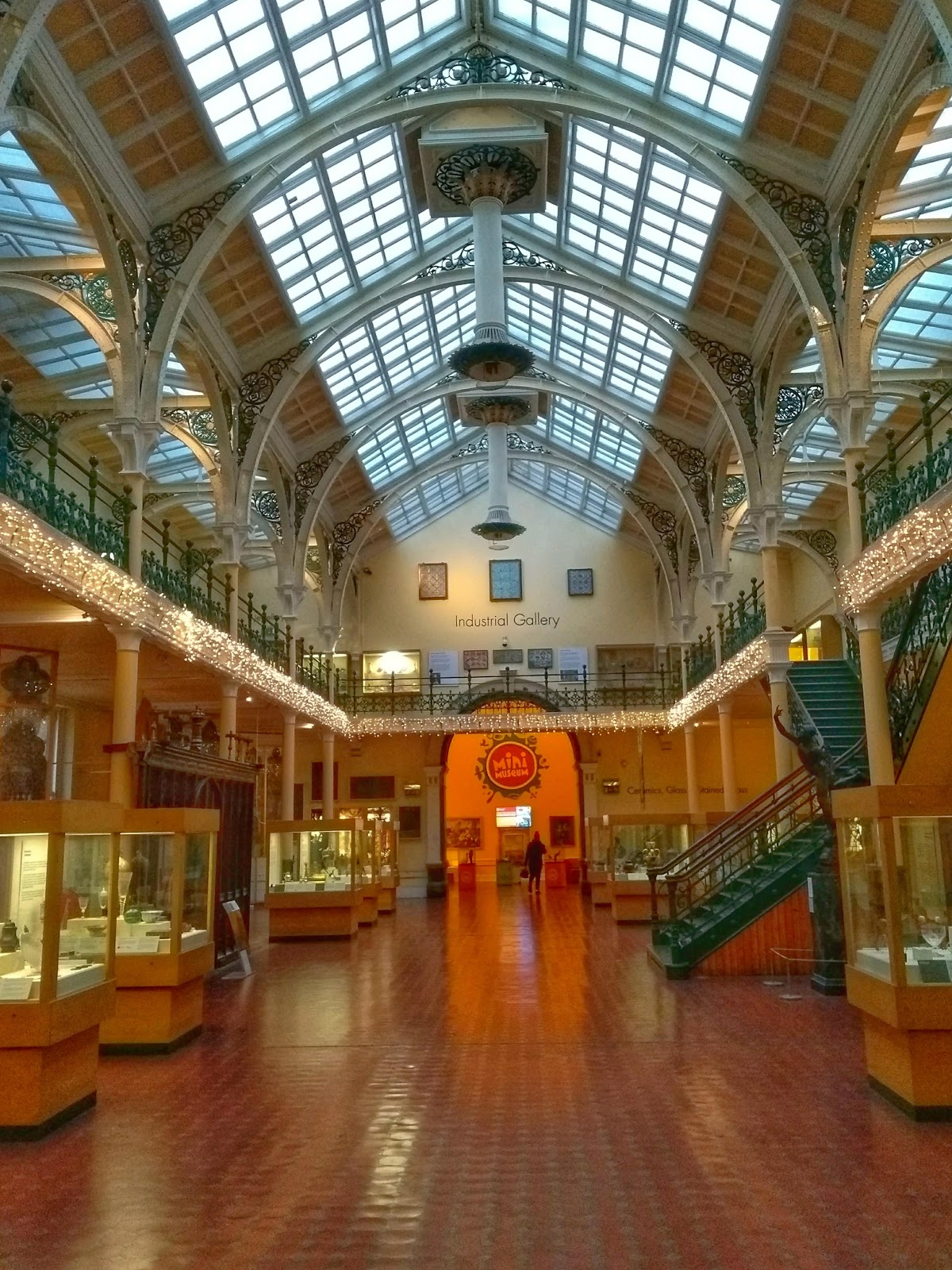
Industrial Hall, Birmingham Art Gallery and Museum


The Birmingham art gallery is situated just outside Birmingham town hall, a faux Roman/Greek edifice that looks like someone has decided to create low budget Greek myth screen-set in the middle of Birmingham.

Birmingham has gone through a great deal of change over the last 10 years, however the BAG has remained a constant. While other museums, such as the science museum have been relocated and large parts of central Birmingham have been redeveloped, BAG is pretty well as I remember it when my mother used to drag me around it.

My mother started her art degree as a mature student, and this sometimes required that me and my brother would accompany her to the art gallery (under duress) for research. Taking two young boys around an gallery is not a task that I would wish on anyone. However something must of clicked, because I still like art galleries today, and I do seem to have inherited a lot of information on the pre-raphaelite brotherhood(PRB) paintings, of which BAG has one of the worlds finest collections. This just goes to show, just because your kids don't appear to be listening,  there is still a chance that something is still going in.

Saying that, I never inherited my mothers love of pre-Raphaelite paintings. I found their simplistic morality more and more jarring as my moral compass got more refined over the years. To me they are the photographic equivalent of chocolate box pictures. Pretty, but in the end an artistic dead end and it is not surprising that the movement was relatively short lived and failed to inspire much outside the PRB clique.

The other main memory of BAG was that it was my first ever TV appearance. The event was on a local TV news affair program called West Midlands today and was due to us being around when they wanted to do a piece on BAG's new exhibit where visitors were encouraged to (shock, horror) actually handle some exhibits. They wanted some expert opinion from some 11 year old's and in those days I was obviously photogenic enough to be selected. Not only that, but I got to speak on camera, and this is where I first found my ability to spout pseudo intellectual garbage, a skill I still find  useful today when asked to comment on one of my photos. The result was 15 minute of fame at school (We lived in simpler times). I also got my photo in the local paper, the Evening Mail looking at a Barn Owl. It was a good day.

Main Ahll, Birmingham Art Gallery


The inside of the BAG has not changed much since then.The entrance halls and galleries are much the same. I always try to pick up ideas about light and composition from paintings, and Birmingham has a good range, although their modern stuff could perhaps do with a revamp. One of the things that irritates me though with art galleries is that they rarely treat photography as art and few if any have any photographic exhibitions, Birmingham is not being an exception here. Even the V&A in London, which is supposed to be the main historical photographic archive, has only a very small photographic gallery. More room is given to stain glass windows.

The one exhibition I had wanted to see was the Staffordshire hoard  . This was one of the largest Anglo-Saxon gold collections ever found and discovered not far from when I used to live. In fact unbeknownst to me, I probably cycled past its resting place  many times. In many ways the hoard is more a Anglo-saxon gold working demonstrator that actual items, consisting of small gold pieces, many from bits of larger items such as sword pommels. However the design and manufacturing skill is superb and showed what we know think as the dark ages, was more sophisticated than we give it credit for


After a walk along the rather good Birmingham history exhibition, and now fully dried out, I retired to find some tea. One thing you can say about the BAG is that it has the finest tea room in Birmingham, and I made full use of its facilities

Still you can only drag a cup of tea out for so long. Dry and refreshed, I still had 2 hours to kill, so I had to decide what to do next. The original plan was to go to Gas Street basin and photo the canals during sunset. One look at the weather outside however showed the chances of seeing any sun was slim to none, therefore I needed a plan B.

So it was off to the library.

The library


When I wore a younger mans clothes, the library was situated just outside the BAG. That library has now been demolished and the site now an area of intensive redevelopment which unfortunately dwarfs the neo-classical buildings. The new library has only moved a few hundred yards between BAG and Gas Street Basin, which itself has become a hub of new development.

The library of my era  was a build in what they termed a brutalist style. That is architecture speak for a big ugly fecker, beloved only by architect academics and historians.  It looked like someone had piled 4 giant concrete slabs on top of each other and then left them to decay. Whatever some may say, naked concrete is a harsh and ugly material and should be hidden from view if possible. Apart from a few purists I don't think many in Birmingham were sorry to see it go. Saying that, the inside was  excellent area for study being open, full of light.

The new library is a totally different building consisting of modern glass panels with a relief of interlocking rings. Although only 5 years old, it has, along with the Selfridge store, become a greatly photographed building

I had walked past it many times, and even take a photos, but never really got anything out of it. However I realised I had never actually been inside it, so this seemed a perfect opportunity to put that rights.


According to Wikipedia, Birmingham library is the largest public library in the United Kingdom, the largest public cultural space in Europe, and the largest regional library in Europe. This may be so, but in some ways it was a brave move to spend so much money on a building whose entire primary function has in recent years suffered due to a sea change in technology. Increasingly libraries are under threat. Across the UK, libraries are being closed or transferred from local authority control to one where they are volunteer run. In many ways it is a sign that we are moving back to a almost Victorian ideal, where services can only be run through local philanthropy (coming to a health service near you soon). There is a strong possibility that this will be the last purpose built library constructed ,certainly at this scale, which is a great pity since I still firmly believe libraries have an important function.

Some of the issues that have affected libraries in recent years can be blamed on austerity, local council cuts and sheer government sheer bloody mindedness. However technology is also partly to blame. When I used the old library, it was basically the only place to find reference information. Nowadays pretty well all the information can be obtained on a mobile phone, tablet etc. It is the same with books. With a kindle I can now carry the contents of a small library on a small hand held device. Some books are never even produced in a physical form and can only be obtained in electronic format. Why do you need a building if all your content can be stored on the cloud.

So in the 21st century what are libraries good for? Well, if a library are to remain relevant they have to be more than places where physical books were stored. Instead they have to be community hubs and areas where they offer services such as internet access to those who would otherwise be denied this increasingly critical resource.

In this respect Birmingham library still has an important function. If to highlight the point, while I was there, I think I only saw about 5 people actually reading a physical book. Most were there to take advantage of a warm space with free wi-fi and a somewhere to plug their laptop in or charge their phone.

OK enough of that, what about the library photographically.

The library consists of 4 levels, of mainly open space. There did not seem to any restrictions on using cameras, but as in all these situations discretion is advised. The interior consists of open plan floors with a wide central opening in which are pierced by shallowly angled escalators. As such they make good targets for practicing architectural photography, with a number of interesting shapes and angles being formed.


Birmingham Library Internals


However the real gem of the library for photographers is the so called 'secret garden'. This area (which is well sign posted and therefore not actually secret)  is a veranda on the 3rd floor that provides a great view of the Birmingham skyline. At the time, some of that skyline was being rebuilt, however it is a great place of nigh shots of the city.

Birmingham from the secret garden


.....and at night


After taking a few shots, I decided to settle down and searched out something to read. Fortunately the library had a goodf photographic section  and I spent a happy hour perusing a number of books on Ansel Adams until it was time to go.


International Conference Center


Bash Street Basin

Bash Street Basin

Bash Street Basin


Finally...

Finally I ended up in Gas Street Basin. If any area defines Birmingham renewel it is this area. Once a pollution infested relic of a industrial bygone age, it is now an area teeming with wine bars and restaurants and surrounded with iconic buildings such as the international convention centre. However despite the changes, it is still a canal boat marina and crossroads and you will often see boats transiting through the low tunnels.

On a good day, it is a fantastic place to get photographs and well worth the mile or so walk from the centre  However today was not going to be one of those days, so I decided to finish up and head to the station and go home.

So after a day spent in my so called home town, how do I feel about Birmingham after day re-evaluating it.

I must admit I like the feel of the new Birmingham. No longer the Cinderella of cities, more known for industrial grit and grime than art and culture, Brum has managed to transform itself since I was a child. The investment in the center has produced a vibrant city, the counter culture in Digbeth is promising development and hopefully Hockley will continue to re-define itself.

That is not to say that Birmingham is a perfect metropolis. Under the new chrome and glass veneer, it is easy to find examples of the 1970's architectural failings, but in some ways this only adds to the range of photographic opportunities.

Yes, it has almost got to the point when rather than hiding my identity, I can say it load and proud.

 I am Tony and I am a Brummie. 

The iconic Rotunda ala Warhol