Showing posts with label Book. Show all posts

Sunday, 11 May 2025

3 exhibitions and a book

I like to get to as many photographic exhibitions as possible. 

This can be a challenge, since the majority are in London, and of those that are not, they tend to be held at inconvenient times.

Despite all the odds stacked against me, I have actually managed to go to three events this year. 


All 3 were very different and each says something different things about photography.

So let's begin the journey:- 

Exhibition 1  - Royal Portraits: A century of photography - Kings Gallery, Edinburgh

The exhibition covered royal portraits from its earliest days to the modern day

This was the only exhibition that had an entrance fee; This was understandable since the image owners are not rich people. :)

Also, they did not allow photos to be taken in the gallery, which was a bit weird. I guess having an image on a commoner's phone would be a dangerous precedent. The upshot was however, I cannot show you any images from the show. 

This is not a big issue, since I am almost certain that whoever you are, you will have seen many of the images already. 

The exhibition showed the progression of royal portraiture from the formal to the latter, more modern, relaxed style.  

At the time, the early images did remind me of something that I could not quite put my finger. Later, I realised it was the communist style leader portraits where every imperfection had been removed, in case the populace got the idea that these were actually just normal humans.

One interesting thing was how the style of image changed as our perceptions of royalty evolved, from the early deferential images, through the 70s punk era, including the famous Sex Pistols' record cover (that at the time was considered almost subversive, but nowadays, post Diana and Harry, seems almost tame). Finally, we have the more relaxed images, where the royal family tries to propagate the idea that they are just like us, as the barriers are broken down through paparazzi intrusion, the internet and the need to generate clickbait, to the point now where it is hard not to see the Royals as a Kardashian spin off.  

 The other takeaway was just how bad some of the images were. With the early images, you could let them off due to limitations of equipment, but considering a Royal gig is much sought after, and the best photographers in the world often vie for it, some of the images were underwhelming.

For example, there were 3 images by Annie Leibovitz. They try to put the queen in a more relaxed setting, but seriously, one of the images had terribly blown highlights. Of course, part of the issue is that access is limited and tightly controlled, so there is very little scope to control the setting. However, the worst one was this one from the coronation of King Charles III

King Charles's Official Coronation Photo Is a 'Little Piece ...
Coronation images by Hugo Burnand. (Copied without permission, and I am now in the tower)  

When I first saw it, my initial reaction was that it was AI-generated. My second was it was a Charles look-alike cosplaying, like on a Game of Thrones set. The background, how Charles is sitting and the way the crown sits on a jaunty angle, just seem both wrong and dull at the same time.  

And this is the problem with Royal photography. Like the Emperor's New Clothes (King surely - Ed). Images are not there to be criticised, but fawned upon. Even in the more modern, relaxed era, images are controlled and censored, so removing any true creativity. 

Exhibition 2 After The End Of History: British Working Class Photography 1989 – 2024 Stills Gallery, Edinburgh

Exhibition 2 could not be more different. 

 It was at the Stills gallery, which is a small photographic gallery just off, ironically, the Royal Mile.

The images were from a number of photographers on the theme working class and it contained the type of photos which would be hated in any camera club setting.

Unlike the royal images, the photos could not be in any way considered beautiful, photogenic or comforting. Instead, they were of mundane scenes from the British heartland of ordinary people doing ordinary things.  

One of the abiding mysteries is how these photographers make a living, since these are not images to hang on a wall or adorn a chocolate box. These images will not appear in international Salons, nor would they win club competitions, but they are all the more honest just for that reason.

What they are is life in realistic detail, and do not represent some fairy tale. I was drawn to a set of images by Kavi Pujara


Kavi took a set of images from their native Leicester. Leicester is a city I know well, and I have always enjoyed the vibrancy of the city due to its vibrant mix of cultures. 

Kavi captured the dichotomy of 1st and 2nd generation immigrants, caught between seeing themselves as British, but at the same time having deep roots back to India. It is a useful reminder, with the hysteria about immigration, of how quickly immigrants become part of a society, and even if some parts of it will never accept them as truly British, they consider themselves as British as your average Anglo-Saxon.

I always found it interesting how some right-wing politicians, such as Pritti Patel and Kemi Badenoch come from 1st generation immigrants families. It's almost as if they feel let down by the reality of the UK compared to the myth they had been sold, and make it their life work to take Britain back to an ideal that never existed
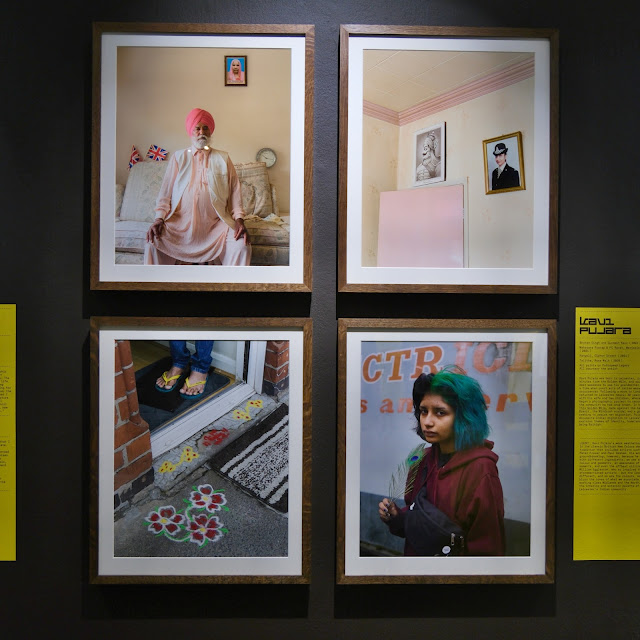
Kavi Pujara


Exhibition 3  Mao Ishikawa, Meads Gallery Warwick

The 3rd exhibition I did on a whim, since I realised it was only 20 minutes from work in lovely Warwick (well, actually Coventry, but Warwick sounds better)

The gallery is on the grounds of Warwick University and helpfully stays open till 10 pm so I had plenty of time to get there and fight the hordes getting in (me and 2 bored museum attendents)

Mao Ishikawa is an Okinawan native, and since I have a fascination with all things Japanese, I thought it would be a great opportunity to see some Japanese photography

 Her photography was very much tied to the Okinawans' experience.  While Okinawa is part of Japan, it also has a subculture and language of its own. Also, after World War 2, for 30 years, the US occupied Okinawa, which created a huge conflict between natives and the large number of US servicemen on the island.

Mao's photos are not easy viewing, and cover the underbelly of life on the island, such as violence, prostitution and drinking. As a woman and native, she was well-placed to observe and photograph them. She also did the same on a trip to the US to stay with a black ex-boyfriend in a poor part of the US.  

Again, none of these images are ones you would hang on the wall, and they were often brutally honest and graphic. However, many of these people would have no voice or evidence about their existence on earth, and as such, such works are more valuable than any pretty landscape shots 

It shows a part of Japanese society that never gets mentioned. However, the work that resonated most was a gentler piece documenting the actors in an Okinawa acting troop, as the performers got older and were not replaced, so they slowly died out. Again, it showed part of life, which, if not recorded, would disappear without a ripple and therefore is invaluable.


So, 3 very different exhibitions, and the question is what I took from each of them. I have to say, the Royal Portrait left me cold. While the other two made me question why I take photographs.  

I have felt for some time that as photographers, we have a duty to record what is around us, warts and all. These images will not win awards, competitions, or Instagram likes, but they may be the only record of your area, and as photographers, we must record and share the events in an honest way.


Dialogue With Photography by Paul Hill , Thomas Cooper 

Dialogue With Photography: Amazon.co.uk ...

Finally, I have also been reading

This is a recently re-published book, originally published in 1979 of interviews with a whole set of photography greats from Man Ray, Cecil Beaton, Henri Cartier-Bresson and Ansel Adams, among others.

When done originally, photography was still struggling to be accepted as a legitimate art form, and many of the photographers had worked through the glory days of published photography, but were hardly household names. 

Nowadays, I can review their work with a click of a button, but then access was far harder. As such, it is a great time capsule of the pioneers of photography.

While you won't get many insights on how to become a better photographer (Most struggled to explain why they did the things they did ), you get a better understanding of how photography came to be where we are now, and it is greatly recommended


Sunday, 11 December 2022

Forty Farms - A review


I first became aware of Amy Bateman through twitter photographic competitions such as Wexmondays. I had had a few small successes and feeling pretty smug, but some person with a handle @Croftfoot kept consistently kept getting in the top 3. I sort of assumed initially that she was a professional photographer, but as I learned more about her, we found out she was someone just starting in the world of photography with no formal training who just happened to have a natural flair for the subject.

Over the years I have crossed paths with Amy a number of times at things like the photo show, and we also got her to do an online talk to my camera club, and in the process learned a little of her backstory. 

She started out as a physio therapist, married a lake district farmer, and gave up her chosen career to have children, then started in photography as a hobby to do something to fill the hours between school runs. 

It is clear that she is one of those people who seem to do well in anything they set her mind too. Normally that would them incredibly irritating, however this is mitigated somewhat by the fact that in person she turns out to be actually a very nice person.

Spotting her talent early meant that I have followed her career trajectory with great interest. So when she announced she had a book coming out, I of course ordered a copy. 

This is the review of that book

Forty Farms

When I put my order in, I had sort of assumed that it would be just your standard photo book of the sort that I have many of. 

The first hint that this book was different was when it dropped through the letter box. Normally, photo books hit the ground with a soft "thwap". This one arrived with a loud crack and the complaint from the nearby British Geological survey that there had been a minor earthquake in the area.

After unboxing and opening the book, I realized this was not only a book containing photos, but also a documentary, analysis and treatise of Lake District farming.

The book covers 40 farms in and around Cumbria, from Barrow-in-Furness to Carlisle, from one family small holdings to giant conglomerates. In it, Amy has interviewed the farm residents in length and laid out a description covering pretty well all the aspects of farming in Cumbria. 

It is clear from reading the interviews that Amy's used her position as someone inset with the Cumbria farming community to gain the trust of the farmers and gain privileged access to the subjects. As a result, the book covers a vast array of subjects, from the farm dwellers themselves to the actual business of farming. 

In many ways, the timing of this book is providential. Through a combination of climate change, Brexit and generally people's relationship with the countryside, farming is going through a tsunami of changes, but one thing you get from the book is that many of the farmers are here not out to get rich but are motivated by a sense of connection with the land and a belief in themselves and their own destiny. You also find that most farming is hard, unyielding work, only partly compensated by the sense of achievement. That is not to say there is any sense of self-pity, just an acceptance of the reality. 

One of the impressions of people who are not in farming is that all farmers and farming are the same, and farmers speak with one voice. Something that stood out from the book is how far from the truth this is, with farmers expressing a wide range of attitudes from things as critical as breeding strategies to the effect of Brexit on farming.  It is clear that farming is like any community, highly stratified and diverse, and the book lays out the differences well, and shows the tensions within the farming community on things like land access.

The attitude of farmers to hikers and walkers accessing their land is an interesting subject, and as someone who often hikes is both a concern and interest. In places like the Lake District there will always likely to be tension since it is an area of both entrenched farming and increased leisure commercialization. These two uses are not always happy partners, and the attitude from farmers ranges from frustration to those who feel that tourism brings in benefits that can be used to boost farm income. Of course the other issue is the that farmers are cash rich, but money poor and there is always pressure to sell off land for development in such a sought after location. Again the book sets out both the issues and the attitudes of the farmers

Interestingly, the author decided to include her own farm in the book. This gives a personal insight into her and her husbands' life, and perhaps a motivation in writing the book itself. One of the interesting point is that although the farm has been in the family for over a hundred years, Colin, Amy's husband, comes from an academic background and is not your traditional farmer. Again, this highlights that few of the farmers are actually dyed in the wool (sic) farmers, with many having careers outside the industry before deciding to give it a go, so going against the idea that farmers are all traditionalists against any change. For example, on the author's farm there is very much the idea that nature must be worked with and not against.

As someone who struggles to even grow sunflowers, it provides a deep dive into the world of farming. I must admit I am still struggling to tell a Hogg from a Gimmer, but that just a sign on how much information has been packed in. It is definitely not a book that you can flick though, but you will need to return to many times.

For a first book, the level of journalism is impressive as is the attitude of the author to let the interviews tell the story and let the reader make up their own mind, rather than use it as a pulpit to try and impose some world view. 

May contain photos

I should also perhaps mention the photos, since this is a photographic blog. 

It is clear that since Amy started picking up a camera, she has expanded her repertoire from landscape, to take in animal, people, documentary and drone photography. In fact, it is hard to think of a photographic genre which this book does not cover (although there is a lack of ICM :) ), and it is clear that Amy has expanded her skill set to become an excellent generalist. 

Most of the photos are of course there to tell the story, but even then some images are slipped in that would stand out on their own, and of course we have some of her best known work, such as the sheep being driven down from the hills. 

Forty Farms Later

In the last page, Amy highlights some of the issues facing farming today, such as the uncertainty of government policy on farming, the changing of government subsidies post-Brexit and the reduction in emphasis from an encouraging bio diversity. Of course, farmers are not immune to the effects of outside events, such as gas prices effects on fertilizer prices. 

As she notes, farmers are not strangers to crisis and change (If you want a low stress life, farming is definitely not your profession) and it is a profession that weeds out quickly the weak, leaving people who are tough, self-reliant and determined. However, everything has a breaking point, and it is easy to forget how critical farming is in Britain; Not only in feeding the nation, but also con how we manage the countryside and strive to create a balance with nature. 

Often, farmers and the public are cast as two sides, in conflict with each other. However, this book shows that farmers and the wider general public have much in common and should work together to meet our common goals.  

This was not the book I was expecting, but it was definitely one I am pleased I purchased. I have come away with a different appreciation of farmers, farming, beautifully wrapped in gorgeous photos of the Cumbrian landscape and farming community. 

The one thing I hope is that there is a follow-up one day, continuing the story of the families involved. Did they succeed? Were their hopes and fears realized?  It calls for a follow-up called 40 Farms Later, 10 years down the line.

What this book highlights is the need for a narrative and outreach to fight the myths and misinformation on both sides. Maybe this is a role someone should pay Amy to do. It is maybe not something she has ever considered doing, but with her track record, I'm pretty sure she would become very good at it.

Forty Farms can be ordered from Amy Bateman's website


Thursday, 6 June 2019

A tale of two books


Good things come to those who wait, and this is especially true when pre-ordering books.

Two such books arrived through the mailbox recently, both very different, but in other ways intrinsically  similar. This is my review of them

Solargraphs by Al Brydon

JW Editions 2019

For those of you who don't already know, a Solargraph is photography stripped back to its very basics. It consists of a piece of photographic paper strapped to some sort of housing, normally a beer can, and a rudimentary pinhole lens made in the front. It is then left somewhere with a view of the sun for 6 months or more and a vague image largely consisting of the sun as it tracks across the sky.

I've had a go myself, and I find it, compared to normal photography very cathartic due to the fact that there is little to do once they cameras have been made and installed rather than wait and hope for the best.

I got to know Al Brydon's work when I visited  his exhibition together with a number of other artists at the Argentea gallery in Birmingham as part of the Inside the outside exhibition. The truth is that I was intrigued by the the fact that Solargraphs could anything other than a play thing and the idea that they may have some commercial value never occurred to me. In the gallery, they were printed on large silk sheets in a way that brought out the shape and tones of the finished work.  When I saw that he was going to create a book of his solargraphs I knew I needed to have it.


In many ways the book is quite different to the prints I saw in December. Solargraphs generally are dark, and matt paper tends to emphasize this, but in other ways the images become less a simple image of the sun but something more elemental and foreboding.

In his forward, Al emphasizes two aspects of Solargraphy  that attracted it to me in the 1st place. Firstly was its very randomness. The more I get into photography, the more I find myself rebelling against the nature of photographic control. Some photographers seem only happy if they can manipulate  the very pixels themselves, while to me achieving such perfection is akin to death itself, being both cold and soulless. Apart from where you place your beer can, you have absolutely no control over the final image. In fact many of the most intriguing images are those that have been somehow distorted by the effects of long weather exposure.

The other aspect is playing with the nature of time. Maybe its my background as a physicist, but I have always been intrigued by how we can use photography to explore how we perceive time, from freezing an instant, imposing two points of time on top of each other or smearing time across seconds, minutes or in the case of Solargraphy days and months. In a way a solargraph shows how the world appears to a tree, tracking the sun as it transits the sky across the year. and some of the most intriguing images are those taken in forests, with the sun shown against the silhouettes of trees. I had originally eschewed forestry areas for my solargraphs, not wanting the track of the sun to be interrupted, but I know realise that the very obstruction that defines the image, not the sun itself.

Many of the images show the effects of water damage. Normal photographic rules would indicate that these were to be discarded, but in this case nature itself is the artist and they add a intriguing texture onto the image.

As Al says in his forward however, you cannot approach these images as photographs, but instead as an abstraction. The images and shapes although hewn from the real world, create images that allow us to cast on their own emotions. I found the images to be be quite dark and foreboding, a bit like when you find yourself lost in directionless forest.  The pockmarks and water stains at the same times talks to me of decay which is a reminder that one of the natures of time and universe is that order and life is not a natural state and all things end.

My only real criticism of the book is that I would of liked perhaps more explanatory text of both the process and why these images were chosen. However this is a book with hidden depths using a process which seemingly simple is capable of creating huge complexity.

Abstract Mindedness by Doug Chinnery

Kozu books 2019

I have always felt that I discovered Doug Chinnery. Yes, he had been around for long before I became aware of him, but I am proud of the fact that I was drwan to his work well before I became aware of the artist.

Let me explain

I was wandering around Bakewell in 2016 and I wandered into a photographic exhibition. On one side was the usual set of images, perfectly composed, created and photo-shopped to an inch of their lives. On the other was a set of B&W images of woodland, random and blurred. I can't remember any of the images of the 1st set, but the woodland images have stayed with me today and obviously had a great impact on me and how I felt about photography.

This was before I started on my photography education, and before, via social media, I came to realise that Doug, together with his partner in crime, Valda Bailey had for many years been both educators and pioneers through light and land tours and experimenting in using the camera as more than a tool to record objects and more as a tool for self expression. So when Doug announced a book, I did not hesitate to put my order in.

For Doug however, the book is not a simple exersise in cataloging work. As he has himself bravely documented, Doug has in recent years been suffering with mental health issues. Even the term mental health can be terrifying to some, suggesting some sort of wide eyed madness, but in truth it is a term that is often abused and covers a huge range of conditions, suffering a wide range of people. In Doug's case it consisted of deep depression, which is debilitating enough for anyone, but for someone who's livelihood is an artistic endeavor, it can be crippling.

Often doing art,  as long as it is removed from the pressure of completion can be therapeutic and as Doug writes in the forward, often just partaking in a creative process  has been enough to keep the black dog at bay for at least a few hours. I have always been intrigued by how art and the mental process is linked. Some of the artists I admire most had there own issues. People like Van Gogh, Edvard Munch  and Carl Federick Hill all struggled with mental health issues, and it is an intriguing question on how there condition affected their art. That is not to say that mental illness is a requirement to create great art, or having a mental illness means you will be a great artist, however by studying the nature of the illness, it may provide an insight on how it is that some people can escape the rigors of the banal and create truly original art work.

You would expect that having to complete the book while suffering from depression, that it would consist of dark and forbidding images, but very few fit that category. In many ways the images are the opposite of the Solargraphs, being colourful, light and bright. Strangely only what you might call traditional landscapes have a dark, mournful quality. In fact one of them is to me the most powerful expression of depression. It consists of a mountain, dark against a grim sky, with only the summit lit and on the the right just appearing out of mist is a hint of rainbow just appearing.

Most of the others images  range from abstract to just expressive. However each is masterwork in the use of a camera as more than a instrument of recording to a true creative tool and they would not be out of place if you saw them hung in a art gallery.

Accompanying the images are verses composed by Doug himself. Doug is dismissive of the quality of his poems, and I do not have enough knowledge to comment one way of the other. However, they have a honesty and poignancy that adds an extra dimension to the images they share a page with.

In many ways this book has a more important purpose than purely as a showcase of Doug's work. This book is another small step in bringing how we deal with mental health issues from the shadows where it has lain, into the light so that it can be dealt with in a mature way, offering sufferers the support they need and ensuring that the conditions can be diagnosed and treated early. As someone who was directly affected by a relative with mental health issues when I was young, I know how important early treatment and diagnosis is. All the proceeds from the book sale have generously been donated by Doug to the young minds mental health charity.
 

A tale of two books

In many ways the photos in these books could not be more different. One is produced by the use of the latest in modern cameras and post processing techniques, the other by the most primitive of apparatus. One consists of images supremely generated and created  by the artist, while the other is left to the  randomness of nature itself. However strangely thing is when looking at each book side by side, some of the images could of easily of been transposed and you would of struggled to work out which was from which book.

Each book represents to me two opposite, but complimentary trends in modern photography. As cameras get more sophisticated and the intelligence in the camera increases, it becomes harder for a photographer to differentiate their work from all the other great images out there. There are two antidotes to this. Firstly as Doug has done, we can embrace the abstract, much in the same way as art was forced to do when photography allowed everyone to take realistic images. Secondly there is a trend the eschew the computer and move back to the analog, where the skill of the photographer is more important than the quality of there camera. These books show that either path can create similar expressive results and are equally valid.

Whatever trend you subscribe to, both books are fantastic editions to any photographers bookshelf, and if you can get a copy of either you will not be disappointed.


Saturday, 22 December 2018

North West by Alex Nail - A book review


Over the years I have been to most parts of England and Wales. However apart from business visits to Edinburgh I have rarely visited Scotland. In fact I have only been there twice on holiday. Once was a wonderful week spent on the shores of Loch Lomand. However, as beautiful as it is, that is tamed tourist friendly Scotland. For truly wild Scotland you need to head further North and I have only done that once, a long time ago when I and a couple of college pals spent a week under canvas at the foot of Ben Nevis in Fort William.

During that time I experienced the utter misery of walking and camping in total driving Scottish rain to the point where your boots and waterproofs become so sodden that you feel you are walking in cold, damp newspaper.

I also still remember the stunning beauty of the landscape, the huge but ancient hills and the feeling of isolation, unique in this crowded isle.

Much to my chagrin and nagging regret, I have never been back since. So when I heard about a new book  by photographer Alex Nail, I knew I needed a copy.

So was it a worthy purchase? Read below for my review

The Review


In an age where photographers seem almost daily to head to Iceland, it is easy to forget that a similar wilderness exist in the UK without the need to fly. An obvious question is why this part of the world does not see the same number of UK photographers.

One of the answers is  provided by Google Maps. If I wanted to go to the same areas this book covers it would take me, from the midlands, about 10 hours driving.

That is a long way. To put it in context, if I time it right, I could get get virtually to Berlin in the same time, or the even French Alps. Although geographically they appears close, they feel a distant, almost a foreign country.

This feeling of non-Britishness is futher backed up by the location names. Assynt and Coigach, Beinn na h'Eaglaise, Loch Kishorn. All these names hint of a deeper older history, one as someone whose family as English as can be, feel little synergy.  In that ways North West Scotland can feel as alien and as foreign as Iceland or Greenland.

Then there is the logistics issue. Google maps show that, compared to the pampered luxury for someone used to the peak or lake district, towns are few and far between. This means to catch the sunrise there is no alternative other wild camp, perched on rocky escarpments, miles from the nearest cafe or mobile phone signal. You have to be dedicated to your art as well as versed in the craft of mountain hiking to take these images.

Of course just being someone who can walk up hills and is willing to put up with living in a small tent in  a howling Scottish gale does not mean that you will end up with great photos. You also need to be someone who knows how one end of a camera from another and how best to realise their vision of the landscape onto the photographic medium.

It is clear that Alex Nail can do this. Oh boy, can he do this.


The book


The temptation would of been to give the book a glossy front cover, but instead  the book itself is wrapped in a beige hessian. It gives it a timeless, classy feel. It a book that could of been made anytime from today to the 1930s. It says there is no need to for a hard sell, the images inside will sell itself.

Inside it is divided into 4 areas, The Coulin hills, Torridon, Assynt and Coigach and the intriguingly titled "The great wilderness" which covers the area Loch Maree and Loch Brown.

In his introduction the author states the challenges and hardships of bringing the book to fruition. Not least, that the book was self published, meaning its success and failure would directly affect the authors pocket. I am always more likely to support books that have a direct connection to the author, which is was why, despite the temptations when I was sent two books by mistake, I felt beholden to return  the 2nd copy.

The author also expresses that he wanted to show a literal landscape, not a idealised or abstract one. In then world of digital manipulation, there is always the temptation to manipulate the viewer to show a landscape that does not really exist.  The only manipulation is time, compressing many years of work into a snapshot  impossible to realise with a few visits to the area.

The photos


So what about the images themselves?

Unlike many landscapes images you see on twitbook nowadays, the images do not grab you by the eye balls and slap your brain into submission. Instead they are more subtle, one that takes a while of quiet study to bring out their full effect. This is a book which is best seen in natural daylight, which allows the subtlety of the highland colours to be fully realised. I'm pretty sure that the saturation dial was barely touched in the making of these prints. As a consequence  these are images you can look at again and again and each time see new detail and points of interest.

Saying that there are standout images, such as the one of "Garbh Eilean and Slioch" which would grace any wall.

From a photographic point of view, it was interesting how Alex broke with normal photographic rules. When I was last in Scotland I had a old film SLR, but never achieved much with it. I took many images of the highlands, but once developed they all felt flat, and and to my disappointment did not reflect the image I saw at the time . Later I learned tricks like putting foreground objects into the shot or getting colleagues to pose to provide scale and context.  Alex however generally eschews these tricks. You will not see hikers posing on crag tops, and foreground items, when seen,  are there only because they existed, not to make a photographic point.

This should of resulted in flat uninteresting landscapes, but it doesn't. That is because Alex is a master in using the light and shadows to provide the scale, relief and contour. Its a great lesson for any aspiring landscape photographer, but one which requires patience and many failures to apply successfully.

The other star is the weather. Whether its the snow fields or the incoming squalls blowing up the glen, they provide an animation of the image. Yes there are a few sunsets and sunrises too., but rather than dramatize the sky, they colorise the landscape. In fact the sky rarely makes an appearance and if it does it is greyed out or undramatic. Instead it is the Scottish landscape that takes center stage.

The other thing you will see little of  is any  sign of human intervention in the landscape. If this was England the hills would of been criss-crossed with stone walls and dotted with sheep. However apart from a solitary shot of red deer, there is nothing man-made or animal, contributing to the idea of a British isolated wilderness. (Of course the irony here is that the landscape as we see it now is artificial, caused by man made intervention over a millennium by the de-forestation of the area). It was only when  writing this review that I saw 2 small white cottages dwarfed by the hills surrounding Loch Maree

 Many of the shots spread over two pages, creating the kind vistas you get if you climb these hills and after getting your breath back standing and breathing in the landscape.

None of the shots feel out of place, but feel carefully selected to say a narrative and express the authors love of this landscape.

Finally.. 


If you are a photographer, someone who enjoys landscapes, or just someone who savour's beautiful things, this book is well worth being on your bookshelf. It will a book that will reward you the more times you study it, bringing out new images each time you turn the pages.

The only downside is that it will instill in you a strong desire to head to the North West Scotland to try to to see the images in the flesh, so to speak.

The best thing I can say about this book is that I almost  convinced me that getting to the North West of Scotland would be worth  10 hours driving and the facing Scottish weather once again....