Saturday, 21 February 2015

Wedding Photography Blues


My family and I recently went to a wedding reception for my wife's cousin wife. I have found recently that I have reached the stage in life where I am more likely to go to a funeral than a wedding,  so it was a nice change, and of course it goes without saying that weddings are a lot more fun to take photos of.

As someone who enjoys most types of photography, weddings raise a bit of a dilemma. Obviously you want to take your camera, but you also don't want to get in the way of the official photographer and be a pain to the bride and groom.

Most importantly I don't want to make the official photographers job any harder than it already is. I always have a lot of respect and sympathy for professionals doing difficult jobs like this and I am sure they find amateurs like me, even ones that are invited guests a right pain. The last thing I want is for me to make their job any harder than it already is. Anyway it is always instructive to watch the photographers at work.

So I try and compromise and take photo's of areas the official photographer tend to miss. I remember from my own wedding (even though it was many years ago), how much you miss of what is going on. I try and take photos in situations the professional is not going to see such as activities of the guests and give them to the happy couple as a thank you. At the same time of course it gives you a chance to practice your hobby.

In terms of good photo opportunities this wedding was a cracker. The bride was Tunisian/French, the groom English and to cap it off one of the relatives was a top notch bagpipe player. So we had a unique mix of Arabic/French/English disco, the hokey cokey, and the gay Gordons on the bag pipes. To cap it off, we also had belly dancing. If you can't get at least one good photo out of that, give up now!

However taking photos at night in a disco was always going to be challenging photographically speaking. In fact it is difficult to think of more difficult lighting conditions. plus we had a situation  with lots of movement (i.e dancing), a hand held camera with limited angles. You soon start to see why wedding photographers get paid so much, or why they carry the kit they do.

So how do we get some decent photos in conditions like this? Well we have a number of options

1. Use a Flash
2. Use the fastest lens possible and keep the aperture wide open
3. Crank the ISO up
4. Embrace the moment

1. Flash

Let me say first off that I don't like to use flashes. One of the reason I bought a DSLR's was because of its ability to take better images in the poor light and to reduce the number of times I had to resort to flash. I dislike the way flashes flatten the scene(darkening the background). I also find they can be very obtrusive when used at public events.

I do have a quite a powerful all singing/dancing flash which allows me to do things like bounce the light off the ceiling, but due Sony's unique hot-shoe design, I can only use it in manual mode which makes life even more challenging. After a while you realize that using such a flash is as much an art form as using the camera .While this may be possible in a studio, where you control, lighting,etc; at a live event with people moving around all the time it is a hit and miss affair

 Of course there is always the camera's own flash, but this is less powerful cannot be tilted to do things like bounce it off the ceiling.

I must admit using flash is probably something I should learn more about.

One of the things I recently find out was that when you use a flash in a dark room, the shutter speed makes little difference, since the period of the flash defines the exposure time. Then there is the flash sync time, which is basically the shortest shutter speed that you can use your flash with. Any faster and the sensor is not fully exposed and part of your image will be obscured by the shutter. Then there is front and rear curtain sync, which are too complex to go into here, but can make a difference if you want to capture objects moving across the plane of the lens with the flash.

2. Use the fastest lens possible and keep the aperture wide open

I took the my fastest lens I have with me which is my  F2.0 50mm prime. But even with this cranked to its maximum aperture, I my shutter speed was still between 1/10 and 1/30 a second, which was really too slow for hand held (Even with the camera at maximum ISO). Not only that, but it meant the I got a very narrow depth of field meaning you had a only a few people in focus,.

3. Crank the ISO up

As I said in point 2, even with the ISO pushed to my camera's maximum(ISO 3200), I found that I was only getting a shutter speed of 1/10 sec.

Increasing the ISO seems like a get out of free card, but it has its issues. The main one being that the higher the ISO goes, the more noise you will get. Generally at 3200 ISO with my camera, the photos are very noisy and I try not to use it above ISO 400 if I can help it. However sometimes it cannot be helped (top tip, never let your camera choose the ISO for you). While other cameras have a bigger usable ISO range, at some point all will hit this problem.

Saying that, this is one of those situations when I wished I had a Sony A7S and I am surprised more wedding photographers don't have one for these sort of events. It also emphasizes the point that camera manufacturers should really concentrate more on overall noise reduction and light sensitivity rather than stuffing in more pixels onto a sensor

One way around the noise issue is to process them via photo manipulation packages such as Lightroom. These have noise reduction features in their RAW conversions. I tend to use ZonePhoto and generally have ignored these settings, since I try to use the low ISO settings when possible where noise is not a great issue. (Noise processing can also greatly extend your RAW processing times)

However in this case I used the feature quite  aggressively and I was quite impressed with the improvements.  OK, it did not produce exhibition quality photos since they did introduce some softening in the image, but they made a very noisy mess into something far more acceptable

4. Embrace the moment.

OK. So the rooms dark, with flashing lights, your lens is too slow and cranking the ISO produces an image that looks like it has been sprinkled with 100's and 1000's and you don't want to use the flash

 So what do you do about it?

Well once answer is become more creative about the shots you take.

With the movement of a disco, by using the slow shutter speed we can blur the subjects and capture some of the energy and motion at the event. I also tried my wide angle zoom at its widest setting  (10 mm) to take the entire room in, which worked quite well.

It is in these sort of situations where your skills and experience can come to the fore in making the best of a difficult situation. OK, they will not always work, but sometimes you get some interesting shots


In these situations you take the light where you can get it


In moderation the in built flash works well. No way could I got this shot otherwise

I try and look for angles that the professionals won't try. Like adding context by including other guests


The belly dancer (I think it wsa the brides sister) was excellent, but without using flash there was no way to get a good picture of her. But the slower shutter speed shows the dynamism of the dance 

Again slow shutter speed adds a surreal quality


I wasn't sure how a wide angle would work, but actually I quite liked the effect


Saturday, 31 January 2015

Getting back on the bike

I'm sure all artists suffer from days when they wonder what the hell they are doing. None of the things they try turn out as they want, they lack inspiration and the reaction of other people to their work ranges from at best lukewarm , through "meh" to just downright hate.

I have to admit I've been going through one of those phases recently.

My entries to photo competitions have garnered far fewer marks than I expected. When I have gone out and taken photos, I have not managed to get the quality and results I want. I reached the point where I wonder whether I was kidding myself that I had any ability at all in photography and perhaps I should just give up and take up a new hobby like basket weaving. (Please note I am not comparing myself here with a real artist, just anyone with artistic pretensions)

It is also very easy to start comparing yourself with others, and feel you will never get to their level. Recently we had a talk at the local photo club  from someone who had just achieved their CPAGB qualification. This is the first time I had heard of this and it was fascinating to learn about the judging process, which is a akin to a photographic competition on steroids. The best analogy I can think off is having to present your photos while standing in front of the judges stark naked.

Anyway ,with that image in your heads, the process requires you to present 10 photos and 6 judges mark them from 2 to 5 (why 2? - Ed.) and you need to garner an average mark of 20 marks per photo to achieve the CPAGB qualification (this is just the 1st level, there are other levels that can be obtained).

The scary thing was that despite this persons photographs being excellent and often winning or getting close to the top in internal club competitions, in the CPAGB judging they only just scraped enough marks to get a CPAGB award.

This made me realise the huge gulf between me and even the lowest level of professional photography.

Anyway I decided I needed to take a step back and have rethink and review of my photography. Was there anything I could do differently? How could I improve my level? Am I kidding myself about my ability?

I think in these situations it is also important to not let despondency get the better of you and actually get out and take some photos.

This is what I did.

And this was the result.


This was taken on the way to work, on a particular cold and frosty morning at a local windfarm. I must admit it has been heavily processed, by doing a HDR conversion on the ground, but the sky is pretty close to the original.

I am really happy with it, and seems to been reasonably received on 500px which is never a bad sign.

Anyway as a result, I feeling a little better about my photos. As the old adage says, if you fall of your bike, you need to get straight back on.


Friday, 23 January 2015

A wider viewpoint

Readers of this blog know that one of my targets in life is to do photography on a budget. So recently I did something very out of character and actually spent a considerable amount of money on a new lens.

Now we need to put this into context. To some a "considerable" amount of money is anything over £1000. The photo blogs are full of individuals who seem quite happy to buy the latest camera bodies plus the lenses to go with them, seemingly money being no object.  However for me anything over £100 seems a wasteful extravagance.

However recently I have been aware of gaps in my lens collection. Specifically at the low and high ends of the focal range. As I was perusing e-bay (always dangerous waters to travel), I noticed a Tamron SP AF 10-24 mm f/3.5-4.5 for sale. So I put a bid in, in the belief (hope) that I had no chance of winning.

I was therefore quite surprised when my bid was the highest.

So for the princely sum of £200 I find I had added a wide angle zoom to add to my lens collection. Now to me £200 seems a lot, but it is slightly mollified (so I to tell myself [and my wife]) that it is roughly half the price of what I would need to pay for it, if I bought it new.

Once I finally got my hands on it, I realized I hadn't got a clue what I was going to do with it. So as with all new toys I started playing with it.

The 1st surprise was how far everything seemed away. Being used to my superzoom 28-210, I had grown accustomed to framing everything using the lens. However you couldn't do that with this. In truth the difference between 10 and 24 mm is quite small, and you do wonder whether a 10mm prime would be just as useful, without the zoom complexity.

The next problem was the size if the  lens. Most of my filters are 62mm, This is 77mm and I found to my dismay I didn't even have a cokin adaptor ring for that size of lens and my filter stepper set stopped at one size to small. So now I am faced with the dilemma of whether to buy a set of 77mm filters.

In hindsight it would made more sense to buy all my filters at 77mm and fit them via an stepper adapter,  but that would of increased the cost. Alternatively I could of invested in a Cokin type system, but they are so bulky. In the end I got around the problem by attaching two plastic cokin type ND filters to the lens and camera through the use of two elastic band.

Anyway below are some examples of my first attempts with my new toy...


Wide Angles close up tend to distort features. However this is not always a bad thing and can produce some intetresting effects especially in portraiture 


A typical wide angle landscape shot. The main issue with a wide angle seems to be the need to have lead in lines. Fortunately the sun being behind me allowed shadows to fulfill that function including one of me

Close up of architecture can suffer from converging lines, and wide angles are especially susceptible to that. However it can also be used to create interesting surreal effects.  

Again some distortion, but the wide angle means I can get the whole church in


Again playing with distortion, the towers lend themselves to converging lines by emphasizing there size. This was taken with my jury rigged filter modification.

This is where wide-angles come into there own by allowing the camera to take in far more of a landscape.


Wednesday, 14 January 2015

The results are in....

As I mentioned here, recently we had the Tom Tivey competition for Natural History and Landscape at the Melbourne photographic society.

Most photographers at some point will have a go at landscape and/or natural history subjects. As a result the competition standard was very high, with some excellent photos on show.

Of course, as with any competition, one of the most important factors is the judge and last nights judge was excellent. Often judges only concentrate on the imperfections in the image, but this judge generally only provided positive comments and gave some good advice as he did so. I thought he made a potentially stressful evening, quite enjoyable.

Of course, as with any judge, you will have a difference of opinion in his choices, and I did not always agree with some of his marking. However the overall winner was definitely deserving of the main award.

In theory, judges should be unbiased and base their choice on the artistic and technical merit of the photo. There is a marking scheme that they should follow. But judges are human (in the most part :) ), and as swayed as much as anyone by there own experiences, and prejudices. One consequence is that they tend to concentrate on the technical aspects and avoid artistic merits (which are harder to judge). However as a result, I was aware that sometimes the judge and my own photo philosophy perhaps did not entirely mesh.

For example, when I take a photo of a wild animal, I think it is important that you put it in the context of it's natural environment. This judge however seemed less bothered by this.

So saying all that, how did my entries do, and what did I gain from the experience?

Well, if the  truth be told , I was a disappointed with my marks. My prints all got 16 each, which sounds like  good results, but were in fact a average mark(You are really looking for 17 and above). My DPI's scored 14, 15, 16 out of 20. Again this sounds good, but it was clear last night that the judge was only scoring between 14 and 20, so 14 was in fact a low score.

But was the judge right to mark as he did?

To decide I have gone back to some of the photos and changed them based on his comments. I have then compared them to see if the results are significantly improved.

Exhibit 1


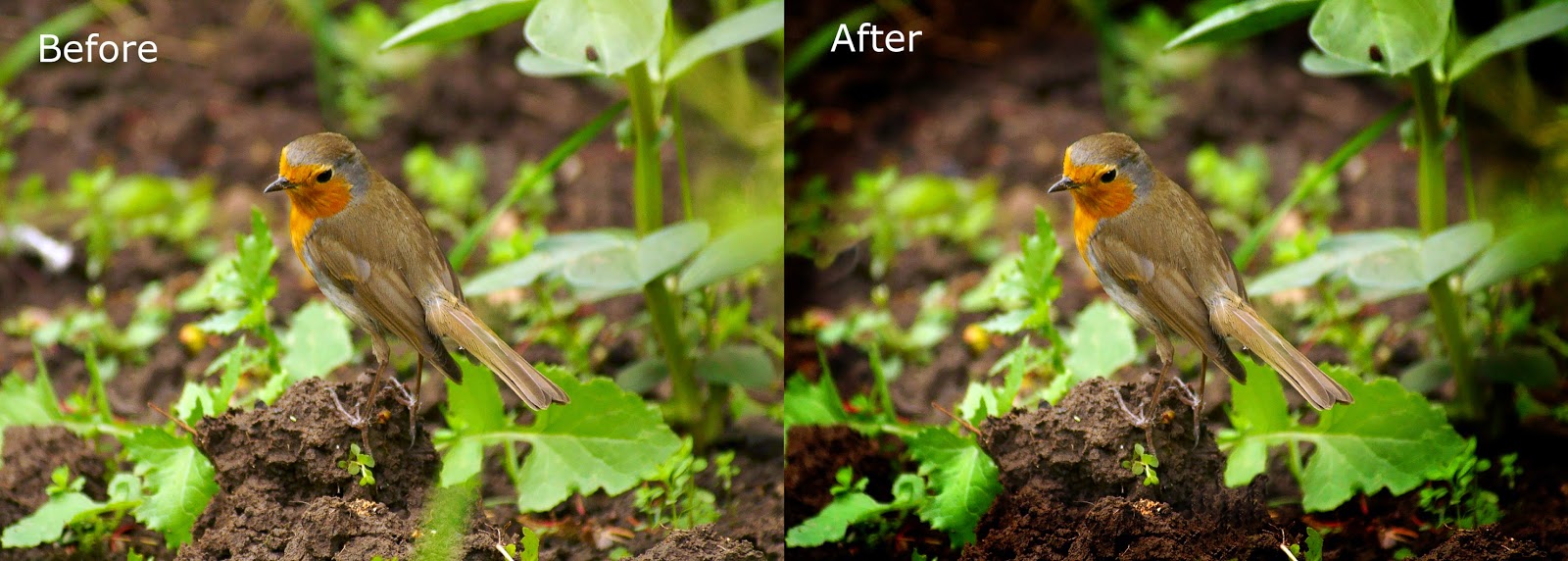
This photo scored 15. The judges main issues was the white blob on the left side of the photo (actually on the big screen the green area in the bottom center caught my eye more).

However is biggest issue (and this was mentioned a number of times) was the lack of catch light in the Robin's eyes. He suggested adding a artificial catch light to lift up the eye and provide more of a focal point.

I must admit this is something I have done in the past (I would prefer that it was in there naturally, but animals are rarely that obliging). It sounds like a good idea and the effect can be good when done well.

However here is the issue. Doing it well is not that easy. You can not just add a blob of white on the eye. It has to look natural, and that means it has to be consistent with the lighting.

The easiest way of achieving this is to enhance a natural reflection in the eye. In the case of the Robin, there is one, but it is small and enhancing it actually does not make a huge amount of difference.

The other big change, apart from removing some of the more glaring artifacts, is that I have added a vignette to the photo. I am in two minds about this. OK, it helps concentrate the eye on the subject, but it also removes some of the natural element of the photo.

So do I think the advice improves the photo?

Well I give the advice a strong  8/10.

I think it does make it better, but in truth maybe it wasn't the best photo to enter in the 1st place

Exhibit 2


This one was originally given  16 marks.

His main complaint was that it would of been better with the subject and reflection central rather than further down.

He may be possibly right, but I really wanted to show the Avocet in it's natural surroundings and to do that I wanted as much space around as possible. This is one situation where a vignette probably degrades rather than enhances the image.

So 5/10

Exhibit 3


This one garnered 15, which I thought was under-marked. 

His suggestion was that it should be closely cropped and the bird moved to one of the thirds composition lines. 

I must admit I had my doubts, but after trying it, I think he was right and it make a more effective photo without removing the natural history element. 

So for this one 9/10

Exhibit 4


This one was given 14, which I think was severely under-marked. OK, I knew at the time that this was a risky entry, but it is one of the photo's which I feel the judge missed what I was trying to achieve.

It is titled "Murmration" and it is a picture of Starlings as they flock before roosting. Now the judges comment was that it would of been better if it had been the picture had been of the shapes of the Starling as they clump and move.

Here I disagree.

What I was trying to show was the speed and movement of the Starlings. Zooming out and showing them as dots, then they would just of been dots. (Maybe it would of been better if I had called it "flocking Starlings")

This way we can see them as Starlings. Now It could be argued that the powerlines distract from the image. My feeling is that it is marginal, and could even provide visual interest in the background. My only concession is that maybe cloning out the upper power line is a slight improvement.

Nor do I think that cropping closer, as suggested, helps in any meaningful way.

So here I have to give 2/10

Summary 

In hindsight it is obvious that maybe some of the photos could of been improved by better cropping or more visual processing. Also I perhaps entered the wrong photo. Vignette is not a technique I greatly use, but perhaps I should think about more in the future.

On the other hand, sometimes you just have to believe in yourself and work to what you feel is right and hope the rest of the world catches up. Is that pompous? Maybe, but if we don't do this, we will just continue to trail others, rather than setting our own path.

Tuesday, 6 January 2015

Inspiration lost and found

A drop on a stick


It's funny sometimes how things happen.

I was out walking recently and complaining to my long suffering wife that I had run out of ideas and inspiration on what to photograph next. At the time I was feeling a bit annoyed with myself that I hadn't taken advantage of the early snow to take more photos.

I got home and started filling the bird feeders, when I realised that the garden was awash with frost laden plants. I grabbed my camera and tripod and spent a happy 40 minutes just snapping the frost on the foliage.

What this goes to show is that, inspiration leaves all of us at times, but it's not gone,  just hiding round the corner waiting to be rediscovered .

Frost
However I am well aware that I need to make full use of  my new found inspiration and need to start making some new photography plans for the year.

In other news...


On Thursday we have the Tom Tivey Natural History & Landscape competition at the Melbourne photographic club. This competition is sure to be a hard fought one, since most consider themselves good landscape and nature phtopgraphers

Unusually for me I have entered 6 photos, 3 prints, 3 DPI's. However as usual it has been difficult to choose the right 6 to enter, but I have decided to go with 2 safe ones and 1 risky one in each category.

I am pretty sure the risky will not score well, but part of me had to do it to remain pure to principles. Anyway I am sure it will be an interesting evening.

Prints


My risky print

DPIs


My Risky DPI

Wednesday, 31 December 2014

The shape of things to come


Firstly, a big thank you to all of you who have taken the time to visit this blog over the last year. I started this blog for my own amusement and as an important part of my learning process. If anyone else has found my journey interesting or useful, so much the better.

I can only apologise for my sometimes less than stellar grammar and spelling. All I can say is that I do proof read my blog before I post it and it looks fine then.

As we reach the end of 2014 it is a good time to think about the coming months ahead.

At my local photographic society we have end of year social(a.k.a Pub session). This year a lady member came along and asked the question that you should never ask in a photographic society.

"What camera should I buy?"

If you do ask this type of question the problem is not that you will not get any response. In fact the opposite, you will get many opinions, but members will suddenly revert to their tribal loyalties . i.e Nikon users will push Nikon cameras and Canon users will say only Canon cameras will do the job.  (As a Sony user I can usually duck out of these sort of discussions.)

However few of the members will ask what you want to do with your camera. Most of the most vocal commentators are semi-professionals who get very animated about lens choice. However if you are someone who only wants a camera to take family and holiday photos, lens choice is not the most important criteria because you are highly unlikely to want to carry around a selection of lenses. Instead you will want one lens with a good focal range like a super-zoom. More important (I feel anyway) is factors like low light performance, weight, size and ease of use.

I suggested the Sony A6000. Not because I am a Sony user, but I think it provides the best value per buck out there, and is the perfect take anywhere camera if you wish get great results in almost all conditions.

However I could see that my opinion was rankling some of my more esteemed and experienced colleagues, who no doubt felt I should bow down to their greater years of experience. The truth is I am never likely to reach the photographic heights of some of the members since time and money is always going to be a limiting factor and I do not have their many years of experience in lenses and cameras usage.

However there is one area of cameras which I will always back myself with, and that is technology.

I have worked in technology industry for over 30 years. I have also taken a great interest in the way technology grows and supersedes older products. For example, I could of easily told Microsoft were going to be in trouble in the tablet space and why they will always be a niche player in that area (If you are interested I highly recommend the gorilla game by Geoffrey Moore ).

Not that I have always got it right. For instance I remember having a argument 15 yeras ago with a colleague that digital cameras will never supersede film, but generally I have a good idea of the way technology is heading.

Therefore since it is the start of the new year I am going to stick my head over the parapet and make some technology predictions on the way photography will go over the next 12 months. I am fully aware of how wrong this can go. For example, I am still waiting for my personal jet-pack and flying car, but here goes

My 2015 Camera Predictions


1. Mirror-less cameras will continue to make in-roads into the professional market, taking market share from DSLR's, even at the top end.

2. Nikon and Canon will produce their 1st full frame mirror-less cameras. Nikon's especially will not gain much market share due to commercially driven design compromises.

3.There will not be much increase in maximum pixel counts in cameras. Instead efforts will be made to increase the sensitivity of existing sensors by going full frame with fewer pixels on mid-range cameras

4. Sony will continue to indicate their continued support of the Alpha series  DSLR's, while doing bugger all to actually back up the claim by filling out the product range with a model between the A57 and A77II. In the meantime they will produce 2 new mirrorless cameras, the A7S II and the A7R II.  

So there you are, my predictions set in stone(well virtual stone anyway). If you have any better ideas, or just disagree with mine, please comment.

Update 31/12/2014

As Mark Abeln reminded me

5. High end cameras to use more smart phone technology in their OS. Not only the ability to upload photos via mobile networks, but also download apps to add new functionality to the camera. Also it would be great if cameras opened up their SDK so allowed programming of new functionality. Why limit yourself to 5 stop HDR where you could expand your camera to do 10 stops aand focus stacking at the same time. Preferably using some sort of graphical programming environment.


Tuesday, 23 December 2014

Videography


Now it has to be said that I am not a great fan of video in DSLR's.

While I am sure some people find the video function on their camera useful, I generally don't use it and worse once in a while it gets in the way, when I inadvertently press the movie record button by mistake (on my camera the video button is too close to the exposure compensation one and although I have disabled the button, so it is only active when I am in video mode, it still gives me a dialog saying I have pressed it, disabling anything else until I have cancelled it )

Some people say that to be a photographer today, especially if you do events like weddings, you need to master both photography and video, or as they like to phrase it videography.

The problem with that is that most DSLR's are not really the right form factor for good videoing. While they may take perfectly adequate video's, to get to the quality of a good dedicated video camera you need to add dedicated mikes, lights, handles etc. After that you might as well not have bothered and bought a decent video camera.

So why do camera manufacturers make a big thing about the video capabilities of their products. Well, it is just another differentiation factor that they can use to get sales. Why buy two camera , when you can get one which does both jobs? They argue. (Of the course the answer is because by doing so you degrade one function i.e the photography, why producing an inferior product for the other, when you could be spending the money making a better stills camera)

However once in a while I too get the urge to take some videos. One such occasion occurred recently when I was taking some more shots of the local power station at dusk and I noticed what is called a murmuration of Starlings occurring over a local field.

Now for those who don't know, a murmuration is a phenomena where Starlings in winter flock together in huge numbers. Just before they roost for the night the flocks dance about the sky in huge patterns, creating one of natures more impressive spectacles.

I realise that still photography was probably not going to really do justice to this, so I tried to video it, to mixed results.

Anyway here is link the YouTube video that resulted from it. Enjoy